Briefly
The New Year bell is a symbol of transition, marking the precise moment when one year ends and another begins. Its ringing carries the idea of letting go of the past and welcoming what is new, often with hope and resolve. Because bells are heard by many people at once, the New Year bell also symbolizes community, shared celebration, and a collective sense of renewal.
What Does the New Year Bell Symbolize?
The New Year bell is one of the most direct symbols of transition. Its sound divides time into a before and an after, giving people a way to mark the passage of the year in a single, audible moment. This is why bells are rung at midnight on December 31 in so many different countries: the ringing creates a shared point of reference for an entire community or nation.
Beyond the simple idea of change, the New Year bell carries several overlapping meanings. It is often understood as a call to reflection, inviting people to look back at the year that has passed before they move forward. It also symbolizes hope, because the sound announces a new beginning that has not yet been shaped by disappointment or failure.
In many traditions, the New Year bell is a symbol of cleansing. The sound is believed to sweep away the troubles, mistakes, and negative feelings accumulated over the previous year, leaving a clear space for something better. This connection between bells and purification is ancient, and it transfers naturally to the New Year setting.
Positive and Negative Meanings
Positive associations: The New Year bell is overwhelmingly positive in its symbolism. It represents renewal, fresh starts, and the chance to begin again. It also stands for hope, joy, and optimism, as well as unity, since the same sound is experienced simultaneously by family, friends, or entire cities. The deep, resonant tone of a bell is often described as calming and uplifting, qualities that reinforce the sense of peace and good intention surrounding the New Year.
Negative meanings: The New Year bell can also have a bittersweet undertone. Because it marks the end of something, it may evoke feelings of loss, nostalgia, or anxiety about time passing. For people who have had a difficult year, the ringing can feel like a reminder of what has gone wrong or what cannot be changed. In some cultural contexts, bells are also associated with warning or alarm, so the New Year bell carries a faint echo of urgency: time is finite, and another year has slipped away.
History and Origins of the New Year Bell Symbolism
The use of bells at the turn of the year has deep roots in the belief that bells can influence the unseen world. For centuries, ringing bells was thought to drive away evil spirits, misfortune, and bad influences. Around the New Year, when people felt the boundary between the old and new year was especially fragile, bells served as a form of audible protection.
In many Christian societies, bells were rung on New Year’s Eve as part of the liturgical calendar. Church bells announced the New Year and invited people to prayer and gratitude. The tradition of the bell at midnight became particularly strong in Europe, where the church bell was often the most prominent public sound in a town or village.
Over time, the religious meaning broadened into a secular one. With the spread of clocks and public timekeeping, the bell became associated less with spiritual protection and more with the exact moment of the year’s turning. The famous “ringing in” of the New Year — a phrase still used in English — comes directly from this custom of celebrating the arrival of the new year with bells.
New Year Bell Symbolism in Different Cultures
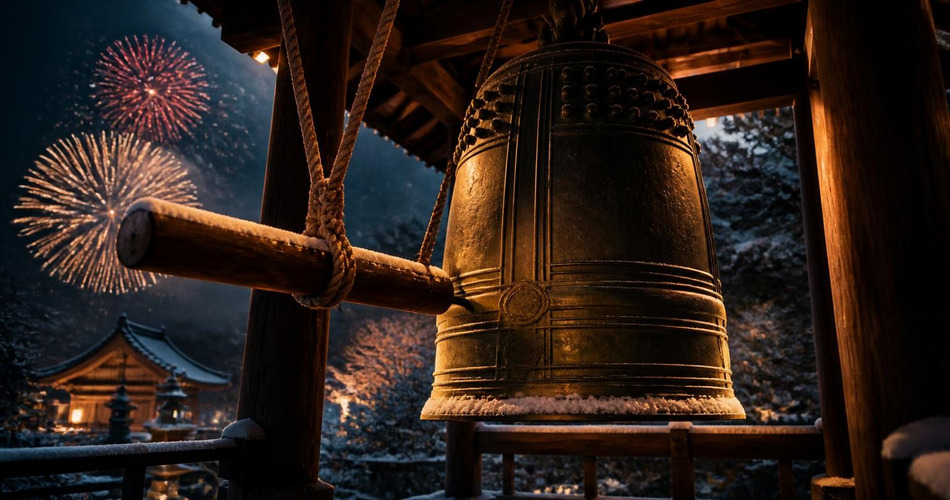
In Japan, the New Year bell is known as joya no kane, and it is one of the most recognizable New Year traditions in the country. Buddhist temples ring their bells 108 times on the night of December 31. The number 108 is significant because it is believed to represent the 108 earthly desires or defilements in Buddhist teaching. Each strike is thought to drive away one of these troubles, so that people can enter the new year purified. The bell used in this ritual is usually a large bonshō, a temple bell struck from the outside with a swinging log.
In European countries such as Germany, Switzerland, and Austria, the ringing of church bells at midnight is a traditional part of New Year celebrations. The sound blends with fireworks and sometimes the singing of hymns, creating a dense, joyful wall of noise intended to welcome the New Year. The bell is not merely a clock chime here; it participates in a larger ritual of expelling the old year and greeting the new one with as much sound as possible.
In many English-speaking countries, the phrase “ring out the old, ring in the new” summarizes the bell’s role. The idea appears clearly in Alfred, Lord Tennyson’s poem “In Memoriam A.H.H.”, which includes the stanza “Ring out, wild bells, to the wild sky.” Tennyson’s poem gave the New Year bell a literary voice, associating it with the casting away of grief, doubt, and strife and the hope for a better future.
Spiritual Meaning of the New Year Bell
Spiritually, the New Year bell acts as a kind of threshold. Its sound is not continuous like a song; it appears, resonates, and fades. This structure mirrors the spiritual understanding of a fresh start: a moment arrives, it is experienced clearly, and then it becomes part of the past. The bell therefore encourages mindfulness, asking people to be present for the moment of change rather than drifting through it.
In Buddhist practice, the ringing of the temple bell is closely connected to ideas of purification and intentional living. Each strike of the bell is an invitation to release attachment and enter the new year with a clearer mind. This is not just a private meditation; it is performed in public, among other people, which adds a communal dimension to the spiritual act.
The resonance of a bell is also significant. Because a bell continues to vibrate after it is struck, it suggests that thoughts and intentions set at the New Year will continue to echo through the months ahead. This gives the spiritual meaning of the bell an element of lasting influence, as if the sound leaves a subtle trace in the world.
The New Year Bell in Myths and Folklore
Bells have a long history in folklore as instruments capable of warding off evil, and the New Year bell inherits this reputation. In various European folk traditions, the louder the noise at the turn of the year, the safer the coming year was thought to be. Bells, pots, pans, and later fireworks were all used to make noise and frighten away ill fortune.
One widely repeated folk saying is that bells ring at midnight to “let the New Year in.” This simple phrase points to an older belief that the New Year is not just a date on a calendar but something that arrives like a guest. Ringing a bell was a way of greeting that guest properly and ensuring a warm welcome.
In some local customs, the New Year bell was thought to have the power to break bad luck. People would listen carefully to the first bell of the year, and the strength or clarity of its sound could be interpreted as a sign of how the year would unfold. These beliefs are not universal, but they reflect a widespread human tendency to read meaning into the sounds that mark important moments.
The New Year Bell in Dreams
When the New Year bell appears in a dream, it often points to feelings about time and change. Because the bell marks the exact boundary between one year and the next, dreaming of it may signal that the dreamer is at a turning point in life, preparing to leave something behind or start something new.
The sound of the bell in the dream is important. A clear, pleasant ringing is generally associated with hope, new opportunities, and a positive transition. A muffled or sour bell sound may reflect hesitation, fear of change, or a sense of being unprepared for what lies ahead. The context of the dream — who rings the bell, where it is rung, and how the dreamer feels — shapes its meaning more than any fixed rule.
Common New Year Bell Dream Scenarios
- Hearing a bell at midnight: often symbolizes readiness for a fresh start and acceptance of change.
- Ringing the bell yourself: suggests that you are taking an active role in shaping your own future.
- A bell that will not ring: may reflect feelings of being stuck or unable to move forward.
- A distant or faint bell: can indicate uncertainty about the future or a sense of being disconnected from important events.
- A bell ringing during the day instead of night: might point to an unexpected opportunity or a change arriving outside the expected time.
New Year Bell Superstitions and Omens
The New Year bell appears in several superstitions that treat its sound as a sign. Many of these are local and informal, but they share a common logic: the way the year begins is a small preview of how the year will continue.
- In some European folk traditions, hearing the New Year bell clearly was considered a good omen, while a muffled or distant sound was seen as less favorable.
- In Japan, it is considered important to hear all 108 strikes of the temple bell, or at least a substantial part of them; missing the final strike is sometimes thought to bring bad luck.
- Making sure the bell is rung at the exact moment of midnight is seen as essential in many places, because ringing too early or too late may symbolically carry the old year into the new one.
- Some believe the sound of the first bell of the year carries the energy of the entire year, so people pause, listen, and let the sound wash over them as a way of absorbing good fortune.
These superstitions should not be treated as universal beliefs. They vary from region to region, and many people participate in New Year bell ringing without any superstition attached to it. Yet the persistence of such ideas shows how much symbolic weight the first sound of the year carries.
The New Year Bell in Art and Literature
The most famous literary treatment of the New Year bell is Alfred, Lord Tennyson’s “In Memoriam A.H.H.”, written in the middle of the nineteenth century. The poem’s final section contains the lines “Ring out, wild bells, to the wild sky” and develops the metaphor of the bell ringing out the old and ringing in the new. Tennyson uses the bell as a way to express both grief and hope, making it one of the defining artistic images of the New Year in English literature.
The New Year bell also appears in visual art, especially in illustrations and paintings of New Year celebrations. Winter scenes showing the bell tower of a church or town hall at midnight are a common motif in European printmaking and postcard art. These images usually combine the bell with other symbols of renewal such as snow, stars, and the young New Year figure, sometimes shown as a baby or child.
In film and television, the New Year bell is often used as an audio cue. The sound of a bell at midnight almost automatically signals “New Year” to audiences, so directors use it to compress the passing of time into a single recognizable moment. This use of the bell is less explicit than in poetry, but it shows how deeply the association has entered visual storytelling.
Meanings of Different New Year Bell Variations
The meaning of the New Year bell can shift depending on the kind of bell and the way it is rung. These variations are not fixed rules, but they color how people experience the symbol.
- Temple bells (such as the Japanese bonshō) emphasize purification, spiritual reflection, and the release of attachment. They are usually rung slowly and deeply.
- Church bells carry historical and religious associations, connecting the New Year to traditions of prayer, thanksgiving, and community gatherings.
- Hand bells are common in family settings and symbolize personal participation in the transition. Ringing a hand bell gives a person a direct, active role in welcoming the New Year.
- Electronic or recorded bells are a modern substitute used in many urban celebrations. They preserve the symbolic meaning of the bell even when no physical bell is available, showing how durable the symbol remains.
Frequently Asked Questions
Q: What does the New Year bell symbolize?
A: It symbolizes transition, renewal, hope, and community. The ringing marks the moment the old year ends and the new one begins, while also inviting people to reflect and let go of the past.
Q: Why are bells rung 108 times at New Year in Japan?
A: In Japanese Buddhist tradition, the bell is rung 108 times to represent the 108 earthly desires or defilements that trouble human beings. Each strike is meant to dispel one of them, allowing people to enter the new year purified.
Q: Is the New Year bell a religious symbol?
A: It has religious roots, especially in Buddhism and Christianity, but today it is also a secular symbol of celebration and new beginnings observed by people of many different beliefs.
Q: What is the origin of “ringing in” the New Year?
A: The phrase comes from the custom of ringing bells at midnight on New Year’s Eve. The sound was believed to drive out evil and misfortune while welcoming the good fortunes of the year ahead.
Related Symbols
- Clock at midnight — marks the exact transition between years, closely related to the bell’s role as a time signal.
- Fireworks — another loud, public way of scaring away bad fortune and celebrating the New Year.
- New Year baby — a symbol of the new year as a young child, emphasizing promise and fresh beginnings.
- Threshold — represents the boundary between old and new, similar to the bell as a marker of passage.
- Chime — a gentler relative of the bell, also used to mark time and transition in rituals.