
Briefly
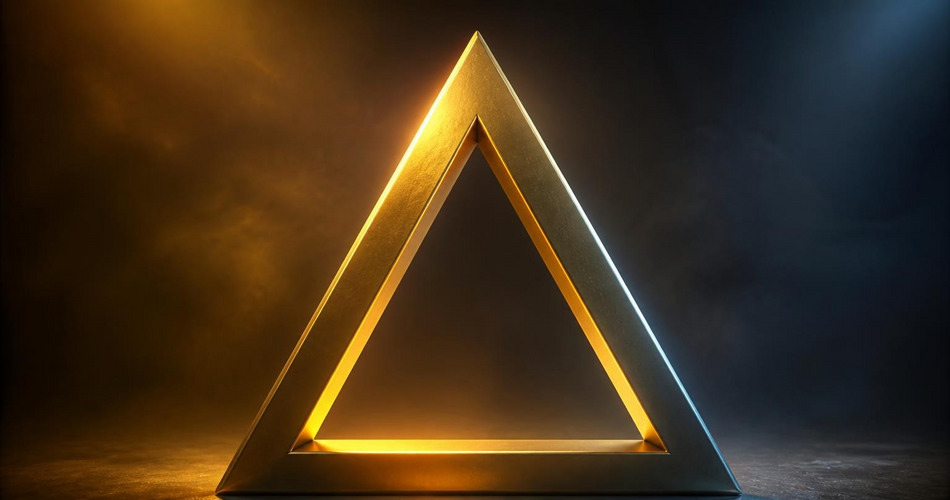
The triangle is one of the most fundamental geometric shapes, rich with symbolic meaning across cultures and disciplines. It represents concepts such as stability, strength, harmony, and the union of opposites. Its three sides and three angles often symbolize the trinity, balance, and the cycle of life, death, and rebirth. From ancient religious iconography to modern logos, the triangle carries connotations of aspiration, protection, and transformation.
What Does Triangle Symbolize?
The triangle is a shape of immense symbolic weight, primarily because of its threefold nature. The number three is universally associated with completeness, unity, and the divine. The triangle thus often represents the trinity in various religious contexts—the Christian Father, Son, and Holy Spirit; the Hindu Trimurti of Brahma, Vishnu, and Shiva; or the Buddhist Three Jewels. Its three points can also signify the past, present, and future; mind, body, and spirit; or birth, life, and death.
In geometry, the triangle is the simplest polygon and the most stable shape, which is why it appears in architecture and engineering as a symbol of strength and endurance. An upward-pointing triangle evokes aspiration, masculinity, and fire, while a downward-pointing one suggests femininity, water, and the earth. When combined, they form the hexagram, a symbol of cosmic balance.
Positive and Negative Meanings
Positive associations: The triangle is widely seen as a symbol of stability, strength, and harmony. Its three sides represent balance and the integration of opposing forces. In many spiritual traditions, it signifies divine protection, enlightenment, and the path to higher consciousness. The equilateral triangle, in particular, embodies perfection and equality.
Negative meanings: In some contexts, the triangle can symbolize conflict or tension, as in the “love triangle” representing jealousy and emotional turmoil. A downward-pointing triangle may be associated with the element of water, which can be linked to emotions and the subconscious, sometimes implying instability or danger. In modern conspiracy theories, the triangle (especially the “Eye of Providence”) is often misinterpreted as a symbol of secret control and manipulation.
History and Origins of Triangle Symbolism
The triangle has been a significant symbol since prehistoric times. The ancient Egyptians used the pyramid shape—a three-dimensional triangle—as a symbol of the sun’s rays and the pharaoh’s ascent to the heavens. In ancient Greece, the triangle was associated with the Pythagorean school, where the number three was considered the perfect number, representing harmony and the cosmos.
In Hindu and Buddhist traditions, the triangle appears in yantras and mandalas as a representation of the divine feminine (downward triangle) and masculine (upward triangle). The Sri Yantra, a complex geometric diagram, is composed of interlocking triangles that symbolize the union of Shiva and Shakti. In medieval alchemy, triangles were used to denote the four classical elements: an upward triangle for fire, a downward triangle for water, a crossed triangle for air, and an inverted crossed triangle for earth.
Triangle Symbolism in Different Cultures
In Christianity, the triangle is a direct symbol of the Holy Trinity. It appears in religious art as a halo shape or as part of the “Eye of Providence” (the all-seeing eye within a triangle) representing God’s watchfulness. In Hinduism, the triangle is central to the Sri Yantra and is often used in temple architecture to represent the three gunas (qualities of nature) or the three worlds (heaven, earth, and the underworld).
In Native American cultures, the triangle can symbolize the tipi, representing shelter and family, or the mountain, signifying strength and endurance. In Celtic art, the triquetra (a three-pointed knot) is closely related to the triangle and symbolizes the triple goddess or the three realms of land, sea, and sky. In modern Western culture, the triangle is used in traffic signs to warn of danger, in logos to convey stability and progress, and in LGBTQ+ iconography (the pink triangle) as a symbol of resilience and pride.
Spiritual Meaning of the Triangle
Spiritually, the triangle represents the journey from the physical to the spiritual. Its upward direction indicates aspiration toward higher consciousness, while its base on the ground symbolizes earthly existence. In many meditation practices, visualizing a triangle is used to focus the mind and balance the chakras. The triangle is also associated with the third eye, the seat of intuition and inner wisdom.
The three points of the triangle can correspond to the three stages of spiritual development: purification, illumination, and union. In alchemy, the triangle is a key symbol in the process of transmutation, representing the union of opposites (the upward and downward triangles) to create a harmonious whole. This concept is echoed in the yin-yang symbol, though that is circular rather than triangular.
Triangle in Myths and Folklore
In Greek mythology, the triangle is indirectly present in the symbol of the delta (Δ), the fourth letter of the alphabet, which was associated with the goddess Demeter and the concept of change. In Norse mythology, the valknut (a symbol of three interlocking triangles) is associated with Odin and the transition between life and death. In alchemical lore, the triangle is central to the “philosopher’s stone” symbolism, representing the three stages of the Great Work: nigredo, albedo, and rubedo.
In modern folklore, the Bermuda Triangle has become a legend of mysterious disappearances, though this is not a symbolic triangle but a geographical area. The triangle shape itself is often used in protective talismans, such as the “triple moon” symbol in Wicca, representing the maiden, mother, and crone.
Triangle in Dreams
Triangles appearing in dreams are often interpreted as symbols of balance, decision-making, or the need to integrate different aspects of the self. A triangle pointing upward may indicate ambition or spiritual growth, while a downward-pointing triangle could suggest a need to ground oneself. Dreaming of a triangle can also reflect a situation involving three people or three choices, such as a love triangle or a career crossroads.
Common Dream Scenarios
- Equilateral triangle: Represents harmony and equality in a situation. May indicate that all aspects of a problem are in balance.
- Inverted triangle: Suggests instability or a need to focus on practical matters rather than spiritual ideals.
- Triangle with an eye: Often linked to the “Eye of Providence,” symbolizing insight, intuition, or being watched.
- Multiple triangles: Can indicate complex relationships or multiple choices that need to be resolved.
Triangle in Superstitions and Omens
In various folk traditions, the triangle is considered a protective shape. Placing a triangle symbol on a door or window is believed to ward off evil spirits. In some cultures, a triangle drawn on the ground is used in rituals to create sacred space. The “triangle of manifestation” in occult practices is a tool for focusing intention. However, the triangle can also be seen as an omen of change—since it has three sides, it may signal a turning point or a decision that will affect three areas of life.
Triangle in Art and Literature
In Renaissance art, the triangle was a favored compositional device, known as the “pyramidal composition.” Leonardo da Vinci’s “Madonna of the Rocks” uses a triangular arrangement of figures to create stability and harmony. In modern art, M.C. Escher’s “Waterfall” features an impossible triangle (the Penrose triangle) that plays with perspective and challenges perception. In literature, the triangle appears as a structural motif—for example, in Dante’s “Divine Comedy,” the three realms (Inferno, Purgatorio, Paradiso) form a triangular journey of the soul. The triangle also appears in the logo of the “Illuminati” in popular culture, often used as a symbol of hidden knowledge.
Triangle Tattoo Meaning
Triangles are a popular choice in tattoo art due to their geometric simplicity and deep symbolism. An upward-pointing triangle tattoo often represents strength, ambition, and spiritual growth. A downward-pointing triangle can symbolize femininity, water, or the earth. The combination of both (the hexagram) is used to represent balance and union. The “Eye of Providence” triangle tattoo is common among those who seek protection or enlightenment. Triangles are also used in minimalist designs to represent the trinity, change, or the three stages of life.
Meanings of Different Types of Triangles
- Equilateral triangle: Symbolizes balance, equality, and perfection. Its three equal sides represent harmony and the unity of body, mind, and spirit.
- Isosceles triangle: Often associated with hierarchy and focus, as the two equal sides point to a single apex, representing ambition or a central goal.
- Right triangle: Represents mathematical precision and the Pythagorean theorem. In symbolism, it can denote a foundation for growth, as in the pyramid’s cross-section.
- Inverted triangle: Associated with the element of water, emotions, and the subconscious. It can also symbolize the feminine principle or a grounding force.
Frequently Asked Questions
Q: What does a triangle symbolize in Christianity?
A: In Christianity, the triangle represents the Holy Trinity—Father, Son, and Holy Spirit. It appears in art as a halo shape or as the “Eye of Providence” symbolizing God’s omniscience.
Q: What does an upside-down triangle mean?
A: An upside-down (inverted) triangle often symbolizes the feminine, water, emotions, or the earth. In some contexts, it can represent instability or a need to ground oneself.
Q: Is the triangle a protective symbol?
A: Yes, in many cultures the triangle is used in protective talismans and amulets. Its three points are believed to ward off evil and create a sacred boundary.
Q: What does a triangle tattoo mean?
A: Triangle tattoos commonly symbolize strength, change, balance, or spiritual growth. The specific meaning depends on the orientation and any accompanying elements, such as an eye or other geometric shapes.
Related Symbols
- Square – represents stability and the material world, contrasting with the triangle’s spiritual aspiration.
- Circle – symbolizes unity and eternity, often paired with the triangle to represent the union of heaven and earth.
- Pyramid – a three-dimensional triangle associated with ancient Egyptian symbolism of ascension and immortality.
- Hexagram – formed by two overlapping triangles, representing the union of opposites and cosmic balance.
- Triquetra – a three-pointed knot symbolizing the triple goddess or the interconnectedness of life.