Briefly
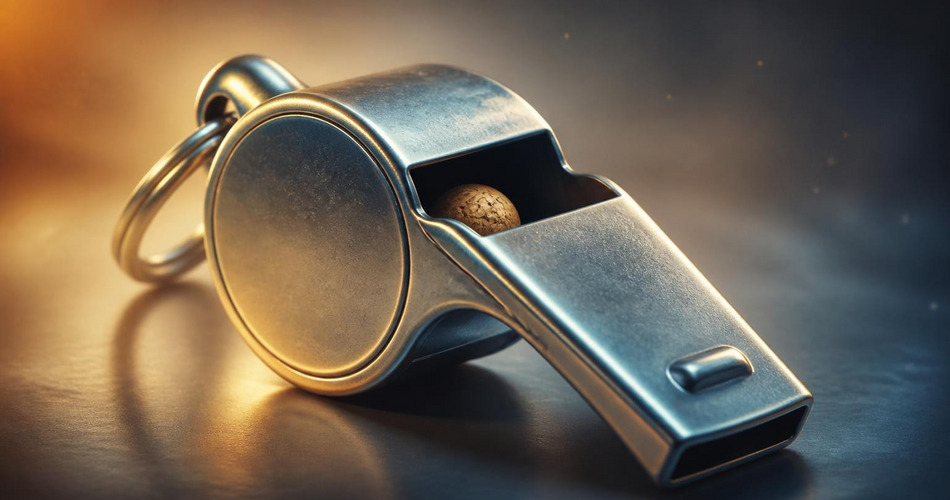
A whistle is a simple device that produces a sharp, penetrating sound when air is forced through it. Across cultures and contexts, the whistle has served as a tool for signaling, commanding attention, warning of danger, and celebrating moments of joy. Its symbolism is closely tied to its practical functions: it can represent authority, urgency, alertness, or the call to action. The whistle’s cheerful tone in leisure settings connects it with recreation and sport, making it a versatile symbol of both control and celebration.
What Does Whistle Symbolize?
The whistle primarily stands for communication over distance. Its piercing sound cuts through noise, making it an effective tool for issuing commands, coordinating groups, or raising alarms. This gives the whistle strong associations with authority and discipline, as seen in the hands of referees, police officers, boatswains, and military drill sergeants. The act of blowing a whistle also implies a single, clear message that demands immediate attention or compliance. Beyond its command-and-control role, the whistle symbolizes celebration and festivity, such as the inexpensive party whistles used at sporting events or New Year’s Eve. The whistle thus plays a dual role: it can signal the start of a race or the end of a foul, the approach of a train or the cheer of a victory.
Positive and Negative Meanings
Positive associations: Whistles are linked to clarity, alertness, and coordinated action. They enable efficient communication in noisy environments, ensure safety by warning of hazards (e.g., train whistles at crossings), and create a sense of shared excitement at sports matches or celebrations. In many contexts, the whistle represents order, fairness, and the smooth running of events.
Negative meanings: However, the whistle’s shrill sound can be associated with intrusion, alarm, and punishment. A referee’s whistle may mark a penalty or an infraction; a police whistle once signaled pursuit or dispersal of crowds. In some superstitions, certain whistle actions (e.g., whistling on stage or inside a theatre) are considered bad luck, and the device itself can be a tool of control that implies subordination or coercion.
History and Origins of Whistle Symbolism
Whistles have ancient origins. Early whistles were made from bone, wood, or clay, and were used for signaling in hunting and warfare. Archaeological finds of whistles date back thousands of years, such as the bronze whistles from ancient China used by military units. The association of whistles with authority grew with the emergence of organized sports and professional police forces in the 19th century. For example, the metal referee whistle became standard in soccer and rugby around the 1870s, cementing the whistle as a symbol of impartial judgment and rule enforcement. Similarly, boatswain’s pipes (a type of whistle) on naval vessels have a long history of conveying distinct commands, linking the whistle to maritime hierarchy and discipline.
Whistle Symbolism in Different Cultures
In many traditional societies, whistles were not only practical but also carried spiritual or superstitious meaning. Among certain Native American tribes, whistles made from eagle bones were used in rituals and dances to communicate with spirits or to call the wind. In West African cultures, whistles have been part of traditional music and ceremonial signaling. In European folklore, whistling at night or indoors was sometimes thought to attract malevolent spirits or the devil — a belief that gave the whistle an ominous connotation. In maritime tradition, the boatswain’s pipe (a whistle) was a symbol of authority and respect, often intricately decorated and kept as a mark of rank.
Spiritual Meaning of Whistle
The whistle’s clear, directional sound has been interpreted as a tool for spiritual communication. In some shamanic practices, whistles are used to call upon spirit guides or to create a distinct sound that bridges the physical and spirit worlds. The whistle’s tone is often seen as a pure, unwavering note that can focus intention and attract attention from beyond. Similarly, in certain meditation or sound-healing contexts, the whistle represents the clarity of a direct message from the divine or the universe, cutting through mental noise.
Whistle in Myths and Folklore
In European folklore, there is a widespread belief that whistling on stage in a theatre brings bad luck to the production — a superstition rooted in the days when theatre crews used whistles to signal scene changes, and an unintended whistle could cause chaos. In maritime folklore, it is said that whistling on a ship may summon a storm or the wind, a belief with practical origins: unnecessary noise could distract crew during dangerous operations. Some tales depict the whistle as a charm or a tool of magical summons, like the silver whistle in the ballad “The Grey Cock” or in Sir Walter Scott’s “The Lady of the Lake,” where a whistle is used to call a hero.
Whistle in Dreams
Dreaming of a whistle often relates to communication and the need to be heard or to pay attention. It may indicate that the dreamer is receiving a clear message from their subconscious or from an external source. A loud or repeated whistle in a dream can symbolize an urgent call to action or a warning about a situation that requires immediate awareness. Conversely, a silent or broken whistle might represent feelings of powerlessness or the inability to make oneself heard.
Common Dream Scenarios
- Blowing a whistle yourself: Suggests you are trying to assert authority or command attention in your waking life.
- Hearing a whistle but not seeing its source: Indicates an unclear or indirect message that you need to decipher.
- Unable to make a sound from a whistle: Reflects frustration in expressing yourself or feeling ignored.
- Being stopped by a referee’s whistle: May represent feelings of being judged, penalized, or held back by rules or social norms.
- A train whistle in the distance: Often symbolizes a forthcoming change, a journey, or a warning about something approaching.
Whistle in Superstitions and Omens
- Theatre superstition: Whistling backstage or in a dressing room is believed to bring bad luck, especially if a technician whistles accidentally during a performance.
- Maritime superstition: Some sailors avoid whistling on board for fear of conjuring strong winds or offending sea spirits.
- Early American folklore: Whistling at night was sometimes thought to attract snakes or evil spirits.
- Mining: Among miners, whistling was often disallowed underground because it could be misinterpreted as a signal or distract from safety cues.
- Good luck whistles: In some cultures, a whistle carried as a charm is believed to ward off danger or summon help in emergencies.
Whistle in Art and Literature
The whistle appears in various works of literature and film as a potent symbol. In William Golding’s novel Lord of the Flies, the conch shell initially serves as a whistle-like call to assemble boys, representing order and civilization. In the classic film Whistle Down the Wind (1961), a child’s misuse of a whistle leads to a series of misunderstandings, highlighting the whistle’s power to attract unintended attention. In poetry, whistles often evoke nostalgia or call to action, such as in Walt Whitman’s “The Whistle,” where the train whistle symbolizes the onward rush of industrial progress. These examples show the whistle’s versatility as a narrative device to signal change, authority, or communication.
Whistle Tattoo Meaning
A whistle tattoo often symbolizes authority, leadership, or a personal call to action. It may be chosen by sports fans, referees, or those who identify with the whistle’s role in keeping order. For some, the tattoo represents the importance of clear communication or the ability to be heard in a noisy world. A whistle with a ball inside (as in a referee’s whistle) specifically signifies fairness and impartiality. Alternatively, a vintage train whistle tattoo can evoke a sense of travel, adventure, or nostalgia for simpler times.
Meanings of Different Types of Whistles
- Referee’s whistle: Symbolizes authority, judgment, and the enforcement of rules; often associated with sports and fairness.
- Train whistle: Represents travel, distance, warning, and the inexorable passage of time; a classic icon of railroads and industrial progress.
- Boatswain’s call (pipe): A maritime symbol of hierarchy, command, and tradition; intricately made and used for specific shipboard signals.
- Police whistle: Historically represented law enforcement and public safety; now evokes nostalgia for mid-20th-century policing.
- Party whistle: A symbol of celebration, festivity, and collective joy; often flimsy and brightly colored, it signals lightness and fun.
- Dog whistle: Although silent to humans, it symbolizes hidden communication, selective hearing, or messages intended only for a specific audience.
Frequently Asked Questions
Q: What does it mean when you dream of a whistle?
A: Dreaming of a whistle usually points to a need for attention, communication, or a call to action in your life. It may indicate you are receiving an important message or trying to assert yourself in a situation.
Q: Why is whistling considered bad luck in theaters?
A: The superstition originates from the 19th century when stagehands used whistles to signal scene changes. An accidental whistle could cause a mishap, and over time the act of whistling backstage became taboo as it was believed to invite bad luck.
Q: Can a whistle be a spiritual tool?
A: Yes, in various shamanic and indigenous traditions, whistles are used in ceremonies to communicate with spirits, focus intention, or create a sound that bridges the material and spiritual realms.
Q: What is the symbolism of a referee’s whistle?
A: A referee’s whistle symbolizes authority, impartiality, and the power to enforce rules. It is a clear signal that commands respect and immediate compliance in competitive settings.
Related Symbols
- Bell: Like a whistle, a bell is used to signal announcements, warn, or call attention.
- Horn: A horn shares the whistle’s role as a loud, attention-getting device, often used in vehicles or ceremonies.
- Conch shell: In many cultures, the conch is blown like a whistle for communication and ritual summoning.
- Siren: A siren is an automated whistle-like alarm used for warnings, especially in emergency vehicles.
- Megaphone: Magnifies the voice similarly to how a whistle amplifies a clear tone, emphasizing the broadcast of a message.