
Briefly
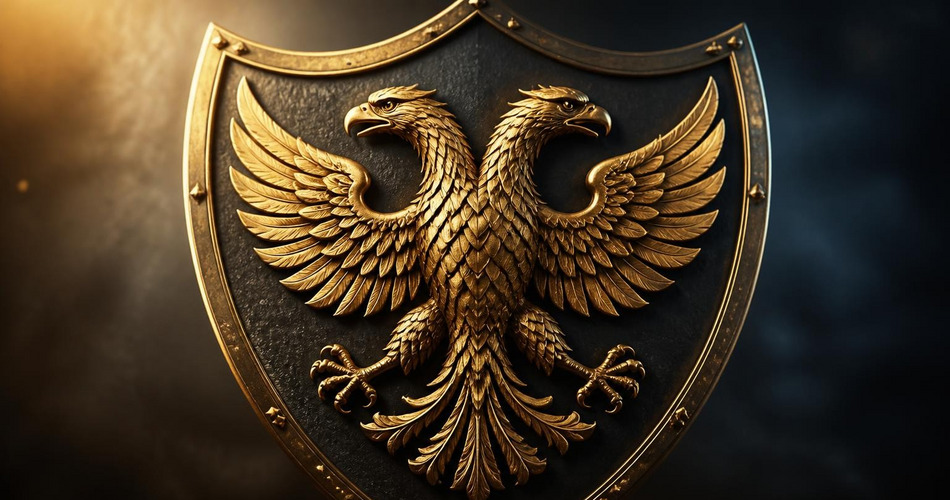
The double-headed eagle is a heraldic symbol featuring an eagle with two heads facing opposite directions, most famously used by the Byzantine Empire, the Holy Roman Empire, and the Russian Empire. It represents dual authority—often secular and religious—as well as vigilance, protection, and the unity of vast territories. The symbol conveys both power and balance, with each head watching over different realms or aspects of rule.
What Does the Double-Headed Eagle Symbolize?
The double-headed eagle primarily symbolizes sovereignty and the union of two distinct powers. In heraldry, the two heads often represent the emperor’s authority over both church and state, or the merging of Eastern and Western traditions. The eagle itself is a traditional emblem of strength, courage, and immortality, while the double-headed variant adds layers of duality—past and future, heaven and earth, or military and civil rule. It also signifies vigilance, as the two heads can watch in all directions, guarding the realm from threats.
Positive and Negative Meanings
Positive associations: The double-headed eagle is widely seen as a symbol of imperial majesty, unity, and enduring strength. It conveys protection, foresight, and the ability to oversee a vast domain. In many cultures, it also represents divine favor and the balance between spiritual and temporal power.
Negative meanings: Historically, the double-headed eagle has also been associated with authoritarianism, imperialism, and military aggression. Its use by expansionist empires can evoke themes of conquest, oppression, and centralized control. In some contexts, it may symbolize division or conflict between the two powers it represents.
History and Origins of the Double-Headed Eagle Symbolism
The double-headed eagle motif dates back to ancient Mesopotamia, where it appeared on seals and artifacts as early as the 3rd millennium BCE. It was later adopted by the Hittites, who used it as a royal emblem. The symbol gained prominence in the Byzantine Empire, where it represented the emperor’s dual authority over secular and ecclesiastical matters. After the fall of Constantinople, the double-headed eagle was adopted by the Russian Empire, symbolizing Moscow as the “Third Rome.” The Holy Roman Empire also used the motif, with the two heads signifying the emperor’s rule over both German and Italian territories. Over centuries, the symbol spread across Europe and into heraldry of many nations, appearing on coats of arms, flags, and official seals.
Symbolism of the Double-Headed Eagle in Different Cultures
In Byzantine culture, the double-headed eagle was a symbol of the emperor’s supreme authority and the unity of the Eastern Orthodox Church with the state. The Russian Empire adopted it after Ivan III married the Byzantine princess Sophia Palaiologina, using it to assert continuity with Byzantine legacy. The Holy Roman Empire used a single-headed eagle initially, but the double-headed version became standard from the 15th century, representing the empire’s dual nature as both German and universal. In modern times, the symbol appears in the coats of arms of several countries, including Albania, Serbia, and Montenegro, where it often signifies national identity and historical sovereignty. In Freemasonry, the double-headed eagle is a symbol of the 33rd degree, representing wisdom and the balance of opposites.
Spiritual Meaning of the Double-Headed Eagle
Spiritually, the double-headed eagle is often interpreted as a symbol of transcendence and the integration of dualities. Its two heads can represent the conscious and subconscious mind, the material and spiritual worlds, or the union of opposites necessary for enlightenment. In some esoteric traditions, it embodies the principle of “as above, so below,” with the eagle’s ability to soar high while remaining grounded in the physical realm. The symbol is also seen as a guardian against negative forces, with its vigilant eyes warding off evil.
The Double-Headed Eagle in Myths and Folklore
While not a common figure in classical mythology, the double-headed eagle appears in some medieval legends and folklore. In Slavic tradition, it is sometimes associated with the mythical firebird or the sun, representing divine power. In Greek myth, the eagle is linked to Zeus, but the double-headed variant is a later heraldic invention. Some folk tales depict the double-headed eagle as a guardian creature that can see both the past and the future, serving as a protector of kingdoms. The symbol also features in the legend of the founding of the Russian state, where it was said to have been brought from Byzantium as a gift of imperial legitimacy.
The Double-Headed Eagle in Art and Literature
The double-headed eagle is a prominent motif in Byzantine and Russian religious art, appearing on icons, church mosaics, and imperial regalia. In literature, it appears in works such as The Double-Headed Eagle by the Russian poet Alexander Blok, where it symbolizes the duality of Russia’s identity. The symbol also features in Umberto Eco’s novel The Name of the Rose, where it is used as a secret emblem of a hidden order. In heraldic art, the double-headed eagle is meticulously rendered on coats of arms, flags, and seals, such as the Russian imperial standard and the Albanian national flag. It remains a popular motif in contemporary graphic design, often evoking tradition and authority.
Tattoo Meaning of the Double-Headed Eagle
As a tattoo, the double-headed eagle often represents power, protection, and a connection to heritage. It is popular among those with Slavic, Balkan, or Germanic ancestry, symbolizing pride in one’s roots and a warrior spirit. The tattoo can also signify duality—such as balancing strength with wisdom, or embracing both light and dark aspects of the self. Some choose the design to invoke vigilance and the ability to see all sides of a situation. In prison culture, the double-headed eagle may denote authority or rank within certain groups.
Meanings of Different Types, Colors, or Variations of the Double-Headed Eagle
- Black double-headed eagle – Often associated with the Holy Roman Empire and later with Prussia; symbolizes authority, discipline, and military might.
- Gold double-headed eagle – Common in Byzantine and Russian heraldry; represents imperial wealth, divine light, and spiritual power.
- Double-headed eagle with crowns – Each head may wear a crown, signifying sovereignty over separate realms; a third crown sometimes appears above, representing unity.
- Double-headed eagle with sceptre and orb – The eagle holds imperial regalia, emphasizing absolute rule and the emperor’s role as both secular and religious leader.
- Double-headed eagle with shield on chest – Often bears a smaller coat of arms on its breast, such as the Moscow coat of arms in the Russian version, symbolizing the heart of the empire.
Frequently Asked Questions About the Double-Headed Eagle
Q: What does the double-headed eagle symbolize?
A: It symbolizes dual authority, often secular and religious, as well as vigilance, protection, and the unity of vast territories.
Q: Why does the double-headed eagle have two heads?
A: The two heads represent the ability to see in all directions, guarding the realm, and often signify the union of two powers—such as church and state or East and West.
Q: Which empires used the double-headed eagle?
A: The Byzantine Empire, the Holy Roman Empire, and the Russian Empire are the most famous users, along with various other states and noble families.
Q: Is the double-headed eagle used today?
A: Yes, it appears on the national flags and coats of arms of Albania, Serbia, Montenegro, and Russia, among others, as a symbol of national identity and heritage.
Related Symbols
- Imperial Eagle – A single-headed eagle used by the Roman Empire and later by Napoleon, representing imperial power.
- Byzantine Eagle – The specific double-headed eagle variant used by the Byzantine Empire, often with gold on a red field.
- Russian Coat of Arms – Features a double-headed eagle holding a sceptre and orb, with the shield of St. George on its chest.
- Albanian Flag – A black double-headed eagle on a red field, symbolizing the nation’s independence and heritage.
- Holy Roman Empire Eagle – The double-headed eagle used by the Holy Roman Empire, often depicted with halos or crowns.