
Briefly
The feather fan is a multifaceted symbol that transcends mere function, embodying status, seduction, and spiritual protection across cultures. Historically an emblem of aristocracy and leisure in Europe, it simultaneously served as a sacred object in shamanic rituals and a sophisticated tool of non-verbal communication. Its symbolism is deeply tied to the bird it comes from, representing flight, freedom, and the celestial realm, while its delicate construction speaks to both luxury and transience.
What Does Feather Fan Symbolize?
The feather fan primarily symbolizes status, luxury, and femininity. In many historical contexts, particularly in 18th and 19th century Europe, the material and craftsmanship of a feather fan directly indicated the owner’s wealth and social standing. Ostrich feather fans, for example, were highly prized and associated with royalty and the upper class. Beyond status, the fan is a powerful symbol of seduction and flirtation. The act of fanning oneself, peeking over the edge of the fan, or using it to create a breeze was codified into a complex “language of the fan” in Victorian society, allowing for discreet romantic communication.
Simultaneously, the feather fan holds deep spiritual and protective meanings. In many indigenous cultures, feathers are considered gifts from the sky, representing a connection to the divine or the spirit world. Fans made from eagle or hawk feathers were used by shamans for purification rituals, healing, and to waft sacred smoke. The fan thus symbolizes the power to cleanse, bless, and ward off negative energies. Its ability to stir the air also connects it to the element of air and the concepts of breath, life, and the intangible spirit.
Positive and Negative Meanings
Positive associations: The feather fan is overwhelmingly associated with positive attributes such as grace, elegance, and refinement. It symbolizes protection, both in a spiritual sense (warding off evil) and a social sense (providing a barrier or a tool for modesty). It represents the power of air, communication, and the ability to create change through subtle means. In many contexts, it is a symbol of celebration, dance, and festive joy.
Negative meanings: Conversely, the feather fan can symbolize vanity, frivolity, and the decadence of the upper classes. Its association with flirtation and hidden communication can imply deceit, coquettishness, and superficiality. The use of exotic bird feathers, particularly in the 19th and early 20th centuries, is now also a symbol of ecological exploitation and the destructive side of fashion, as the plume trade drove several bird species to the brink of extinction.
History and Origins of Feather Fan Symbolism
The use of fans dates back to antiquity, with early examples found in Egypt, Greece, China, and Japan. The earliest fans were rigid, often made from leaves or feathers, and served both practical and ceremonial purposes. In ancient Egypt, the fan was a potent symbol of royalty and divine authority, often depicted being held by attendants behind the pharaoh. The “flabellum,” a liturgical fan used in Christian ceremonies, has its roots in these ancient processional fans, symbolizing the purity and majesty of the divine.
The folding fan, or sensu, is believed to have been invented in Japan or China around the 7th century. In Japan, the fan became deeply integrated into social rituals, Noh theatre, and the tea ceremony. The sensu was not just an accessory but a tool for communication and a status symbol, with specific colors and designs indicating rank and occasion. The feather fan as a prominent Western fashion accessory exploded in popularity during the 16th century, reaching its zenith in the 18th and 19th centuries. The demand for ostrich, peacock, and egret feathers fueled global trade and, unfortunately, massive bird hunting.
Symbolism in Different Cultures
In European culture, the feather fan was the ultimate symbol of aristocratic femininity. The language of the fan developed in Victorian England and Spain, where specific movements of the fan conveyed messages to suitors. For instance, drawing the fan across the cheek meant “I love you,” while twirling it in the left hand meant “We are being watched.” This coded language solidified the fan as a symbol of sophisticated, albeit constrained, female agency.
In Japanese culture, the fan (sensu and uchiwa) is a highly formalized symbol. The sensu is an essential prop in Noh and Kabuki theatre, representing the character’s soul, emotions, or actions (e.g., a closed fan can be a sword, an open fan can be the moon or a river). In the tea ceremony, the fan is placed before guests as a sign of respect. A fan decorated with feathers might be used in specific dances or by courtesans, symbolizing beauty, transience, and allure.
In Native American cultures, feather fans are sacred objects. The “Eagle Wing Fan” is a powerful tool used by medicine people (shamans) for healing ceremonies, smudging rituals, and prayer. The feathers are seen as direct conduits to the Great Spirit, carrying prayers to the heavens and bringing blessings back to the earth. The type of feather (eagle, hawk, owl, turkey) imbues the fan with specific spiritual properties, such as courage, vision, or protection.
Spiritual Meaning of the Feather Fan
Spiritually, the feather fan is a tool for cleansing and blessing. It is commonly used in smudging ceremonies to waft the smoke of sage or sweetgrass over a person or space, purifying the aura and dispelling negative energy. This practice is found in many indigenous traditions worldwide. The fan represents the element of Air, which is associated with the mind, intellect, creativity, and the breath of life. Using a feather fan in a spiritual context is an act of invoking the wind, calling for change, clarity, and the movement of stagnant energy. It symbolizes a connection to the bird spirit, which offers a higher perspective and a link between the earthly and the celestial.
Feather Fan in Myths and Folklore
Feathers themselves are deeply embedded in global mythology, and by extension, the feather fan inherits this rich symbolism. In Egyptian mythology, the goddess Ma’at weighed the hearts of the dead against her ostrich feather to determine their worthiness for the afterlife. An ostrich feather fan, therefore, could symbolize truth, justice, and divine judgment. In many European folktales, fans were magical objects. A fairy godmother might wave a fan to cast a spell, or a witch might use a fan to stir up a storm. The fan is often a tool of transformation and illusion in folklore, capable of hiding one’s face (anonymity) or creating a dramatic entrance (theatricality).
Feather Fan in Dreams
Dreaming of a feather fan can be interpreted as a symbol of social grace, flirtation, or hidden communication. It might suggest a desire to be more elegant or sophisticated, or it could represent a situation where you feel you are not communicating directly. A broken or tattered feather fan in a dream might symbolize lost status, faded beauty, or the end of a frivolous phase of life. A fan made of white feathers could represent purity and spiritual protection, while a black feather fan might suggest mystery, hidden motives, or a touch of the dramatic.
Common Dream Scenarios
- Waving a feather fan: A desire to attract attention, cool down a heated situation, or express flirtatious energy.
- Receiving a feather fan as a gift: An invitation into a higher social circle, a sign of admiration, or the acquisition of a new skill (the “language” of the fan).
- Finding a broken feather fan: Disappointment in a romantic pursuit, loss of social standing, or the end of an era of elegance.
- A fan made of specific feathers (e.g., peacock, raven): The specific bird symbolism applies. Peacock feathers in a dream can represent vanity, beauty, and the “evil eye” (protection), while raven feathers suggest mystery and prophecy.
Feather Fan in Superstitions and Omens
Feather fans, particularly those made from peacock feathers, carry specific superstitious weight. In many Western cultures, particularly in theater and some European traditions, peacock feathers inside the home are considered bad luck or an omen of misfortune, as the “eyes” on the feathers are thought to represent the all-seeing evil eye. However, in other cultures, peacock feathers are a symbol of protection and good luck. The use of feather fans in theater is also steeped in superstition; they are often treated with great care and respect, as they are considered “alive” with the spirit of the bird.
Feather Fan in Art and Literature
The feather fan is a prominent motif in art and literature, often used to signify status, seduction, or the era of its creation. A quintessential example is Jean-Honoré Fragonard’s Rococo painting “The Swing” (1767). In the painting, a young woman on a swing kicks off her shoe, while a small statue of a cherub holds a finger to his lips, and a suitor watches from the bushes. The woman holds a fan, which here symbolizes the frivolity, secret romance, and playful eroticism of the French aristocracy before the Revolution.
In literature, Oscar Wilde’s play “Lady Windermere’s Fan” (1892) uses the fan as a central plot device. The fan is a symbol of a woman’s reputation and social standing. When Lady Windermere’s fan is found in a compromising position, it threatens to destroy her marriage and social life. Wilde uses the fan to explore themes of morality, hypocrisy, and the double standards of Victorian society. The fan is not just an accessory but a loaded emblem of honor, scandal, and the performance of virtue.
In film, the feather fan is a visual shorthand for the Jazz Age in Baz Luhrmann’s adaptation of “The Great Gatsby” (2013) and the original novel by F. Scott Fitzgerald. The extravagant parties are filled with women waving large ostrich feather fans, symbolizing the decadence, excess, and moral decay of the era. The fan here represents the performative nature of wealth and the desperate pursuit of pleasure.
Feather Fan Tattoo Meaning
A feather fan tattoo is a popular choice for its aesthetic appeal and layered symbolism. It often represents beauty, grace, and a love of vintage or theatrical aesthetics. For some, it is a symbol of spiritual protection and a connection to the divine, drawing on the shamanic uses of the fan. Because the fan is composed of multiple feathers, it can also symbolize community, unity, and the strength found in collective beauty. A fan tattoo can be a tribute to a specific culture (e.g., a Japanese sensu tattoo) or a general symbol of femininity and personal power.
Meanings of Different Types, Colors, or Variations of Feather Fans
- Ostrich feather fan: The ultimate symbol of Hollywood glamour, luxury, and theatricality. It evokes the silent film era and the flapper aesthetic.
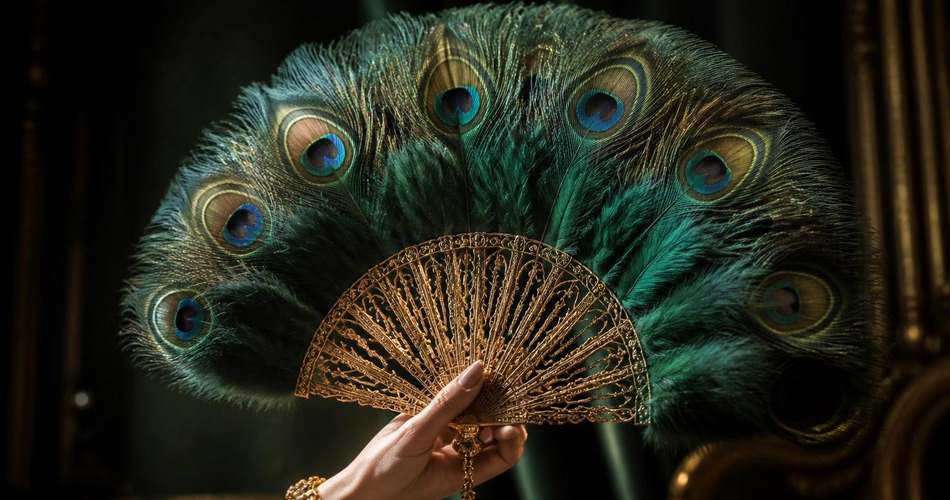
- Peacock feather fan: Rich in symbolism, representing royalty, beauty, vanity, and the all-seeing eye. It can be a protective talisman or an object of superstition.
- White feather fan: Purity, innocence, spirituality, and divine connection. Often used in weddings and spiritual ceremonies.
- Black feather fan: Mystery, elegance, sophistication, and the esoteric. It can be associated with magic, the night, and hidden knowledge.
- Eagle or Hawk feather fan: Power, courage, vision, and a direct connection to the spirit world. Used in Native American healing rituals.
- Japanese Sensu (folding fan): A symbol of Japanese culture, representing the unfolding of life, prosperity, and social status. Used in tea ceremonies and theatre.
Frequently Asked Questions about Feather Fans
Q: What does a feather fan symbolize in a dream?
A: In dreams, a feather fan often symbolizes social grace, flirtation, hidden communication, or a desire for elegance. A broken fan can indicate lost status or faded beauty.
Q: Are peacock feather fans bad luck?
A: In some Western superstitions, peacock feathers inside the home are considered bad luck because the “eyes” on the feathers are thought to represent the evil eye. However, in other cultures, they are symbols of protection, beauty, and royalty.
Q: What is the language of the fan?
A: The language of the fan was a complex system of non-verbal communication used primarily in Victorian England and Spain. Specific movements and positions of the fan conveyed messages of interest, rejection, or warning to potential suitors.
Related Symbols
- Feather: The core element of the fan, symbolizing flight, freedom, and spiritual ascension.
- Fan (Hand Fan): The object itself, a broader symbol of status, air, and communication.
- Peacock: The source of the most iconic feathers, representing vanity, beauty, and immortality.
- Ostrich: Symbolizes truth, justice, and protection (from Ma’at’s feather).
- Eagle: Represents power, courage, and a connection to the divine, especially in Native American symbolism.
- Smudging: The ritual use of smoke, often wafted with a feather fan, for purification.


