
Briefly
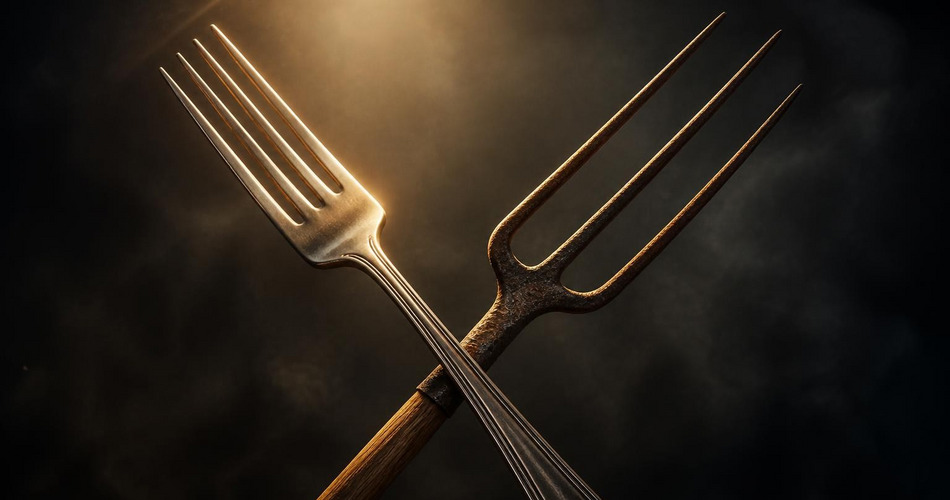
The fork is a deceptively simple object that carries a wide range of symbolic meanings. In its most common form as an eating utensil, it represents the act of choosing and separating — bringing food to the mouth while dividing portions. The fork also appears as a pitchfork in agriculture and folklore, where it symbolizes harvest, labor, and sometimes the devil. Meanwhile, the three-pronged trident stands for power, authority, and mastery over the sea. Across these forms, the fork consistently embodies the idea of a crossroads — a point where paths diverge and decisions must be made.
What Does a Fork Symbolize?
The fork is above all a symbol of choice. Its tines represent multiple possible directions, and the act of using a fork involves selecting one piece of food while leaving others behind. This makes the fork a natural emblem for decision-making and the moment when a person must commit to a path. In a broader sense, the fork signifies duality and the coexistence of opposing forces — good and evil, right and wrong, past and future. The fork also carries connotations of division and separation, as it physically pierces and lifts food, dividing it from the whole.
Outside the dining table, the pitchfork symbolizes agricultural abundance and the toil of the harvest, but also rebellion and anti-authority when associated with the devil. The trident, with its three prongs, adds a layer of divine power and cosmic balance, as seen in the hands of Hindu and Greek deities.
Positive and Negative Meanings of a Fork
Positive associations: The fork represents the clarity that comes with making a conscious choice. It can symbolize abundance and nourishment, as it is the tool that brings food to the mouth. In mythology, the trident is a symbol of protection, authority, and control over the natural elements. The pitchfork, in its agricultural context, stands for hard work, harvest, and sustenance.
Negative meanings: The fork is also linked to conflict and division. It can represent betrayal, as in the phrase “speaking with a forked tongue.” The devil’s pitchfork is a direct symbol of temptation, evil, and damnation. In dream lore, a fork may indicate anxiety about a difficult decision or fear of making the wrong choice. The instrument’s piercing tines can also suggest aggression or invasive scrutiny.
History and Origins of Fork Symbolism
The eating fork as we know it dates back to ancient Greece and Rome, where large forks were used to hold meat while carving. The personal dining fork became popular in the Middle East and was introduced to Europe in the 11th century, but it was not widely adopted until the 16th century, initially viewed as a decadent or even sinful object. Over time, the fork became a mark of refinement and civilized dining, contrasting with the more rustic knife and spoon.
The pitchfork has ancient roots as an agricultural tool, used for lifting hay and straw. Its symbolic shift toward the demonic occurred in medieval Christian art, where the devil was often depicted with a pitchfork, possibly borrowing from the trident of pagan sea gods. The trident itself originates as a fishing spear but became the attribute of Poseidon (Greek) and Neptune (Roman), representing dominion over the oceans and the power to cause storms or calm waters.
Fork Symbolism in Different Cultures
In Western culture, the fork has a dual identity. On one hand, it is a symbol of etiquette and social class — proper table manners require the correct use of fork and knife. On the other hand, the pitchfork is a potent symbol of rebellion, used by the devil in countless paintings and by angry mobs in popular imagery. The fork in the road is a classic Western metaphor for life-changing choices.
In Hinduism, the trishula (trident) is the weapon of Lord Shiva, symbolizing his power to create, preserve, and destroy. The three prongs represent the three gunas (qualities) of nature, the three aspects of time, or the triad of will, action, and knowledge. The trishula is both a fearsome weapon and a spiritual symbol of balance.
In Chinese culture, the fork has little traditional symbolism, as chopsticks have long been the primary eating utensil. However, in modern times, the fork has been adopted in global dining and carries connotations of Western influence and modernity.
Spiritual Meaning of a Fork
Spiritually, the fork represents the moment of decision between two paths — often between good and evil, or between the material and spiritual worlds. In Christianity, the devil’s pitchfork serves as a warning against temptation and sin, reinforcing the idea that every choice has moral consequences. In Hinduism, the trishula is a reminder of the divine balance between creation and destruction, and the need to transcend the threefold nature of reality.
The fork also appears in meditation and self-reflection as a symbol of duality. It invites the individual to examine where they are dividing their energy or attention, and to recognize that the power to choose lies within.
Fork in Myths and Folklore
The most famous mythological fork is the trident of Poseidon, god of the sea. With this weapon, Poseidon could raise storms, shatter rocks, and cause earthquakes. The trident later passed to the Roman god Neptune and remains a symbol of naval power and maritime authority. In Hindu mythology, the trishula of Shiva is equally powerful, used to sever the head of the demon Ganesha (later replaced with an elephant head) and to destroy the three cities of the Asuras.
In European folklore, the pitchfork became the devil’s signature tool. Medieval illustrations often show Satan wielding a pitchfork to torment souls in hell. This image may have originated from depictions of the Greek god Pan with his cattle goad, later adapted by Christian artists. The fork in the road also appears in myths such as the story of Hercules at the crossroads, where he must choose between virtue and vice — a classic allegory of moral choice.
Fork in Dreams
Dreaming of a fork often points to a real-life decision that needs to be made. The dream may reflect anxiety about which direction to take, or a feeling of being pulled in two different ways. A fork in the road in a dream almost always symbolizes a major life choice. Dropping a fork in a dream can suggest a missed opportunity or a warning to pay attention to details. Finding a fork may indicate that a solution or new option is presenting itself. As with all dream symbols, the context and emotions felt in the dream are crucial for interpretation.
Common Dream Scenarios Involving a Fork
- Fork in the road: A classic symbol of a major life decision. The dreamer may be at a turning point.
- Dropping a fork: Often interpreted as a missed chance or a sign to be more careful with choices.
- Eating with a fork that breaks: Suggests difficulty in carrying out a decision or a plan that fails.
- A fork that is dirty or rusty: May indicate unresolved issues or unhealthy choices that need to be addressed.
- Finding a golden or silver fork: Could represent a valuable opportunity or a rewarding path if chosen.
Fork in Superstitions and Omens
Several folk superstitions surround the fork. Dropping a fork is considered bad luck in many Western traditions, especially if it falls on the floor — some believe it means an unexpected visitor will arrive. Placing a fork on the table with the tines pointing upward is thought to invite bad luck or even a quarrel. Crossed forks are also seen as a negative omen, associated with arguments or crossed purposes. On the positive side, finding a fork can be taken as a sign that a decision will soon become clear.
Fork in Art and Literature
Perhaps the most famous literary use of the fork as a symbol is in Robert Frost’s poem “The Road Not Taken” (1916), where the speaker stands at a fork in a yellow wood and must choose one path over the other. The poem has become a universal metaphor for life choices and individuality. In visual art, the devil’s pitchfork appears in countless medieval and Renaissance depictions of Hell, such as in Hieronymus Bosch’s “The Garden of Earthly Delights” and in the frescoes of the Last Judgment. The trident is a recurring motif in maritime art and in depictions of Neptune or Poseidon, from ancient Greek pottery to Baroque paintings by artists like Gian Lorenzo Bernini.
Fork Tattoo Meaning
Fork tattoos can carry several meanings depending on the design. A simple dinner fork may symbolize a love of food and cooking, or a more personal connection to family meals and hospitality. A fork combined with a knife can represent the balance of life or the duality of nurturing and cutting away. Pitchfork tattoos often have a rebellious edge, suggesting a devil-may-care attitude or a connection to punk and counterculture movements. Trident tattoos are popular among those who feel a connection to the sea, or who wish to embody the authority and power of the ancient gods. Many people also get fork tattoos to represent a major life decision they have made, using the fork as a permanent reminder of their chosen path.
Frequently Asked Questions
Q: What does a fork symbolize in general?
A: The fork commonly symbolizes choice, duality, division, and the moment of decision. It can also represent abundance (as an eating utensil) or power and rebellion (as a pitchfork or trident).
Q: What does it mean if you drop a fork?
A: According to Western superstition, dropping a fork often means an unexpected visitor will arrive. It may also be a sign to pay attention to a missed opportunity or to be more careful with a decision.
Q: What is the spiritual meaning of a trident?
A: The trident, especially in Hinduism as the trishula of Shiva, symbolizes divine power, the balance of creation and destruction, and the transcendence of the three gunas (qualities of nature).
Related Symbols
- Knife: Often paired with fork; represents division, cutting ties, and precision.
- Spoon: A utensil of nurturing and gathering, contrasting with the fork’s piercing action.
- Trident: A three-pronged fork symbolizing power, authority, and divine control.
- Pitchfork: An agricultural tool turned symbol of rebellion, the devil, and hard labor.
- Crossroads: The metaphorical fork in the road, representing life choices and destiny.


