Briefly
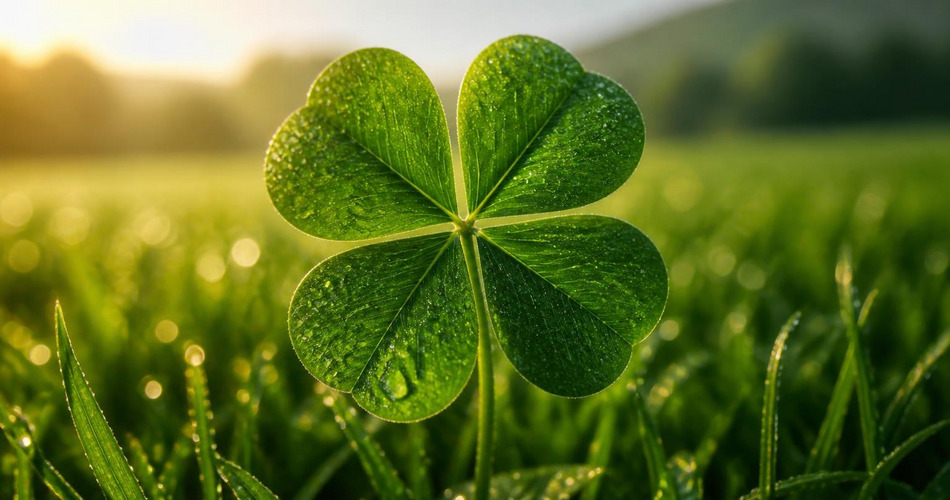
The four-leaf clover is a rare genetic variation of the common three-leaf clover, and its unusual structure has long made it a symbol of extraordinary good fortune. Each of its four leaves is traditionally associated with a specific blessing: hope, faith, love, and luck. Because of its scarcity — estimates suggest only about one in 10,000 clovers has four leaves — finding one has been regarded as a particularly fortunate event, especially in Celtic and Christian traditions.
What Does the Four Leaf Clover Symbolize?
The four-leaf clover is primarily known as a symbol of good luck, but its meaning extends beyond fortune. Each leaf is said to represent a distinct virtue: the first leaf stands for hope, the second for faith, the third for love, and the fourth for luck. This combination makes the clover an emblem of a well-balanced, blessed life. Because it is so rare, the four-leaf clover also symbolizes the unexpected and the miraculous — a sign that blessings can appear even in the most ordinary of settings.
In broader terms, the clover is connected to fertility and growth. As a hardy plant that thrives in fields and meadows, it represents the earth’s abundance and the promise of renewal. The four-leaf clover is also sometimes seen as a protective talisman, warding off bad spirits and offering a shield against misfortune.
Positive and Negative Meanings
Positive associations: The four-leaf clover is overwhelmingly regarded as a positive symbol. It is most commonly linked to unexpected good fortune, success in endeavors, and protection from harm. It is also a sign of perseverance — finding a rare clover encourages patience and attention to the natural world. Spiritually, it represents divine favor, grace, and the presence of blessings in one’s life. The four leaves themselves serve as a reminder of the importance of hope, faith, love, and luck in achieving happiness.
Negative meanings: Negative associations with the four-leaf clover are rare. Some traditions warn that if you find a four-leaf clover and give it away, you may lose your own luck or transfer it to the receiver. In a few superstitions, the clover’s protective power can backfire if the finder shows greed or boastfulness. However, these are minor notes in an otherwise auspicious symbol.
History and Origins of the Four Leaf Clover Symbolism
The association of the four-leaf clover with good luck has ancient roots. The Druids in pre-Christian Celtic cultures regarded clovers as sacred plants, capable of warding off evil spirits. The number four itself held deep significance in Celtic mythology, representing the four seasons, the four cardinal directions, and the four elements — earth, air, fire, and water.
In early Christian symbolism, the four-leaf clover was sometimes used to represent the cross or the four gospels. The popular legend that St. Patrick used the three-leaf shamrock to explain the Holy Trinity may have contributed to the four-leaf variant later being seen as a symbol of God’s grace. By the Middle Ages, the four-leaf clover had become a widely recognized charm for achieving good fortune, especially in Ireland and parts of Britain.
Four Leaf Clover Symbolism in Different Cultures
In Irish and broader Celtic culture, the four-leaf clover is one of the most iconic symbols of luck. It is often featured alongside the shamrock in jewelry, art, and St. Patrick’s Day celebrations. In Irish folklore, carrying a four-leaf clover was said to help one see fairies and even evade their tricks.
In medieval English traditions, the four-leaf clover was thought to protect against witches and evil spirits. Women would sometimes sew a dried clover into the hem of a garment for protection. In some Germanic and Scandinavian customs, finding a four-leaf clover meant you would have the power to spot demons and avoid their influence.
In modern global culture, the four-leaf clover has become a universal sign of luck, used in advertising, branding, and everyday expressions. It appears on lottery tickets, greeting cards, and as a motif in fashion and home decor.
Spiritual Meaning of the Four Leaf Clover
On a spiritual level, the four-leaf clover represents divine protection and a connection to higher powers. Its rarity is seen as a reminder that blessings are not always common but are all the more precious when they appear. The four leaves correspond to spiritual concepts in various traditions — for example, the four elements, the four seasons, and the four directions — symbolizing completeness and harmony with nature.
Some see the clover as a guide for personal growth: each leaf encourages the development of hope, faith, love, and luck in one’s own life. Meditating on the symbol is thought to help cultivate optimism and trust in the universe.
Four Leaf Clover in Myths and Folklore
In Irish and Scottish folklore, the four-leaf clover is closely tied to the world of fairies. According to legend, carrying a four-leaf clover would grant you the ability to see fairies and protect you from their mischief. In some tales, the clover was a portal to the fairy realm or a token that could win a fairy’s favor.
Another enduring myth holds that Eve took a four-leaf clover with her when she and Adam were expelled from the Garden of Eden, as a reminder of paradise. This story may have helped Christianize the popular pagan symbol. In 19th-century England, children believed that finding a four-leaf clover allowed you to make a wish that would come true if you whispered it to the wind.
Four Leaf Clover in Superstitions and Omens
- Finding one: It is considered a portent of immediate good luck and is often kept as a talisman. Some say the luck lasts as long as you carry the clover.
- Giving it away: A common superstition warns that if you give a four-leaf clover to someone else, you transfer your luck to them — and may even lose your own.
- Drying it: Drying a four-leaf clover and storing it in a book or a locket is believed to preserve its protective powers for many years.
- Wearing it: Wearing a four-leaf clover as jewelry is thought to attract good luck and guard against harm, especially for travelers.
- Shared luck: If a group of people find a four-leaf clover together, the fortune is said to be divided among them.
Four Leaf Clover in Art and Literature
The four-leaf clover appears in many works of art and literature, typically as a symbol of luck and the extraordinary. In literature, one of the most famous references is in the Irish folk song and poem “The Four-Leaf Clover” by Ella Higginson, which celebrates the clover’s rarity and beauty. The clover also appears in children’s stories and nursery rhymes, often as a charm or magical object. In visual art, the four-leaf clover is commonly used in illustrations of Irish culture, in St. Patrick’s Day decorations, and in designs for jewelry and textiles. It is also a recurring motif in tattoo art, where it often represents a wish for ongoing good fortune.
Frequently Asked Questions About the Four Leaf Clover
Q: What does a four-leaf clover symbolize?
A: The four-leaf clover symbolizes good luck, with each leaf traditionally representing hope, faith, love, and luck.
Q: Why is a four-leaf clover considered lucky?
A: Its rarity — about 1 in 10,000 clovers has four leaves — made it a powerful talisman in Celtic and Christian cultures, believed to ward off evil and bring good fortune.
Q: What is the difference between a shamrock and a four-leaf clover?
A: A shamrock typically has three leaves and is a national symbol of Ireland, while a four-leaf clover is a rare mutation of the same plant and is specifically associated with luck.
Q: Can I grow a four-leaf clover?
A: The mutation is genetic, so you cannot guarantee growth, but some clover varieties have a higher tendency to produce four leaves, and they can be cultivated through careful breeding.
Q: What should I do if I find a four-leaf clover?
A: You can keep it as a lucky charm, press it in a book, or laminate it. Many believe you should make a wish when you find one.
Related Symbols
- Shamrock — the three-leaf clover symbol of Ireland, associated with the Holy Trinity and luck.
- Horseshoe — another protective good luck charm, often placed above doorways.
- Rabbit’s Foot — a talisman for good luck, common in Western superstitions.
- Ladybug — a beetle that brings good fortune and is seen as a sign of protection.
- Rainbow — symbolizes hope and the promise of good things after a storm.
- Cross — a symbol of faith, sometimes linked to the four-leaf clover in Christian tradition.