Briefly
The nightingale is a small bird celebrated for its powerful, melodic song — often heard at night. It symbolizes beauty, love, longing, and the transcendent power of artistic expression, while also carrying undertones of melancholy, loss, and the bittersweet nature of desire. Its dual character makes it a lasting symbol in poetry, music, and folklore across cultures, representing both the joy of creation and the ache of yearning.
What Does the Nightingale Symbolize?
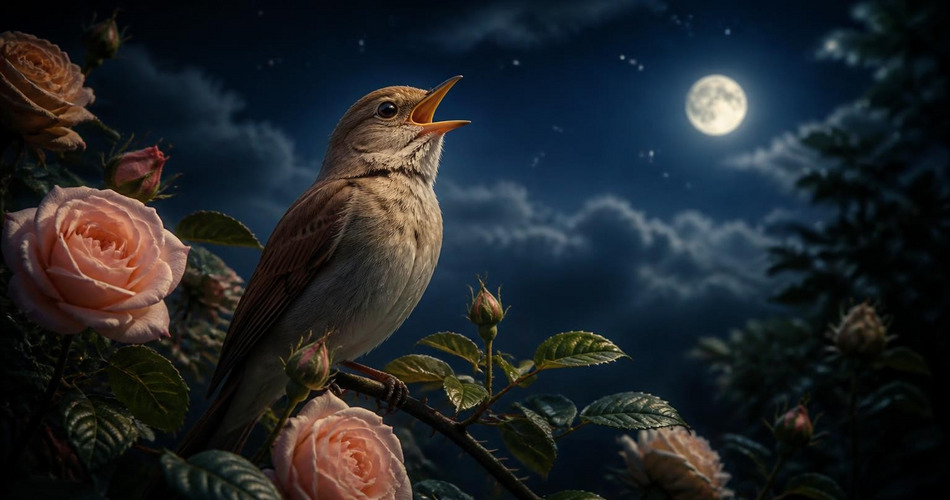
The nightingale’s symbolism revolves around its voice. Because it sings at night, it is associated with the moon, darkness, and secrets revealed in solitude. Its song is both arresting and fleeting, inspiring interpretations that link it to the ephemeral nature of beauty and the persistence of longing.
In Western culture, the nightingale is often a figure of love — frequently representing unrequited or separated love. It also embodies the ideal of the artist who creates from pain, turning sorrow into beauty. In Eastern traditions, particularly in Persian and Sufi poetry, the nightingale (bulbul) represents the soul yearning for union with the divine, singling out the rose as its beloved.
Positive and Negative Meanings
Positive associations: The nightingale symbolizes inspired creativity, pure joy in music, and the triumph of hope over darkness. Its song is often seen as a gift of nature, bringing comfort to loners and lovers alike. In many stories, it sings to reunite separated souls or to guide lost travelers.
Negative meanings: The nightingale’s song can also evoke melancholy and sorrow, particularly when linked to loss, rejection, or unfulfilled desire. Its nighttime singing hints at loneliness and the pain of hidden feelings. In some traditions, it is a portent of separation or an omen of tears, especially when heard in an unexpected context.
History and Origins of the Symbolism
The nightingale’s symbolic roots stretch back to ancient folklore. In Greek mythology, the story of Philomela — transformed into a nightingale after being silenced — gave the bird a haunting association with trauma and voice reclaimed. This myth, retold by Ovid in Metamorphoses, became a cornerstone of Western literary symbolism.
Throughout medieval Europe, the nightingale was praised in verse and song as the “bird of love.” Troubadours and poets used it to signal the arrival of spring and the renewal of romantic feeling. By the Romantic era, the nightingale had become a symbol of the poet’s own soul — singing nocturnally, from depth of emotion, indifferent to an audience.
Symbolism in Different Cultures
In Persian culture, the nightingale (bulbul) is inseparable from the rose. Classic poets like Rumi and Hafez used this pairing to express the soul’s longing for God, the beloved, or ultimate truth. The bird’s song is a metaphor for prayer and spiritual ascent.
In Chinese tradition, the nightingale is less prominent, but similar songbirds evoke harmony with nature. In Japanese culture, the uguisu — often mistranslated as nightingale — signals the coming of spring and is a motif in art and poetry for renewal and appreciation of the present moment.
In English folklore, the nightingale is associated with both love and forewarning. Its presence near a home was sometimes thought to bring good fortune, while its song at unusual hours could hint at news from afar.
Spiritual Meaning
Spiritually, the nightingale reminds us that even in darkness beauty can arise. Its song is a call to listen to one’s inner voice and to trust the wisdom of intuition. In Sufi thought, the nightingale’s longing for the rose symbolizes the soul’s descent into the material world and its innate desire to return to the divine source.
For those on a spiritual path, encountering a nightingale — in waking life or in dreams — may encourage authentic expression and the courage to speak one’s truth even when no one seems to listen.
In Myths and Folklore
The most famous myth is that of Philomela in Greek mythology. After being abused and having her tongue cut out, she weaves her story into a tapestry; later, she and her sister are transformed into birds — Philomela into a nightingale, whose song is both a lament and a statement of survival.
Folklore across Europe contains many tales of nightingales as guides to lost lovers or as sentinels of secret meetings. Their songs were thought to soothe the grieving or to warn of danger, though specific omens vary by region. In some Slavic tales, the nightingale is a helper who reveals hidden truths to the hero.
In Dreams
Dreaming of a nightingale often reflects a longing for emotional or artistic expression. Hearing its song may indicate a hidden message from your subconscious, urging you to pay attention to your deepest feelings. The bird’s nighttime song in a dream can symbolize clarity emerging from obscurity.
If the nightingale is silent or caged in a dream, it may point to feelings of suppression or the fear that your voice is not being heard. Alternatively, a freely singing nightingale suggests a time of creative awakening and romantic possibility.
Common Dream Scenarios
- Hearing a nightingale song — a symbol of inspiration, love, or intuition rising within you.
- Seeing a nightingale in flight — freedom, release from a burden, or a journey of the spirit.
- A nightingale singing near your window — a message from the unconscious or a call to pay attention to matters of the heart.
- A nightingale trapped or caged — feelings of being silenced or constrained in some area of life.
- A nightingale in daylight — an awakening of clarity, or a reminder that beauty exists even in the mundane.
In Superstitions and Omens
Superstitions about nightingales are less documented than for other birds, but a few patterns exist. In parts of Britain, hearing a nightingale’s song at night was once considered a good omen for romance, while in some rural areas it was thought to predict rain if heard before dawn. In Eastern European lore, a nightingale singing on a rooftop was believed to bring blessings to the household.
These superstitions are not universal, but they consistently reflect the bird’s role as a messenger between worlds — carrying news to the waking mind from the realm of dreams and instincts.
In Art and Literature
The nightingale has inspired countless works. John Keats’ Ode to a Nightingale (1819) is perhaps the most famous — the bird’s song contrasts with human suffering, symbolizing immortal art and the poignant distance between nature and humanity. Hans Christian Andersen’s fairy tale The Nightingale (1843) uses a real nightingale versus a mechanical one to celebrate authenticity and the natural world over artificial imitation.
William Shakespeare referenced the nightingale in Romeo and Juliet, where its song marks the dawn and separates the lovers. In Persian poetry, Rumi’s verses often depict the nightingale’s love for the rose as a metaphor for the soul’s devotion to God. These works cement the nightingale as a timeless emblem of emotional depth and artistic transcendence.
Tattoo Meaning
Nightingale tattoos are uncommon but meaningful. They are chosen by those who identify with the bird’s duality — joy found within sorrow, or the courage to sing one’s truth in the dark. The design often incorporates musical notes, roses, or a crescent moon to reinforce the bird’s connection to love and the night.
For many wearers, the nightingale symbolizes resilience: the ability to transform pain into beauty, or to express emotions that words cannot capture. It can also honor a lost love, as the bird’s song is often associated with remembrance.
Frequently Asked Questions
Q: What does a nightingale symbolize in love?
A: The nightingale symbolizes passionate, often unrequited or separated love — its song is a declaration of longing and devotion.
Q: Why is the nightingale associated with night?
A: Because the male nightingale sings primarily at night, often through the dark hours, making its voice even more striking and mysterious.
Q: What does hearing a nightingale in a dream mean?
A: Hearing a nightingale in a dream often points to a message from the subconscious related to love, creativity, or a hidden truth that wants to be expressed.
Related Symbols
- Rose — the nightingale’s beloved in Persian poetry; together they symbolize love, beauty, and sacrifice.
- Moon — the celestial companion of the nightingale’s song, representing mystery and inner light.
- Songbirds — other melodious birds like larks and thrushes, sharing themes of joy and nature’s voice.
- Philomela — the mythical figure whose transformation into a nightingale ties the bird to narrative and resilience.
- Darkness — the setting of the bird’s music, symbolizing the unknown and the depth of emotion.