Briefly
The pentagram is a five-pointed star drawn in a single continuous line, one of the oldest and most versatile symbols in human history. It has represented everything from the human form and the five senses to spiritual protection, magic, and the elements. While often associated with Wicca and modern occultism, its meanings vary widely across cultures and time periods, encompassing both positive concepts like balance and harmony and negative associations with evil or witchcraft.
What Does the Pentagram Symbolize?
The pentagram primarily symbolizes the five elements — earth, air, fire, water, and spirit — arranged in a harmonious whole. In many traditions, the upward-pointing pentagram represents spirit ruling over the four material elements, signifying balance, protection, and the connection between the divine and the earthly. It also stands for the human being: the head, arms, and legs correspond to the five points, echoing the Renaissance idea of the microcosm reflecting the macrocosm.
In Pythagorean philosophy, the pentagram was a symbol of mathematical perfection and health, known as the pentalpha because it contains the golden ratio. It was used as a secret sign among followers to recognize one another. In later esoteric traditions, the pentagram became a tool for invoking and banishing spirits, as well as a protective emblem against malevolent forces.
Positive and Negative Meanings
Positive associations: The pentagram is widely regarded as a symbol of protection, balance, and spiritual insight. In Wicca and Neopaganism, it represents the unity of the elements and the divine, and is used in rituals to create sacred space. Its geometric perfection also symbolizes knowledge, wisdom, and the interconnectedness of all life.
Negative meanings: Inverted pentagrams (with one point down) are often linked to Satanism and evil, especially in popular media and Christian folklore. This association stems from the 19th-century occult revival and later sensationalism, where the inverted star was used to represent the triumph of matter over spirit. However, within some traditions, the inverted pentagram simply represents the descent of spirit into matter or the second-degree initiation in Wicca.
History and Origins of the Pentagram
The pentagram appears as early as 3000 BCE in Mesopotamian pottery and Sumerian symbols, where it likely represented the star of Ishtar or the goddess Inanna. Ancient Greeks used it extensively; Pythagoreans considered it a symbol of mathematical perfection and health. In early Christian art, the pentagram sometimes represented the five wounds of Christ or the Star of Bethlehem.
During the Middle Ages, the pentagram was used in European folk magic as a protective symbol, often inscribed on doorways or amulets to ward off witches and evil spirits. It appeared in medieval grimoires like the Key of Solomon as a tool for summoning and controlling spirits. The Renaissance revived interest in the pentagram through Hermeticism and alchemy, where it symbolized the quintessence — the fifth element that unites the other four.
Symbolism in Different Cultures
In Chinese tradition, the pentagram is associated with the five phases (Wu Xing) — wood, fire, earth, metal, and water — and their cycles of creation and destruction. In Japanese culture, the pentagram (known as seigaiha or star shape) appears in family crests and Buddhist iconography, sometimes representing the five elements or the five Buddhas.
In Western occultism, the pentagram is central to ceremonial magic, Wicca, and Thelema. Aleister Crowley used the pentagram extensively in his rituals, associating each point with a specific element and direction. In modern Neopaganism, the pentagram is a universal symbol of faith, often worn as jewelry or displayed on altars.
In Christianity, the pentagram has had a mixed history. Early Christians used it as a secret symbol for the five senses or the five joys of Mary, but later it became associated with heresy and witchcraft during the Inquisition. Today, some Christian groups still view it with suspicion due to its occult connections.
Spiritual Meaning of the Pentagram
Spiritually, the pentagram represents the integration of the physical and spiritual. The upward-pointing pentagram is often used in meditation to align the chakras or to invoke divine protection. In Wiccan practice, drawing a pentagram in the air is a common method for casting a circle and consecrating ritual tools.
The five points are also linked to the five senses, suggesting that spiritual awareness comes through embodied experience. Some traditions see the pentagram as a map of the soul’s journey from the material world (the lower points) to spiritual enlightenment (the top point).
The Pentagram in Myths and Folklore
In European folklore, the pentagram was a powerful protection against witches, demons, and the evil eye. It was common to carve a pentagram on a door, a cradle, or a stable to prevent harm. In German folklore, the Drudenfuss (druid’s foot) was a pentagram drawn on thresholds to keep out malevolent spirits — a motif that appears in Goethe’s Faust, where Mephistopheles is trapped by a pentagram on the floor.
In Slavic folklore, the pentagram was used in healing rituals and to ward off vampires. The symbol also appears in fairy tales and folk magic as a boundary marker between the human world and the supernatural.
The Pentagram in Dreams
Dreaming of a pentagram often relates to themes of protection, balance, or spiritual conflict. The symbol may appear when the dreamer is seeking guidance or feels the need to defend against negative influences. The orientation of the pentagram in the dream can alter its meaning: an upright pentagram suggests harmony and spiritual growth, while an inverted one may indicate inner turmoil or a need to ground oneself.
As with all dream symbols, personal associations and cultural background strongly influence interpretation. A pentagram in a dream may simply reflect the dreamer’s exposure to the symbol in waking life, such as through media or religious practice.
Common Dream Scenarios with Pentagrams
- Seeing a glowing pentagram: Often interpreted as a sign of spiritual awakening or a call to pay attention to one’s inner life.
- Drawing a pentagram: May represent a desire to create boundaries or to engage in ritualistic behavior for protection.
- An inverted pentagram: Could indicate feelings of being overwhelmed by material concerns or a warning against negative influences.
- A pentagram on a door or threshold: Suggests a need to protect one’s personal space or to examine what is allowed into one’s life.
The Pentagram in Superstitions and Omens
In many folk traditions, a pentagram drawn on the ground or above a doorway is believed to prevent witches and evil spirits from entering. In some cultures, finding a pentagram-shaped object is considered a lucky omen, while in others it is viewed with suspicion due to its association with the occult.
Modern superstitions often link the inverted pentagram with Satanism, leading to its use in horror films and heavy metal imagery. However, within Neopagan communities, the upright pentagram is a positive symbol of faith and protection, and seeing one is considered a blessing.
The Pentagram in Art and Literature
The pentagram appears in numerous works of art and literature, often as a symbol of mystery, magic, or the supernatural. In Goethe’s Faust, the pentagram on the threshold prevents Mephistopheles from leaving, illustrating its protective power. In Dan Brown’s The Da Vinci Code, the pentagram is discussed as a symbol of the divine feminine and the golden ratio, linking it to Renaissance art and architecture.
In visual art, the pentagram is a recurring motif in the works of occult-influenced artists such as Austin Osman Spare and in the surrealist paintings of Remedios Varo. It also appears in contemporary fantasy literature, such as in the Harry Potter series, where it is used in magical diagrams and spells.
Pentagram Tattoo Meaning
Pentagram tattoos are popular among those who identify with Wicca, Neopaganism, or occult spirituality. The upright pentagram tattoo often signifies protection, balance, and a connection to the elements. It may be combined with other symbols like the moon, runes, or flowers to personalize the meaning.
An inverted pentagram tattoo is less common but is sometimes chosen by those who embrace the symbol’s darker associations or who follow certain Left-Hand Path traditions. However, many wearers of either orientation emphasize the pentagram’s positive aspects of spiritual growth and self-empowerment.
Meanings of Different Pentagram Variations
- Upright pentagram: Represents spirit over matter, protection, and harmony. Commonly used in Wiccan rituals.
- Inverted pentagram: Often associated with Satanism or the descent of spirit into matter. In some traditions, it symbolizes the second-degree initiation in Wicca.
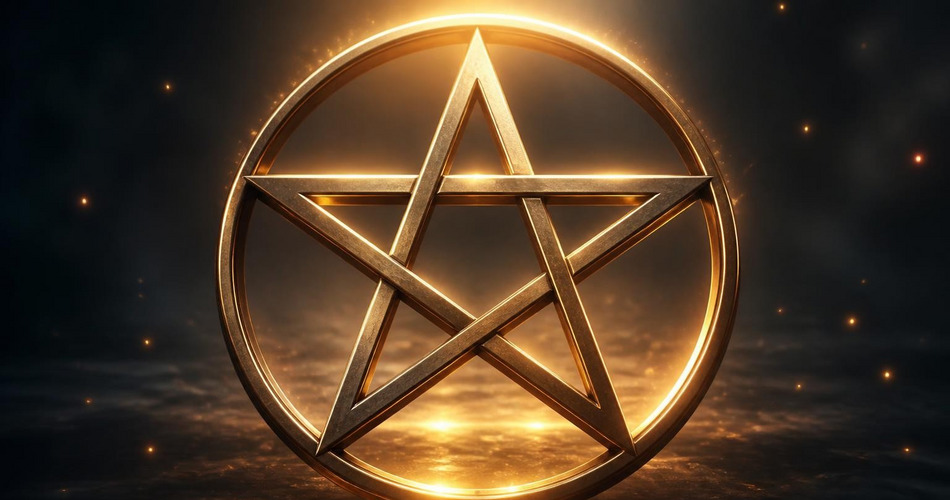
- Pentagram with circle: Known as a pentacle, it adds the symbolism of unity, eternity, and the cycle of life. This is the standard emblem of Wicca.
- Colored pentagrams: Colors may add layers of meaning — green for earth, blue for water, red for fire, yellow for air, white or purple for spirit.
Frequently Asked Questions About the Pentagram
Q: Is the pentagram always a Satanic symbol?
A: No. The pentagram has been used for thousands of years across many cultures as a symbol of protection, balance, and spirituality. Its association with Satanism is a relatively recent development, primarily from the 19th century onward.
Q: What is the difference between a pentagram and a pentacle?
A: A pentagram is a five-pointed star drawn in one continuous line. A pentacle is a pentagram enclosed within a circle, often used as a ritual tool or amulet in Wicca and ceremonial magic.
Q: Can Christians use the pentagram?
A: Historically, some Christians used the pentagram as a symbol of the five wounds of Christ or the Star of Bethlehem. However, due to its later association with occultism, most Christian denominations now discourage its use.
Q: What does an inverted pentagram mean?
A: In popular culture, it is often linked to Satanism. In some occult traditions, it represents the descent of spirit into matter or the material world. In Wicca, it can signify the second-degree initiation.
Related Symbols
- Hexagram: A six-pointed star, often associated with Judaism (Star of David) and alchemical union of opposites.
- Pentacle: A pentagram within a circle, used as a protective amulet and Wiccan symbol.
- Star of David: A hexagram representing Jewish identity and divine protection.
- Triquetra: A three-pointed knot symbolizing the triple goddess or the Holy Trinity.
- Ankh: An Egyptian cross symbolizing life and immortality.