Briefly
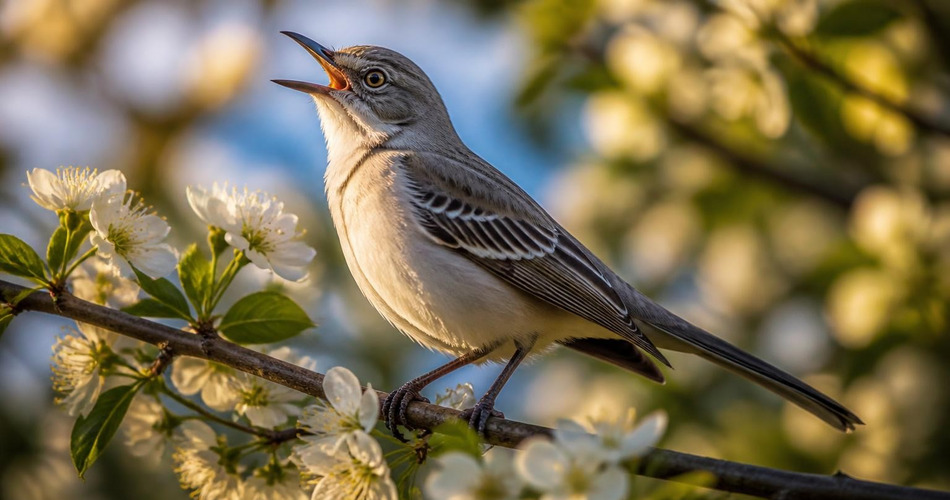
The mockingbird is widely recognized as a symbol of communication, imitation, and creative expression. Its ability to mimic the songs of other birds and even mechanical sounds links it to adaptability, learning, and the power of voice. In many contexts, the mockingbird also represents innocence and protection, most famously through Harper Lee’s novel To Kill a Mockingbird, where it stands for harmless beings that only bring joy. At the same time, its assertive defense of its nest gives it a strong association with protection and courage.
What Does the Mockingbird Symbolize?
The mockingbird primarily symbolizes the power of voice, mimicry, and adaptability. As a master imitator, it represents the ability to learn, reproduce, and communicate complex ideas. This bird also embodies innocence, as its song brings pleasure rather than harm. In spiritual contexts, the mockingbird encourages finding one’s authentic voice by exploring and absorbing influences from the environment.
Additionally, the mockingbird is a symbol of protection. It aggressively defends its nest against intruders, including larger birds and humans. This behavior translates into meanings of familial defense, territorial integrity, and standing up for what is important.
Positive and Negative Meanings
Positive associations: The mockingbird is seen as creative, adaptable, and eloquent. Its mimicry demonstrates intelligence and the capacity for learning, while its song brings beauty and variety to natural soundscapes. Its protective nature symbolizes loyalty and bravery in defending loved ones.
Negative meanings: On the downside, the mockingbird’s mimicry can be interpreted as deception or lack of originality—borrowing the voices of others rather than singing its own tune. Its persistent singing, especially at night during mating season, can be perceived as noise or annoyance. Some also view its aggressive nest defense as excessive or confrontational.
History and Origins of the Mockingbird Symbolism
The mockingbird (Mimus polyglottos) is native to North America, and its symbolic meanings have deep roots in indigenous cultures. Many Native American tribes, including the Cherokee and Creek, regarded the mockingbird as a symbol of communication and intelligence because of its remarkable vocal abilities. They told stories of the mockingbird as a teacher who taught other birds their songs, and sometimes as a messenger between humans and spirits.
In colonial America, European settlers were fascinated by the bird’s vocal talents, and it became a symbol of the New World’s rich wildlife. By the 19th century, the mockingbird appeared in American literature and folklore as a figure of innocence and charm. Its most enduring literary association comes from Harper Lee’s 1960 novel To Kill a Mockingbird, where the title carries the moral imperative not to harm that which brings only goodness.
Mockingbird Symbolism in Different Cultures
In Native American cultures, the mockingbird is often a positive figure. The Hopi people associated it with creativity and the arts, believing that its song could inspire painters and weavers. Among the Pueblo tribes, the mockingbird is considered a guardian of the south, associated with warmth and the summer season.
In African American folklore of the American South, the mockingbird was sometimes seen as a protector of the home and a symbol of resilience. Its fearless defense of its nest mirrored the protective instincts within families and communities facing adversity.
In modern Western culture, the mockingbird is largely viewed through the lens of literature and conservation. It is a state bird of several Southern states and appears in songs and poems as an emblem of nostalgia, home, and the natural world.
Spiritual Meaning of the Mockingbird
Spiritually, the mockingbird encourages people to find their own voice by exploring a variety of influences. It teaches that true authenticity often comes from synthesizing diverse experiences rather than rejecting them. The bird’s ability to imitate perfectly suggests that learning from others is a valuable step in self-development.
The mockingbird also carries a message of protection on a spiritual level—its fiery defense of its nest reminds us to safeguard our personal boundaries and loved ones. Its appearance may signal a need to stand firm or to speak up for those who cannot speak for themselves.
The Mockingbird in Myths and Folklore
In Cherokee mythology, the mockingbird is said to have helped the Creator shape the world by teaching all the other birds their songs. Without the mockingbird, the world would have been silent and without music. In some versions of the story, the mockingbird is also the keeper of the sacred fire, a role that underscores its connection to life and warmth.
Among the Creek people, the mockingbird was respected as a doctor or medicine bird, whose song could heal the sick. This belief likely arose from the bird’s tireless singing and its association with dawn—a time of renewal.
In European-derived American folklore, the mockingbird sometimes appears as a trickster figure, using its mimicry to fool other animals. However, compared to the raven or coyote, this trickery is usually mild and more playful than malicious.
The Mockingbird in Dreams
Dreaming of a mockingbird often relates to communication and self-expression. It may indicate that you need to speak your truth or that you are being influenced by someone else’s words. A singing mockingbird in a dream suggests creative inspiration or a harmonious period ahead.
If the mockingbird is aggressive or attacking, it could symbolize a need to protect your boundaries or that you feel threatened by someone’s words. Its mimicry in a dream might be a warning to double-check information or to recognize when someone is not being authentic.
Common Dream Scenarios Involving Mockingbirds
- A mockingbird singing joyfully – indicates creative inspiration, happy communication, or a positive social situation.
- A mockingbird imitating other sounds – suggests you are adapting to your environment or perhaps being too influenced by others.
- An aggressive mockingbird dive-bombing you – represents a threat to your personal space or a need to defend your ideas.
- A baby mockingbird – symbolizes new ideas or a vulnerable aspect of your voice that needs nurturing.
- Many mockingbirds singing together – points to a chorus of opinions around you; may indicate community or social pressure.
Mockingbird Superstitions and Omens
In Southern American superstition, seeing a mockingbird early in the morning is considered a good omen for the day ahead. Some believe that a mockingbird singing outside your window foretells a letter or news arriving soon. Because of its protective nature, spotting a mockingbird near your home is often seen as a sign that your family is safe.
Conversely, a mockingbird flying into a window or house is sometimes viewed as a warning of deception or miscommunication. However, such beliefs are regional and not universally held.
The Mockingbird in Art and Literature
The most famous literary use of the mockingbird is in Harper Lee’s To Kill a Mockingbird (1960). In the novel, the mockingbird symbolizes innocence and the idea that killing something that does no harm is a sin. The character Miss Maudie explains that “mockingbirds don’t do one thing but make music for us to enjoy”—a moral at the heart of the story.
In poetry, the mockingbird appears in works by Walt Whitman, Emily Dickinson, and Robert Frost. Whitman’s poem “Out of the Cradle Endlessly Rocking” uses the mockingbird’s song as a symbol of lost love and artistic birth. Dickinson wrote several poems referencing mockingbirds, often linking them to nature’s music and the idea of authenticity. In modern media, the mockingbird has also inspired the “mockingjay” in Suzanne Collins’ The Hunger Games series, though that is a fictional hybrid bird.
Mockingbird Tattoo Meaning
A mockingbird tattoo often symbolizes one’s own voice, creativity, or a protective nature. It can also represent an admiration for literature, especially To Kill a Mockingbird. Many people choose this bird to commemorate a loved one who was gentle and harmless. The tattoo may be depicted in flight, singing, or with flowers to emphasize innocence and natural beauty.
Frequently Asked Questions About Mockingbird Symbolism
Q: What does a mockingbird symbolize spiritually?
A: Spiritually, the mockingbird represents finding your own voice through learning from others, creative expression, and protecting your personal boundaries.
Q: Is a mockingbird a good omen?
A: In many traditions, yes—hearing or seeing a mockingbird is considered a positive sign of communication, good news, and protection.
Q: What is the meaning of a mockingbird in To Kill a Mockingbird?
A: In Harper Lee’s novel, the mockingbird symbolizes innocence and the idea that it is wrong to harm those who bring only goodness and no harm.
Q: What does a mockingbird tattoo mean?
A: A mockingbird tattoo commonly signifies creativity, self-expression, protection, and a gentle spirit, often tied to the literary symbolism of innocence.
Related Symbols
- Mockingjay – a fictional hybrid from The Hunger Games, symbolizing rebellion and communication.
- Nightingale – shares the songbird symbolism, often associated with night, love, and poetry.
- Lyrebird – another master of mimicry, symbolizing imitation and the natural artistry of sound.
- Canary – represents joy and warning, often used in coal mines; a symbol of sensitivity.
- Dove – a symbol of peace and innocence, complementary to the mockingbird’s gentle nature.