Briefly
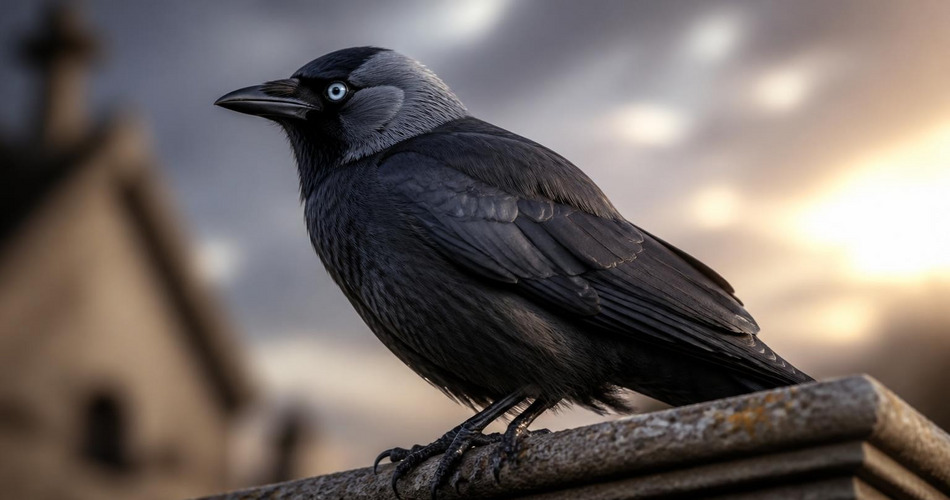
The jackdaw, a member of the corvid family, is a bird rich in symbolism. Known for its glossy black-and-grey plumage and piercing pale blue eyes, the jackdaw is most frequently associated with intelligence, curiosity, and adaptability. It also carries connotations of trickery and thievery, due to its habit of stealing shiny objects. Across cultures, the jackdaw has been viewed both as a clever companion and a troublesome omen, making it a complex figure in symbolism and folklore.
What Does the Jackdaw Symbolize?
The jackdaw primarily symbolizes intelligence and problem-solving. As a corvid, it shares the family’s renowned cognitive abilities, including tool use and social learning. The jackdaw also represents curiosity and resourcefulness—it is a bird that explores its environment thoroughly and adapts quickly to change. Its sociable nature, often nesting in colonies, symbolizes community and communication. Additionally, the jackdaw’s habit of collecting bright objects has linked it to themes of attraction to the superficial and the value of discernment.
Positive and Negative Meanings
Positive associations: The jackdaw embodies keen intelligence and the ability to thrive in diverse environments. Its playful, inquisitive behavior encourages adaptability and creative thinking. In some contexts, it is a symbol of cleverness and even loyalty, as jackdaws form strong pair bonds and cooperative flocks.
Negative meanings: The jackdaw’s reputation for stealing shiny trinkets has made it a symbol of dishonesty and petty theft. It is sometimes seen as a trickster, one that uses cunning for selfish gain. In folklore, its presence can portend bad luck or deceit, and its chattering calls have been interpreted as gossip or malicious talk.
History and Origins of the Jackdaw Symbolism
The jackdaw (Corvus monedula) has been observed by humans for millennia. Its name originates from the Old English jac (a nickname for a small bird) and daw (an onomatopoeia for its call). In ancient Greece, the jackdaw appeared in Aesop’s fables, most notably in “The Jackdaw and the Borrowed Feathers,” where a jackdaw dresses in peacock feathers to gain status, only to be ridiculed—a story about pretending to be something one is not. This fable established an early symbolic link between the jackdaw and deceitful imitation. Roman naturalist Pliny the Elder also wrote about the jackdaw’s ability to learn speech, reinforcing its association with intelligence and mimicry.
Jackdaw Symbolism in Different Cultures
In European folklore, the jackdaw is often considered a bird of ill omen, especially if it perches on a church or house alone. In some regions, it was believed that a solitary jackdaw foretold death. However, in Cornish folklore, the jackdaw was respected and sometimes kept as a pet for its cleverness. In Romani culture, the jackdaw is viewed as a trickster and a symbol of cunning.
In Asian contexts, jackdaws are less prominent, but in parts of India, similar corvids are seen as messengers or carriers of souls. Western ornithology and birdwatching have contributed to a more neutral, biological understanding, but the jackdaw’s symbolic weight remains tied to its intelligence and mischievous nature.
Jackdaw in Myths and Folklore
The jackdaw appears in several notable myths and folktales. The Aesopic fable of the jackdaw in borrowed feathers is one of the oldest recorded stories about the bird, teaching a lesson about pride and deception. In medieval European bestiaries, the jackdaw was described as a noisy, thieving bird that could be tamed but remained untrustworthy.
The most famous English literary treatment is “The Jackdaw of Rheims,” a poem by Thomas Ingoldsby (Richard Barham) from The Ingoldsby Legends (1840). The poem tells the story of a jackdaw that steals a cardinal’s ring and is eventually sanctified after appearing to help find it—a humorous tale blending theft with redemption. This work cemented the jackdaw as a trickster capable of both mischief and forgiveness.
Jackdaw in Dreams
Dreaming of a jackdaw often points to issues of deception or the need to examine what is truly valuable. Because of its association with shiny objects, a jackdaw in a dream may encourage the dreamer to look beyond superficial appearances and question their own motives or those of others. It can also represent a clever idea or a warning against gossip.
Common Dream Scenarios
- A jackdaw stealing something shiny: Suggests that you or someone close may be focusing too much on material wealth or outer image, ignoring deeper values.
- A jackdaw chattering loudly: May represent gossip or noisy distractions in your waking life that prevent clear thought.
- A pair of jackdaws: Often symbolizes partnership, loyalty, or the need for cooperative effort.
- A dead jackdaw: Could indicate the end of a deceptive situation or the loss of cleverness in a personal relationship.
Jackdaw in Superstitions and Omens
- Seeing a single jackdaw is considered bad luck in some British traditions, echoing the rhyme “one for sorrow” associated with magpies.
- A jackdaw nesting on a house chimney is sometimes thought to protect the home from fire, but also to foretell a death if it leaves suddenly.
- In parts of Scotland, a jackdaw near a window was believed to be a messenger of death from the otherworld.
- If a jackdaw flies into a building, it is seen as an omen of important news or an unexpected change.
Jackdaw in Art and Literature
Beyond “The Jackdaw of Rheims,” the jackdaw appears in the poetry of William Cowper. In his poem “The Jackdaw” (1782), Cowper describes the bird’s thieving habits and its inability to change its nature, using it as a moral lesson about ingrained character. The jackdaw also appears in various natural history paintings and illustrations, such as those by John James Audubon, who depicted the bird with scientific accuracy while capturing its alert, intelligent demeanor.
In modern literature, the jackdaw occasionally appears as a symbol of urban wildlife resilience, such as in the works of nature writer Richard Mabey or in poems by Ted Hughes, where corvids often represent primal intelligence. The bird’s presence in these works reinforces its symbolic associations with cleverness and survival.
Jackdaw Tattoo Meaning
A jackdaw tattoo can symbolize intelligence, adaptability, and a rebellious or mischievous spirit. Because of the bird’s connection to collecting treasure, some wear the jackdaw to represent a fascination with beauty or the pursuit of knowledge. It can also serve as a reminder to look beyond appearances. The pale blue eye of the jackdaw is often emphasized in tattoo designs to capture its piercing, watchful quality.
Meanings of Different Types, Colors, or Variations
The jackdaw is generally uniform in appearance: black body, grey nape, and pale blue-white eye. There are no significant color variations in the wild, though juveniles have darker, less distinct grey markings. In heraldry, the jackdaw is sometimes depicted as a “daw” and may be shown with a ring in its beak, referencing the Rheims legend. Such images emphasize the bird’s thieving and clever nature.
Frequently Asked Questions
Q: What does a jackdaw symbolize in the Bible?
A: The jackdaw is not directly mentioned in the Bible, but corvids like ravens appear as messengers of God (e.g., feeding Elijah). The jackdaw’s absence means it carries no direct biblical symbolism.
Q: Are jackdaws good luck or bad luck?
A: In most European folklore, alone jackdaws are considered bad luck, though in some traditions they are protective if they nest on a home. Their dual nature makes them ambiguous omens.
Q: Why do jackdaws steal shiny objects?
A: While popularly believed, studies show jackdaws are no more attracted to shiny objects than other corvids. The reputation likely comes from their natural curiosity and tendency to pick up items while foraging.
Q: What is the difference between a jackdaw and a crow?
A: Jackdaws are smaller than crows with a distinctive grey nape and pale blue eye. They also have a shorter, sharper call and more gregarious social behavior.
Related Symbols
- Crow – another corvid symbolizing death, intelligence, and mystery
- Raven – often associated with prophecy, wisdom, and creation myths
- Magpie – a fellow corvid known for collecting shiny objects and tied to superstition
- Rook – a sociable corvid linked to community and communication