Briefly
The cypress tree has long stood as a powerful symbol of mourning, eternity, and spiritual resilience. Its tall, narrow silhouette and dark evergreen foliage have made it a fixture in cemeteries and sacred spaces across the Mediterranean and beyond. From ancient Persia to classical Greece and Rome, the cypress has been linked to death, the afterlife, and the enduring soul. Yet it also represents hope, protection, and unwavering faith, embodying the paradox of loss and lasting memory.
What Does the Cypress Tree Symbolize?
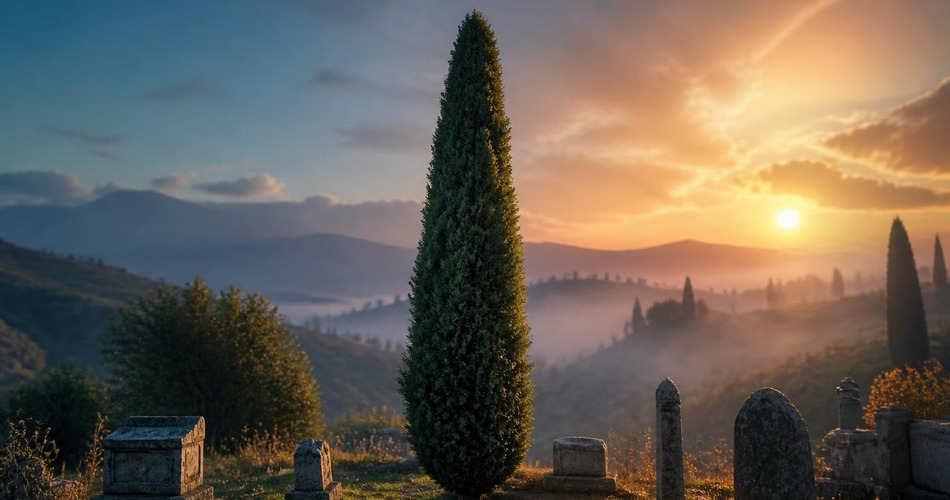
The cypress tree is most commonly associated with mourning and remembrance. Its dark, conical shape and slow growth evoke a sense of permanence and solemnity, making it a natural emblem for cemeteries and memorials. Beyond grief, the cypress also symbolizes eternity — because it is evergreen and long-lived, it represents life that continues beyond death. In many traditions, the tree is seen as a bridge between the earthly and the divine, a guardian of sacred ground. Its fragrant, durable wood has been used for temples and coffins, reinforcing its connection to the sacred and eternal.
Positive and Negative Meanings of the Cypress Tree
Positive associations: The cypress is a symbol of resilience, hope, and protection. It thrives in harsh environments, standing tall and green even in dry, rocky soils, which makes it an emblem of endurance and steadfast faith. In gardens and cemeteries, it is thought to ward off evil spirits and provide a peaceful resting place for the dead. Its evergreen nature also signifies eternal life and the soul’s immortality.
Negative meanings: The cypress is overwhelmingly associated with death, sorrow, and funerary rites. Its presence in graveyards and its dark, somber appearance can evoke feelings of grief, loss, and melancholy. In some contexts, the tree may be seen as a symbol of mourning that never ends, or as a harbinger of bad luck if planted near a home.
History and Origins of Cypress Tree Symbolism
The cypress (Cupressus sempervirens) is native to the eastern Mediterranean and has been cultivated for thousands of years. Ancient Persians planted cypress trees in their gardens as symbols of eternity and paradise — the word “paradise” itself comes from the Old Persian word for a walled garden filled with trees, including cypress. In ancient Greece and Rome, cypress was sacred to Hades/Pluto, the god of the underworld, and to the goddess Hecate, who oversaw crossroads and the dead. The Romans planted cypress at the entrances of tombs and used its wood for funeral pyres. The tree’s association with death and the afterlife was so strong that it became a standard motif in funerary art and architecture across the Mediterranean world.
Cypress Tree Symbolism in Different Cultures
In ancient Egypt, cypress wood was used for mummy cases and temple doors, symbolizing protection and eternal life. The tree was also planted near graves to guard the spirits of the departed.
In Persian culture, the cypress was a sacred tree representing immortality and resistance to decay. It appears in Persian poetry and gardens as a symbol of enduring love and spiritual beauty.
In Greek and Roman traditions, the cypress was closely tied to the underworld. The myth of Cyparissus — a young boy transformed into a cypress tree after grieving too deeply over his beloved stag — reinforced the tree’s role as an emblem of mourning and eternal sorrow.
In Christianity, the cypress became a symbol of faith, patience, and the hope of resurrection. Its evergreen foliage and sturdy wood were seen as signs of the faithful soul that endures through trials. The tree is mentioned in the Bible (Isaiah 41:19) as one of the trees that will flourish in the desert, symbolizing God’s provision.
In Islam, the cypress is often planted in cemeteries and mosque gardens as a reminder of eternity and the afterlife. Its tall, upright form is thought to point toward heaven, encouraging the believer to focus on spiritual matters.
In Chinese culture, the cypress is associated with longevity and virtue. Its slow growth and hard wood represent steadfastness and moral integrity, and it is sometimes planted in temple courtyards or ancestral tombs.
Spiritual Meaning of the Cypress Tree
Spiritually, the cypress tree represents the soul’s journey toward immortality and enlightenment. Its vertical, spire-like shape is often seen as a ladder connecting the earthly realm to the divine. In meditation and contemplative traditions, the cypress stands for focus, inner strength, and the ability to rise above worldly concerns. Many people believe that planting a cypress tree near a home or sacred space can create a protective barrier against negative energies and spirits, making it a symbol of spiritual guardianship.
Cypress Tree in Myths and Folklore
The most famous myth involving the cypress is the Greek story of Cyparissus. According to Ovid’s Metamorphoses, Cyparissus was a young boy who accidentally killed his beloved tame stag. Overcome with grief, he begged the gods to let him weep forever. They granted his wish by turning him into a cypress tree, and the tree’s resin drops resemble tears. This myth cemented the cypress as a symbol of mourning and eternal sorrow in Western culture.
In Persian folklore, the cypress is often associated with Zoroastrian rituals and is considered a sacred tree that can ward off evil forces. It was believed that cypress branches placed on a house could protect inhabitants from lightning and malevolent spirits.
Cypress Tree in Art and Literature
In literature, the cypress appears prominently in ancient and modern works. Ovid’s Metamorphoses contains the foundational myth of Cyparissus, linking the tree to grief and transformation. In Dante’s Divine Comedy, cypress trees are mentioned in the context of Purgatory, where they symbolize purification and the hope of salvation. The Persian poet Hafez frequently used the cypress as a symbol of the beloved’s upright stature and eternal beauty. In modern times, the cypress is a recurring motif in the poetry of Rainer Maria Rilke, who saw it as a figure of solitude and transcendence.
In painting, Vincent van Gogh famously featured cypress trees in his work, most notably in The Starry Night (1889) and Wheat Field with Cypresses (1889). Van Gogh saw the cypress as a symbol of life and death intertwined, its dark, swirling shape reaching toward the heavens while rooted in the earth. His cypresses convey a sense of emotional intensity and spiritual longing.
Cypress Tree Tattoo Meaning
Cypress tree tattoos are chosen to represent resilience, memory, and a connection to the eternal. They can serve as memorials for lost loved ones, symbolizing that the person lives on in spirit. The tall, slender shape of the cypress also makes it a visually striking motif that can be combined with other elements like moons, stars, or birds. For some, a cypress tattoo is a personal talisman for protection and spiritual grounding, reminding the wearer of their inner strength and faith.
Frequently Asked Questions About Cypress Tree Symbolism
Q: Why is the cypress tree associated with death?
A: The association comes from ancient Mediterranean cultures where cypress was planted in cemeteries and used for funeral pyres and coffins. Its dark, somber appearance and evergreen nature made it a symbol of mourning and eternal life after death.
Q: Is the cypress tree positive or negative in symbolism?
A: It carries both positive and negative meanings. Negatively, it symbolizes grief and loss; positively, it represents resilience, protection, and hope for eternal life.
Q: Can I plant a cypress tree near my home?
A: Culturally, opinions vary. In some traditions it is considered protective, while in others it may be seen as a sign of mourning. In practical terms, cypress trees make excellent windbreaks and ornamental trees due to their hardiness and low maintenance.
Q: What does a cypress tree represent in dreams?
A: Dream interpretation is not a supported section in this article, but common associations include themes of loss, enduring memory, or spiritual growth — though such interpretations are speculative and not based on reliable sources.
Related Symbols
- Willow — mourning and flexibility, also associated with grief
- Yew — eternal life and death, common in churchyards
- Pine — resilience and longevity, evergreen symbolism
- Olive — peace and endurance, culturally significant in the Mediterranean
- Evergreen — eternal life and unwavering faith