
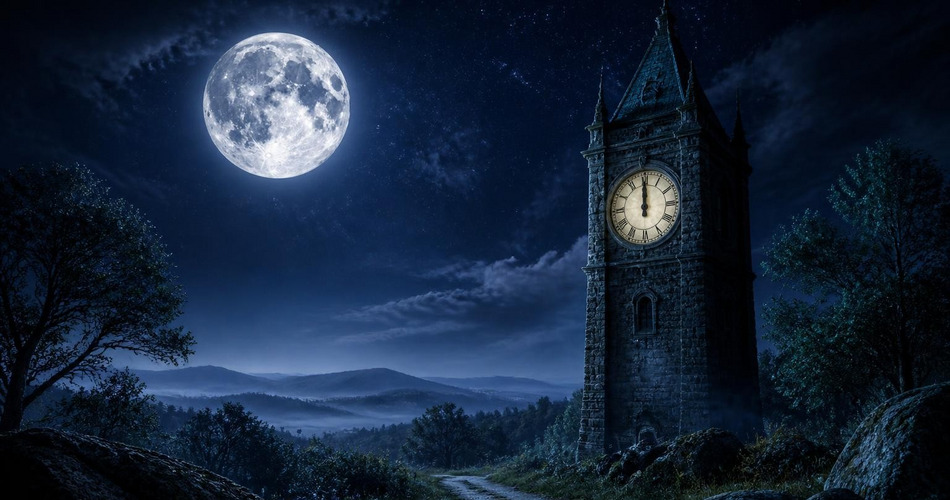
Briefly
Midnight marks the exact midpoint of the night and the transition from one day to the next. It is a boundary moment — neither fully belonging to the day that ended nor to the one beginning. Across cultures and traditions, midnight has come to represent mystery, hidden knowledge, transformation, and the threshold between the known and the unknown. It carries both positive associations of renewal and new beginnings and darker meanings linked to fear, the supernatural, and the subconscious.
What Does Midnight Symbolize?
Midnight is first and foremost a threshold. As the stroke of twelve, it closes one calendar day and opens another, making it a natural symbol of endings and beginnings. This liminal quality gives midnight its power: it is a time when ordinary rules seem suspended and other possibilities feel closer to the surface.
In many symbolic frameworks, midnight is connected to the hidden aspects of life. It is the hour of darkness at its deepest, when visibility is lowest and the imagination becomes more active. This makes it a symbol of the unconscious mind, of secrets, and of things that are not meant to be seen in the light of day. At the same time, because it precedes dawn, midnight also symbolizes waiting, anticipation, and the promise of what is yet to come.
Midnight is also strongly associated with stillness and silence. Most human activity pauses at this hour, creating a sense of suspension that can feel peaceful or unsettling depending on the context. In symbolic terms, this stillness makes midnight a time for reflection, meditation, and inner listening.
Positive and Negative Meanings
Positive associations: Midnight carries meanings of renewal and fresh starts. Since it marks the beginning of a new day, it is a natural symbol of second chances, transformation, and the opportunity to begin again. In spiritual contexts, it is often seen as a powerful time for prayer, meditation, and setting intentions, when the quiet world allows for deeper focus. Midnight is also associated with magic and wonder — the “magic hour” when fairy tales unfold and extraordinary things become possible. The fairy godmother’s spell in Cinderella, for instance, depends on the liminal power of midnight, after which the enchantment ends.
Negative meanings: The darker side of midnight is equally well established. It is traditionally the “witching hour,” when supernatural forces are believed to be most active and the boundary between the living and the dead grows thin. Midnight has long been associated with fear, danger, and the unknown — a time when evil spirits, ghosts, and demons are said to roam. Because it is the hour of deepest darkness, it also symbolizes despair, loneliness, and the shadow side of the human psyche. In folklore and horror, midnight is when curses are cast, deals with the devil are made, and dark rituals take place.
History and Origins of the Symbolism
The symbolic weight of midnight has deep roots in how humans have measured and experienced time. Before mechanical clocks, night was divided into watches rather than hours, and the deepest part of the night was recognized across cultures as a period of vulnerability and heightened spiritual activity. The ancient Romans marked the midpoint of the night with ritual observances, and many cultures developed traditions around this liminal hour.
The development of the mechanical clock in medieval Europe fixed midnight as the official start of the civil day in many regions, reinforcing its role as a boundary. The idea of the “witching hour” emerged from European folklore, which held that supernatural creatures were most powerful at this time, when the fabric between worlds was thinnest. This belief was strong enough that many people avoided being awake at midnight, and protective rituals were sometimes performed to ward off harm.
In astronomical terms, midnight is also significant as the point when the sun is at its lowest position below the horizon. This connection to the celestial cycle ties midnight to the winter solstice — the longest night of the year — which has been a powerful symbol of death and rebirth in many ancient traditions, from the Roman festival of Saturnalia to the Norse Yule celebrations.
Midnight in Different Cultures
While the general symbolism of midnight is broadly consistent, different cultures have developed their own distinctive interpretations. In European folklore, midnight is dominated by the supernatural: it is the time of ghosts, witches, and unholy bargains. German folklore speaks of the “Geisterstunde” (ghost hour), while British tradition is rich with tales of hauntings and phantom encounters at the stroke of twelve.
In Christian tradition, midnight holds a more hopeful meaning. It is associated with vigilance and waiting for divine intervention — the parable of the wise and foolish virgins waiting for the bridegroom at midnight is a classic example. The Christmas carol “It Came Upon the Midnight Clear” connects the hour with the birth of Christ and the arrival of peace. Midnight Mass remains one of the most important liturgical celebrations of the Christian year.
In Islamic tradition, the night is divided into segments, and the last third of the night — which often falls after midnight — is considered a blessed time for prayer and supplication. Muslims are encouraged to wake during this period to seek closeness to God, making midnight a time of spiritual devotion rather than fear.
In Japanese folklore, the hour between midnight and 2 a.m. is sometimes called the “hour of the ox” (丑三つ時), a time when many supernatural beings, including ghosts and fox spirits, are believed to appear. This mirrors the European “witching hour” and shows how widely the association between midnight and the supernatural is spread across the world.
Spiritual Meaning of Midnight
Spiritually, midnight represents a threshold between the material and the spiritual worlds. Because it is a time of darkness and stillness, it is often regarded as an ideal moment for introspection, prayer, and meditation. The quiet of midnight allows the mind to turn inward, away from the distractions of daily life, making it a powerful time for spiritual practice in many traditions.
In esoteric and mystical traditions, midnight is associated with the activation of hidden knowledge and inner transformation. Alchemical symbolism sometimes uses the darkest point of the night as a metaphor for the nigredo — the blackening stage in which old forms break down before new ones can emerge. This connects midnight to themes of death and rebirth, dissolution and renewal, and the necessary darkness that precedes enlightenment.
For many people today, midnight functions as a symbolic reminder to pause and reflect. It is a natural moment for gratitude, for reviewing the day that has passed, and for setting intentions for the new one. Even outside any specific religious framework, the spiritual significance of midnight as a sacred pause remains accessible and meaningful.
Midnight in Myths and Folklore
Midnight is one of the most frequently recurring settings in myths and folklore around the world. In European fairy tales, it is the hour when enchantments are strongest and most fragile — Cinderella’s carriage turns back into a pumpkin at the stroke of twelve, and the Beast’s transformation in “Beauty and the Beast” is bound to a similar magical clock. These stories use midnight to dramatize the tension between the magical and the ordinary, and the consequences of time running out.
In Slavic folklore, midnight is associated with the rusalki — water spirits said to appear at night to lure travelers — and with various forest spirits that emerge during the darkest hours. Scandinavian tradition includes stories of the “midnight sun” in the far north, where the sun never sets in summer, creating a striking inversion of the usual symbolism of midnight as darkness.
Ghost stories across nearly every culture make use of midnight as the traditional hour of haunting. The idea that spirits return to the living world at midnight is so widespread that it suggests a deep psychological basis: midnight is the boundary between the known day and the unknown night, and the boundary is exactly where the imagination places the supernatural.
Midnight in Dreams
Dreams that feature midnight often draw on the symbolic associations of darkness, boundaries, and transition. When midnight appears in a dream, it frequently points to a moment of change in the dreamer’s life — an ending that must be accepted before a new beginning can unfold. The dream may be inviting the dreamer to acknowledge something that has been kept in the shadows.
Midnight dreams can also represent the unconscious mind itself. Just as midnight is the darkest point of the night, it may symbolize a period of confusion, uncertainty, or hidden emotions. Being awake at midnight in a dream might suggest that the dreamer is becoming aware of something that has been suppressed or unnoticed in waking life.
The emotional tone of the dream is especially important. A peaceful midnight dream with stars or moonlight may represent calm reflection and readiness for change. A frightening midnight dream involving ghosts, pursuit, or darkness may indicate anxiety about the unknown or fear of what lurks below the surface of consciousness.
Common Midnight Dream Scenarios
- Looking at a clock that reads midnight: Often signals awareness of a deadline or a decisive turning point approaching in your life.
- Standing alone in darkness at midnight: Suggests feelings of isolation, uncertainty, or a period of inner work that must be done without outside help.
- Hearing a clock strike twelve: Can represent a call to attention — a reminder that something important is happening or about to happen.
- Seeing moonlight or stars at midnight: Indicates hope, clarity, and the presence of guidance even in a difficult or confusing season.
- Meeting a figure or spirit at midnight: May represent an encounter with your own shadow self, hidden fears, or intuitive knowledge trying to surface.
- Waiting for something at midnight: Points to anticipation, uncertainty, and the tension of not yet knowing what the new day will bring.
Midnight in Superstitions and Omens
Superstitions around midnight are numerous and varied. A common belief in European tradition is that if you look into a mirror at midnight, you may see your future spouse — or alternatively, the devil. This reflects the idea that midnight is a crack in reality through which other forces can reach into the ordinary world. Another widespread belief holds that a death in the household can be foretold by a clock that stops or chimes at midnight without explanation.
Many superstitions treat midnight as a time when ordinary precautions apply with special force. Whistling at night, for example, is discouraged in many traditions because it is said to attract spirits — a belief found in cultures as distant as Russian, Japanese, and Hawaiian folklore. Similarly, sweeping the floor at midnight is sometimes considered bad luck because it is believed to sweep away good fortune or disturb ghostly presences.
Not all midnight omens are negative. In some traditions, making a wish at exactly midnight is considered especially potent, and the new year is almost universally welcomed with celebrations at the stroke of twelve because the boundary between years is felt to be a moment of concentrated potential. The belief that midnight wishes come true survives in modern culture and shows the enduring double character of the hour — fearsome yet full of possibility.
Midnight in Art and Literature
Midnight has inspired some of the most memorable works in art and literature. In Vincent van Gogh’s painting The Starry Night (1889), the deep blue night sky — rendered with swirling stars and a glowing moon — captures the mystical and emotional power of the midnight hour, transforming darkness into a turbulent, living landscape.
In literature, midnight often serves as a dramatic turning point. In Charles Dickens’s A Christmas Carol, the Ghost of Christmas Past visits Scrooge at the first stroke of midnight, signaling the beginning of his supernatural journey and his chance for redemption. Similarly, the central plot of Cinderella, in both the Charles Perrault version and countless adaptations, hinges on the stroke of midnight as the moment when magic ends and reality returns.
Poetry has also made midnight a recurring theme. The American poet Henry Wadsworth Longfellow wrote The Midnight Ride of Paul Revere (1860), which immortalized the famous ride as it unfolded \”on the eighteenth of April, in Seventy-five; hardly a man is now alive who remembers that famous day and year.\” More contemplatively, the German poet Rainer Maria Rilke explored the spiritual dimensions of the night hour in several poems, including the ninth Duino Elegy. In music, Mozart’s Eine kleine Nachtmusik (A Little Night Music) evokes the elegance of a night serenade, while Beethoven’s Moonlight Sonata captures the meditative, melancholic quality often associated with the midnight hour.
Midnight Tattoo Meaning
Tattoos that symbolize midnight are not as common as those for sun, moon, or stars, but the theme does appear where it does carry meaningful symbolism. A midnight-themed tattoo often uses imagery such as an old clock face frozen at 12:00, a full moon at its highest point, or a dark landscape under a star-filled sky. These designs speak to the wearer’s connection to introspection, mystery, and personal transformation.
For some, a midnight tattoo represents an identity shaped by night — a recognition that they feel most alive, alert, or at peace during the quiet hours. For others, it marks a pivotal moment in their life, similar to a \”midnight experience\” when everything changed. The combination of darkness and starlight in such tattoos balances the theme of uncertainty with the promise of guidance, making the midnight tattoo a symbol of finding one’s way even in the darkest times.
Meanings of Different Midnight Variations
While midnight as a concept is consistent, its symbolic meaning shifts depending on the details of the image or experience. A clear, moonlit midnight carries connotations of beauty, romance, and clarity — darkness softened by light. A cloudy, moonless midnight, by contrast, suggests total obscurity and is more often associated with fear, confusion, and the unknown.
In seasonal terms, summer midnight has its own special meaning. In regions near the poles, the \”midnight sun\” means the sun remains visible even at the stroke of twelve, overturning the usual symbolism entirely and creating a sense of timelessness and the suspension of natural order. Winter midnight, especially on the winter solstice, is the longest and darkest night of the year and has historically been a powerful marker of the turning point when light begins to return.
The difference between a midnight that feels peaceful and one that feels threatening is often a matter of context — whether one is alone or with others, whether there is shelter or exposure, whether the dreamer or viewer feels safe. These nuances are worth paying attention to, as they change the meaning of the midnight symbol significantly.
Frequently Asked Questions
Q: What does midnight symbolize in the Bible?
A: In the Bible, midnight is associated with watchfulness, divine intervention, and sudden events. The parable of the ten virgins (Matthew 25) describes the bridegroom arriving at midnight, urging readiness, while Acts 16 records Paul and Silas praying and singing hymns to God at midnight when an earthquake freed them from prison.
Q: What is the difference between midnight and the witching hour?
A: Midnight is the literal time of 12:00 a.m., while the witching hour is a folkloric period — often midnight itself or the hour following — believed to be when supernatural powers are strongest. The witching hour is specifically associated with witches, ghosts, and evil spirits, whereas midnight carries both positive and negative symbolism.
Q: Is midnight a positive or negative symbol?
A: Midnight carries both meanings. Positively, it symbolizes new beginnings, renewal, spiritual insight, and the magic of transformation. Negatively, it is linked to fear, the supernatural, death, and the unknown. Its meaning depends heavily on cultural context and how it appears in a particular story, dream, or tradition.
Q: Why is midnight called the \”deep night\” in some spiritual traditions?
A: Many spiritual traditions view midnight as the point of deepest spiritual darkness, when the material world is least visible and the spiritual world is most accessible. This is why it is often recommended for meditation, prayer, and contemplative practices that require freedom from distraction.
Q: What does midnight mean in modern psychology?
A: In psychological terms, midnight often represents the unconscious or shadow self. Because it is a time of darkness, stillness, and low external stimulation, it symbolizes the inner world — including suppressed emotions, unexamined thoughts, and the hidden motives that surface when the conscious mind rests.
Related Symbols
- Night — the larger domain of darkness, rest, and the unknown in which midnight sits at the deepest point.
- The Moon — the celestial body most associated with midnight, symbolizing intuition, cycles, and feminine energy.
- Dawn — the counter-symbol to midnight, representing light, renewal, and the return of activity.
- The Witching Hour — the supernatural dimension of midnight in Western folklore.
- The Winter Solstice — the longest night of the year, celebrated as a turning point of light and rebirth.
- Clocks — the instruments that mark midnight and give it its power as a boundary between days.
- Darkness — the state that midnight embodies in its most extreme form.