
Briefly
A knot is a deliberate intertwining of cord, rope, or thread, creating a structure that holds fast. As a symbol, it represents binding—whether two people in marriage, an idea in memory, or a problem that defies simple solution. Knots appear across cultures as signs of unity, eternity, and complexity, from the endless knot of Buddhism to the intricate patterns of Celtic art. They can signify both commitment and entanglement, reflecting the dual nature of connections in human experience.
What Does Knot Symbolize?
At its core, a knot symbolizes connection—the act of tying together separate elements into a unified whole. This makes knots powerful emblems of relationships, agreements, and lasting bonds. They also represent eternity and continuity, as in the endless knot that loops without beginning or end. In many traditions, knots guard against harm or lock in blessings, serving as talismans of protection. Conversely, a knot can stand for a difficulty or complication, something that must be untangled or cut through, as in the legendary Gordian knot.
Positive and Negative Meanings of Knots
Positive associations: Knots signify unity, commitment, and the strengthening of bonds—marriage knots, friendship knots, and decorative knots are common examples. They also represent protection (sailor’s knot charms) and the infinite, unbroken flow of life (Buddhist endless knot). In crafts and navigation, knots demonstrate skill and reliability.
Negative meanings: Knots can symbolize confusion, entrapment, and unresolved problems—a “knotty” issue or a “tangle” of emotions. In dreams, they often indicate feeling stuck or burdened by a situation. Historically, knots were also associated with magic and binding spells, sometimes with harmful intent, such as “tying a knot” to hinder or curse someone.
History and Origins of Knot Symbolism
The use of knots as symbols dates back to prehistory. Among the earliest recorded examples are the quipu of the Inca civilization, complex arrangements of colored and knotted cords used for record‑keeping and communication—each knot’s position and twist encoded information. In ancient China, knots were used for decorative and ceremonial purposes, with the “lover’s knot” and “mystic knot” appearing in art and jewelry.
Perhaps the most famous knot in Western history is the Gordian knot, a legendary tangle that no one could untie until Alexander the Great cut it with his sword, symbolizing a bold solution to an intractable problem. The Celtic knot, especially the triskelion and the endless knot, emerged in early medieval art and continues to symbolize eternity, the interconnectedness of life, and the cycle of existence.
Knot Symbolism in Different Cultures
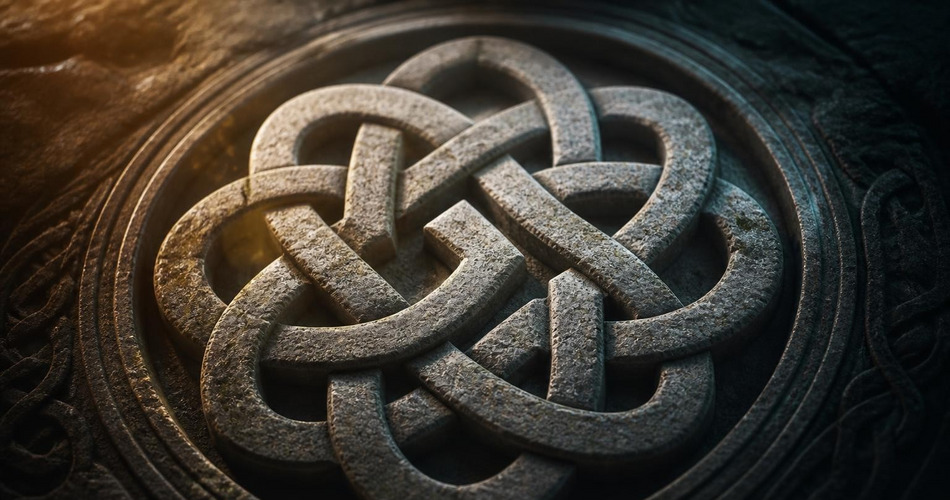
In Celtic culture, intricate knotwork adorns stone crosses and illuminated manuscripts like the Book of Kells. The unbroken line of a Celtic knot represents eternal life, the unity of spirit and nature, and the seamless weaving of past, present, and future. These patterns often lack a clear start or end, reinforcing the idea of infinity.
In Buddhism, the “endless knot” (śrīvatsa) is one of the Eight Auspicious Symbols. It symbolizes the interweaving of wisdom and compassion, the cyclical nature of samsara, and the unity of all phenomena. The knot’s closed circuit conveys the permanence of the Buddha’s teachings.
In many African traditions, knots hold spiritual power. The Nkisi power figures of the Kongo people often incorporate knots to bind spiritual forces. In West African Adinkra symbols, the “Gye Nyame” knot represents the supremacy of God and the interconnectedness of all creation. Among the Yoruba, the knot (ògún) is associated with Ogun, the god of iron and war, signifying binding oaths and protective bonds.
Spiritual Meaning of Knots
Spiritually, knots often serve as metaphors for the soul’s journey. The act of tying a knot can represent making a commitment to a spiritual path, while untying a knot symbolizes release from karma or earthly attachments. In meditation practices, the endless knot is used as a focus for contemplating the unity of existence and the flow of energy without beginning or end.
In some traditions, knots are used in prayer. For example, prayer beads—such as the Buddhist mala or the Catholic rosary—often have knots between beads to count prayers and to symbolize the binding of one’s intentions to the divine. The endless knot in Tibetan Buddhism is considered a powerful protective symbol, often worn as amulets or painted on temple walls.
Knots in Myths and Folklore
The Gordian knot is the most enduring mythic knot. According to legend, an ox‑cart bound by an intricate knot was dedicated to Zeus in Gordium. An oracle declared that whoever could untie it would rule Asia. Many tried and failed until Alexander the Great, who simply cut the knot with his sword, fulfilling the prophecy. This story has become a symbol of audacious problem‑solving.
In Norse mythology, the Valknut—a symbol of three interlocking triangles—is often interpreted as a knot associated with Odin and the slain warriors. It likely represents the transition between life and death and the binding of fate. In Greek myth, Heracles tied a knot (the “Heracles knot”) that no one could undo, which later became a symbol of marriage and fidelity, often used in ancient wedding girdles.
In folklore, knots have been used in protective magic. Sailors would tie special knots to ensure safe passage; in the British Isles, “witches’ knots” were woven into hair or fabric to ward off evil. Conversely, knots could be employed in cursing—tying a knot and speaking an ill wish was believed to bind misfortune to a person.
Knots in Dreams
In dream interpretation, knots commonly reflect feelings of entanglement or captivity. A dreamer may be struggling with a complicated relationship, a stubborn problem, or an emotional tangle. The state of the knot in the dream—whether it is being tied, untied, or cut—can indicate the dreamer’s ability to resolve these issues.
Common Dream Scenarios
- Tying a knot: May signify the dreamer is making a commitment, such as a promise or a marriage, or creating a permanent bond.
- Untying a knot: Suggests a breakthrough or the resolution of a long‑standing conflict; a sense of liberation.
- Cutting a knot: Reflects a decisive, even drastic, solution to a problem—similar to Alexander’s approach—or a desire to end a relationship or obligation.
- Finding a knot that cannot be untied: Indicates frustration, a feeling of being trapped, or a situation that seems hopeless.
- A knot that breaks: May represent a broken agreement or a failure of support, leading to disappointment.
Knots in Superstitions and Omens
Superstitions surrounding knots are widespread. In many European traditions, a bride’s wedding dress was sewn with knots to protect her from evil spirits, and the “love knot” was exchanged as a token of eternal affection. “Tying the knot” remains the most common idiom for marriage, reflecting the idea of an unbreakable union.
Folk magic often used knots to bind or release. In some parts of England, a pregnant woman would avoid tying knots to prevent complications in childbirth. Sailors considered certain knots (like the “Turk’s head” knot) to bring good luck and protection at sea. In contrast, finding a knotted string or hair was believed to be a sign of a curse or a witch’s work.
In many cultures, giving a knotted cord as a gift symbolizes a wish for the recipient’s health, prosperity, or unity. The Mayan huipil (woven blouse) often features knotted patterns that convey the weaver’s prayers and intentions.
Knots in Art and Literature
In visual art, Celtic knotwork is perhaps the most famous expression, appearing in the Lindisfarne Gospels and the Book of Kells. These elaborate interlacing patterns serve both decorative and symbolic purposes, emphasizing continuity and the sacred order of the universe.
In literature, the image of the knot appears frequently. In Shakespeare’s Henry V, the king speaks of “the knot of peace” to describe the unification of England and France through marriage. In Moby‑Dick, Herman Melville devotes a chapter to knot‑tying as a metaphor for the entanglement of fate and human endeavor. The Gordian knot is referenced in countless works, from Alexander Pope’s poetry to modern fantasy novels, as a symbol of a problem that requires bold action.
In modern film, the theme of “tying the knot” is central to romantic comedies, while the act of untying or cutting a knot often marks a decisive plot turn (e.g., in The Lord of the Rings, the breaking of the One Ring is akin to cutting the knot of Sauron’s power). Knots also feature in postmodern art, such as the rope installations of Janine Antoni, which explore themes of labor, connection, and constraint.
Knot Tattoo Meaning
Knot tattoos are popular for their aesthetic and symbolic depth. The Celtic knot tattoo is one of the most common, chosen to represent eternity, heritage, and the interconnectedness of life. Many wear it as a symbol of faith or as a memorial to a loved one, since the unending line implies that the bond continues beyond death.
The endless knot tattoo, especially in Tibetan Buddhism, signifies wisdom, compassion, and the cycle of rebirth. It is often placed on the wrist or back as a protective charm. The “love knot” tattoo, featuring two intertwined loops, directly represents a romantic bond or a promise of fidelity. Sailors traditionally tattooed the “Turk’s head” knot for good luck and safe return from voyages.
Simpler knot designs, such as the barrel knot or the figure‑eight, may be chosen for their geometric beauty or as a personal reminder of a specific commitment (e.g., sobriety, marriage). The versatility of knot patterns allows for highly individualized meanings while retaining universal themes of unity and endurance.
Meanings of Different Types of Knots
- Celtic knot: Symbolizes eternity, the connection between heaven and earth, and the cycle of life, death, and rebirth.
- Endless knot (Buddhist): Represents the interweaving of wisdom and compassion, the infinite nature of enlightenment, and the unity of all phenomena.
- Love knot: Traditionally exchanged between lovers as a pledge of eternal affection; also appears in wedding ceremonies.
- Gordian knot: Symbolizes a complex problem that requires an unconventional or bold solution; often used in leadership contexts.
- Valknut: Associated with Norse mythology, this knot of three interlocked triangles symbolizes the transition between life and death, the power of Odin, and the honor of warriors.
- Quipu knot: Used by the Inca for recording data; each knot’s position and twist holds specific numeric or narrative meaning.
- Fisherman’s knot: A practical knot that joins two lines; symbolically represents trust, skill, and the union of two forces.
Frequently Asked Questions
Q: What does a knot symbolize in a dream?
A: Knots in dreams often reflect feelings of entanglement, unresolved problems, or commitments. Tying a knot may indicate a new bond, while untying suggests liberation. Cutting a knot points to a decisive or drastic solution.
Q: What is the spiritual meaning of a knot?
A: Spiritually, knots represent unity, eternity, and the binding of intention. The endless knot in Buddhism signifies the interconnectedness of all things, while in many traditions, tying a knot is a ritual act of commitment or protection.
Q: Why is a knot a symbol of marriage?
A: The phrase “tying the knot” originates from the ancient practice of physically tying the hands of a bride and groom together (handfasting) to seal their union. The knot symbolizes an unbreakable bond of love and fidelity.
Q: What does a Celtic knot tattoo mean?
A: A Celtic knot tattoo typically symbolizes eternal life, heritage, and the interconnectedness of all things. The unbroken line of the knot represents continuity and the absence of a beginning or end.
Q: Are knots used in superstitions?
A: Yes. Knots have been used in folk magic both for protection (e.g., sailor’s knot charms) and for cursing. Many cultures consider knotting during pregnancy or weddings to be powerful, with specific actions tied to good or bad omens.
Related Symbols
- Endless knot – Direct variation, central to Buddhist iconography.
- Celtic cross – Often incorporates knotwork; symbolizes faith and eternity.
- Chain – Like a knot, represents connection and binding, but with a linear, flexible quality.
- Spiral – Shares themes of continuity and infinite path, especially in Celtic art.
- Labyrinth – A symbolic path with knots of twists and turns; represents a complex journey.