Briefly
Amber is fossilized tree resin, not stone, yet it has been treasured for thousands of years as a gem-like material with a warm, golden translucence. It symbolizes endurance because it preserves fragments of ancient life, protection because it was worn as an amulet against harm, and vitality because of its sun-like color and perceived healing warmth. Across Europe and Asia, amber has been linked to the sun, to the sea, and to grief, making it one of the most layered natural symbols in human culture.
What Does Amber Symbolize?
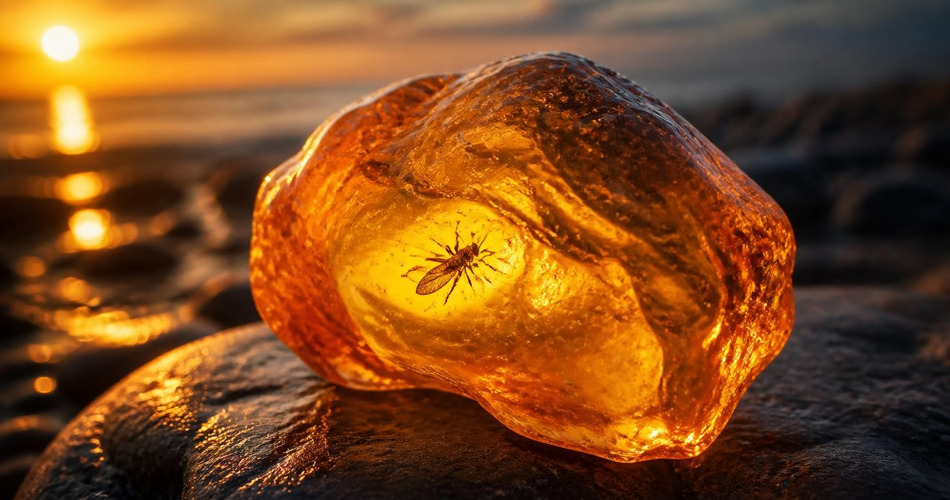
Amber primarily symbolizes endurance. Because it forms over millions of years from resin that has hardened and fossilized, amber carries a sense of deep time. Holding a piece of amber can feel like touching a moment from the distant past, especially when it contains an ancient insect or plant inclusion.
Amber is also a symbol of protection. From ancient Mediterranean amulets to Baltic folk charms, amber was believed to guard the wearer against illness, envy, and misfortune. Its warm, honey-like color connects it to the sun, and the sun itself has long been regarded as a life-giving, protective force.
In addition, amber represents warmth and healing. It is slightly warm to the touch, unlike most stones, and this physical quality reinforced its reputation as a comforting, revitalizing material. Many cultures used amber in jewelry and medicine alike, treating it not merely as decoration but as a substance that could restore balance and well-being.
Positive and Negative Meanings of Amber
Positive associations: Amber is linked with protection, longevity, vitality, and emotional warmth. It is believed to absorb negative energy, calm the mind, and remind the wearer of the enduring beauty of nature. Its warm glow has made it a symbol of hope, joy, and the life-giving power of the sun.
Negative meanings: Because amber is soft and can be easily scratched or burned, it has sometimes symbolized fragility despite its age. Its association with the past can also lean toward melancholy, as a reminder of what has been lost or preserved in time. In some folk traditions, amber was connected to tears, binding it to grief and mourning as well as to beauty.
History and Origins of Amber Symbolism
The story of amber symbolism begins with its physical origin. Amber is produced when resin oozes from certain trees, especially conifers, and undergoes polymerisation over millions of years. The oldest amber deposits are around 320 million years old, while the most famous sources, such as the Baltic region, formed roughly 40 to 60 million years ago.
Prehistoric people valued amber not only for its appearance but also for its strange properties. When rubbed, amber becomes electrically charged and attracts small lightweight objects. The ancient Greek word for amber was elektron, from which the word electricity is derived. This mysterious behavior gave amber an aura of magic and made it seem alive or animated.
Amber was traded across vast distances long before written history. Baltic amber has been found in Egyptian tombs, Mycenaean graves, and Phoenician settlements, showing that it was one of the earliest luxury goods in Europe and the Mediterranean. Its presence in burial sites suggests it was not only a sign of wealth but also a material with religious or protective meaning.
Amber Symbolism in Different Cultures
In Baltic cultures, amber has been called Lithuanian gold and Baltic sea gold, and it is deeply woven into national identity and folklore. The sea often washes amber onto the shores of Lithuania, Latvia, and Poland, which is why many Baltic legends describe amber as a gift from the sea or as the tears of a sea goddess.
In ancient Greece and Rome, amber was associated with the sun and with precious metal. The myth of Phaethon, the son of the sun god Helios, told how his sisters wept and were transformed into poplar trees, with their tears turning into amber. This legend made amber a symbol of grief transfigured into beauty.
In Chinese culture, amber is associated with the tiger soul because of its rich golden-orange colours. In traditional Chinese belief, amber was thought to contain the spirit of the tiger, giving the wearer courage and protection. It has also been used in powdered form as an ingredient in traditional medicine.
In the Middle East and North Africa, amber has been used for amulets and prayer beads. The warm, translucent material is considered purifying and soothing, and it has been worn for centuries as a marker of status and spiritual devotion.
Spiritual Meaning of Amber
In spiritual and metaphysical traditions, amber is regarded as a grounding and cleansing stone. It is said to carry the energy of the sun, helping to melt away heavy emotions and restore lightness of spirit. Because it is organic, it is sometimes described as a bridge between the plant kingdom and the mineral kingdom.
Amber is also connected with memory and ancestral wisdom. Its ability to preserve ancient life forms makes it a natural emblem of remembrance and continuity. Many people use amber in meditation to connect with the past, release emotional baggage, and gain clarity about long-standing patterns.
In crystal healing practices, amber is associated with the sacral chakra and the solar plexus chakra, areas linked to creativity, personal power, and emotional balance. It is often recommended for soothing stress, encouraging patience, and promoting a positive outlook.
Amber in Myths and Folklore
One of the most famous amber myths comes from Greek mythology. According to the story, Phaethon, the mortal son of Helios, tried to drive his father’s sun chariot and lost control, plunging the earth into chaos. Zeus struck him down, and Phaethon’s grieving sisters, the Heliades, were turned into poplar trees beside the river Eridanos. Their tears, streaming into the river, hardened into drops of amber.
Lithuanian folklore tells a different tale. The sea goddess Jūratė fell in love with a mortal fisherman named Kastytis, and when her underwater amber palace was destroyed because of their forbidden love, pieces of it washed ashore as amber. The fragments, still found on Baltic beaches, are considered remnants of the goddess’s broken home and a reminder of tragic love.
In many folk traditions, amber was burned as incense or placed in sickrooms to purify the air and drive away evil spirits. Its pleasant, pine-like scent when heated added to its reputation as a cleansing substance, and it was often combined with herbs in protective rituals.
Amber in Dreams
Dreams of amber are usually interpreted in relation to its symbolic qualities of preservation, warmth, and protection. Because amber holds things in perfect arrested time, dreaming of amber can point to a desire to preserve something valuable, whether a memory, a relationship, or a phase of life.
Amber in a dream may also serve as a reminder of one’s inner strength. Its golden glow can reflect personal vitality and confidence, while its ancient origins suggest that the dreamer carries wisdom from past experience. On the emotional level, an amber dream can signify healing and the release of sadness.
Common Amber Dream Scenarios
- Finding amber on a beach: Often seen as a sign of unexpected good fortune, hidden talents, or a valuable opportunity that has been washed up by time.
- Wearing amber jewelry: May indicate a need for emotional protection, self-confidence, or a reminder to carry warmth and kindness in daily life.
- An amber gem containing an insect: Can symbolize something from the past that is still present, a memory that has been perfectly preserved, or a lesson that must be examined closely.
- Breaking or losing amber: Often linked to fears about losing something precious, the end of a period of safety, or the need to let go of an old emotional attachment.
- Receiving amber as a gift: Tends to represent loyalty, affection, and the transfer of protective energy from the giver to the dreamer.
Amber in Superstitions and Omens
Amber has long been considered a protective amulet against negative forces. In many European folk traditions, amber beads were placed around the necks of infants to shield them from evil spirits and illness. The translucent stone was also hung in homes to ward off fire because its warm colour was believed to repel flame.
In some regions, amber was thought to change colour in response to a wearer’s health. If the amber darkened, it was said to be absorbing sickness or misfortune; if it became dull, danger was near. These beliefs reinforced amber’s role as a barometer of well-being.
Amber was also used in love divination. In some folk customs, a piece of amber was thrown into a fire: if it burned brightly and quickly, the love was true, but if it smouldered and smoked, the affection was uncertain. This practice blended amber’s connection with the sun, with warmth, and with emotional sincerity.
Amber in Art and Literature
Amber appears in several significant works of literature. In the Odyssey, Homer mentions amber as a precious gift presented to Penelope, an early sign of its status as a luxury material in the ancient Mediterranean world.
One of the most famous artistic uses of amber is the Amber Room, an 18th-century chamber in the Catherine Palace in Russia, decorated with panels of amber, gold leaf, and mirrors. Although the original was looted during World War II and disappeared, reconstructed in 2003, the Amber Room remains a legendary testament to the material’s beauty and cultural importance.
In modern literature, amber is often used as a symbol of time and memory. For example, in the poetry of the Polish writer Czesław Milosz, amber and the Baltic landscape appear as emblems of a fragile, layered identity, connecting personal memory to the deep history of a region. More broadly, the image of an insect trapped in amber has become a widely used metaphor in fiction for time being frozen and secrets being preserved.
Amber Tattoo Meaning
Amber tattoos are chosen for their connection to permanence and protection. A tattoo depicting an amber stone, or an insect preserved in amber, often represents a person’s ability to hold onto important memories while continuing to grow.
The golden-orange colour of amber tattoos also gives them a warm, radiant feel. People who choose amber motifs frequently see them as symbols of resilience, inner strength, and the positive energy that can be drawn from difficult experiences.
Amber Types and Variations
- Baltic amber: The most famous variety, formed about 44 million years ago and known for its rich range of yellows, oranges, and rare blue-green tones.
- Dominican amber: Generally clearer and often containing more inclusions; it also includes the very rare blue amber, which fluoresces blue under sunlight.
- Burmese amber: One of the oldest forms, around 99 million years old, and prized for its deep reddish and brown hues.
- Green amber: A darker, more opaque variety that occurs in the Caribbean, sometimes called green amber for its olive or forest tones.
- Bone amber: An opaque, chalky-looking form created by many tiny air bubbles; it was historically popular for beads and amulets.
- Pressed amber: Made by fusing smaller pieces under heat and pressure; it is still genuine amber, though less valuable than solid natural pieces.
Frequently Asked Questions About Amber Symbolism
Q: Is amber actually a stone?
A: No, amber is fossilized tree resin, not a mineral. It is organic in origin, which is why it is soft, lightweight, and warm to the touch.
Q: What does amber symbolize spiritually?
A: Spiritually, amber symbolizes the sun, vitality, purification, and the preservation of memory. It is often used for grounding, emotional healing, and connecting with ancient wisdom.
Q: Why is amber associated with protection?
A: Amber has been worn as an amulet for thousands of years. Its warm glow and association with the sun made it seem naturally protective, and its electrostatic charge appeared magical to ancient peoples.
Q: Does real amber have healing properties?
A: In folk medicine and modern alternative practices, amber is believed to soothe pain and inflammation, particularly in teething babies, though there is no strong scientific evidence supporting these effects.
Q: Why does amber sometimes contain insects?
A: Sticky resin can trap small organisms before it hardens. Over millions of years, the resin fossilizes and preserves the remains, creating the inclusions for which amber is famous.
Related Symbols
- Sun: the celestial source of amber’s warmth and golden glow
- Honey: another golden natural substance associated with preservation and sweetness
- Gold: the metal amber is often compared to in colour and value
- Resin: the raw tree substance from which amber is formed
- Fossils: reminders of deep time and the preservation of ancient life
- Sea: the force that brings Baltic amber to shore in legend and reality