The onion is a symbol of hidden depth, layered meaning, and concealed truth. Its many concentric skins suggest that understanding comes gradually, one layer at a time, and that what appears simple on the surface often holds complexity beneath. At the same time, the onion’s ability to bring tears and its sharp, pungent nature connect it to sorrow, purification, and emotional release. Across cultures and centuries, it has represented protection, healing, resilience, and the cyclical nature of life and death.
What Does Onion Symbolize?
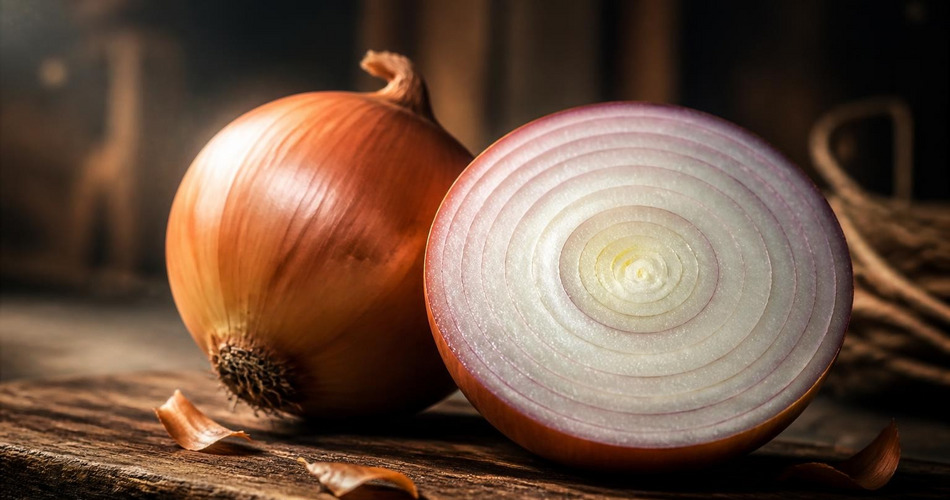
At its core, the onion symbolizes **hidden layers**. Just as peeling an onion reveals more and more concentric rings, the onion has become a metaphor for uncovering truths about oneself, others, or a situation. This makes it a powerful emblem of introspection and self-discovery: each layer you remove brings you closer to the center, to the essential core of a matter.
The onion also represents protection. Its pungent aroma and sharp taste have historically been believed to ward off evil spirits, illness, and even vampires in some folk traditions. In many cultures, onions were hung in homes or worn as amulets to guard against negative influences — a practice that blends practical preservation with symbolic defense.
Because the onion can be stored for long periods and still sprout anew, it also carries meanings of resilience, endurance, and renewal. In ancient Egypt, its spherical shape and internal rings suggested eternity, and onions were placed in tombs alongside the dead. This association with the afterlife, combined with its ability to regenerate, makes the onion a quiet symbol of the cycle of life, death, and rebirth.
Positive and Negative Meanings of Onion Symbolism
Positive associations: The onion stands for clarity and revelation — the idea that patience and persistence will ultimately expose the truth. It also symbolizes strength, health, and vitality, as onions have been used for centuries in traditional medicine to treat everything from colds to wounds. Its protective qualities are seen as a shield against harm, both physical and spiritual, and its resilience in storage and growth makes it a symbol of endurance and hope.
Negative meanings: The onion is equally tied to sorrow and discomfort. Cutting an onion brings tears to the eyes, making it a natural metaphor for grief, regret, or painful truths that surface unwillingly. The strong odor, which lingers on the hands and breath, has also associated the onion with unpleasantness, secrecy, or something that leaves a mark even after it is gone. In some contexts, the onion’s many layers imply deceit or concealment — a sense that someone or something is not what it appears to be on the surface.
History and Origins of Onion Symbolism
The onion is one of the oldest cultivated vegetables in human history, with origins traced to Central Asia and evidence of its use dating back over 5,000 years. Ancient Sumerian texts and Egyptian tomb paintings depict onions as part of daily diet and religious offerings. In Egypt, the onion’s concentric rings and spherical form symbolized the universe and eternity, and onions were buried with pharaohs to ensure their rebirth in the afterlife.
The ancient Greeks and Romans also valued the onion both as food and symbol. Greek athletes consumed onions before the Olympic Games, believing they improved strength and stamina, while Roman gladiators were said to rub onion juice over their bodies to firm up muscles. In medieval Europe, onions were used as currency, given as gifts, and hung outside doors to protect households from plague and evil spirits. This long history of practical and symbolic use laid the groundwork for the onion’s enduring status as a symbol of strength, health, and occult protection.
Onion Symbolism in Different Cultures
In ancient Egyptian culture, the onion was sacred. Its spherical shape and inner rings represented the cosmos, and its layered structure was seen as a symbol of eternity — a theme reinforced by the onion’s ability to sprout and regenerate. Onions were placed in the hands or over the eyes of mummies, and offerings of onions were made to the gods.
In Roman and Greek traditions, the onion was linked to physical fortitude and warrior virtue. Eating onions was believed to impart strength and courage, and the plant was associated with Mars, the god of war. This martial connection carried into medieval Europe, where onions were given to soldiers before battle and were thought to protect against wounds.
In many Asian cultures, the onion is viewed as a symbol of prosperity and good fortune. In Chinese tradition, onions are sometimes hung in doorways during the New Year to attract wealth and banish misfortune. In Indian folk medicine and Ayurveda, onions are considered warming and purifying, used to balance the body and ward off illness. Across these cultures, the onion’s dual nature — protective and pungent, nourishing and tear-inducing — is consistently recognized.
Spiritual Meaning of Onion
Spiritually, the onion symbolizes the **soul’s journey** toward truth and enlightenment. Just as peeling an onion can bring tears, spiritual growth often involves confronting painful realities and letting go of illusions. The onion teaches that the path to the center — to the divine spark or the essential self — requires patience, honesty, and the willingness to shed layer after layer of ego, pretension, and fear.
In some contemplative traditions, the onion is used as an object of meditation. Its structure mirrors the idea that reality is composed of infinite layers of perception, and that the ultimate truth lies not in any single layer but in the whole. The onion’s ability to regenerate from its own flesh also carries a spiritual message about resurrection and the enduring nature of the spirit, making it a quiet but powerful emblem of faith and hope.
Onion in Myths and Folklore
Onions appear in myths and folklore across the world, often as talismans against evil. In European folklore, onions were hung in homes, barns, and stables to repel witches and ward off the evil eye. The strong odor was believed to confuse or drive away malevolent spirits, and onion braids were sometimes placed under pillows to bring prophetic dreams.
In Greek mythology, the onion was linked to the story of the hero Pelops, whose shoulder blade was said to be made of ivory and was venerated at Olympia. While the onion itself is not central to this myth, onions were used in offerings to the gods, and their pungent nature was thought to carry prayers upward. In Slavic folklore, onions were planted in gardens to protect crops from hail and disease, and were given to newlyweds to ensure a strong and fruitful marriage.
The belief that onions can absorb negative energy persists in various folk practices. Cut onions left in a room were thought to draw out illness, and onion skins were burned to cleanse a space of bad luck. These traditions reflect a widespread cultural intuition that the onion is not just food, but a tool for spiritual hygiene.
Onion in Dreams
Dreaming of onions is often interpreted as a sign that something is being revealed gradually. The dreamer may be in a situation where the full truth has not yet surfaced, or they may be uncovering hidden aspects of their own personality. Peeling an onion in a dream can symbolize self-reflection, the slow process of understanding, or the emotional effort required to get to the heart of a matter.
Onions in dreams can also represent health and vitality, suggesting that the dreamer should pay attention to their physical well-being. Alternatively, the tears caused by onions in a dream may point to suppressed sadness or the need for emotional release. The specific context — whether you are cutting, eating, or receiving an onion — can shift the meaning toward themes of effort, nourishment, or unexpected news.
Common Onion Dream Scenarios
- Peeling an onion: A slow process of discovery; you are getting closer to a truth, but it may bring tears before clarity comes.
- Cutting an onion: Emotional release or the pain of facing something difficult; what you are dealing with may sting, but it is necessary.
- Eating an onion: Strengthening your health and resilience; accepting something sharp or unpleasant for your own good.
- Receiving an onion as a gift: A warning to look deeper into someone’s motives, or a sign that protection is being offered.
- A rotten onion: A situation that looks healthy on the outside but is decaying within; a need to discard something no longer useful.
Onion in Superstitions and Omens
Onions have a long history in superstition and folk magic. In many parts of Europe, it was believed that hanging onions in the kitchen or above the door would protect the household from illness, evil spirits, and even lightning. Onion braids were hung in stables to keep animals healthy and ward off witches.
A common folk practice involved using onions to predict the weather or the future. On St. Thomas Day (December 21), people would cut open twelve onions, one for each month of the coming year, and fill them with salt. The amount of moisture each onion absorbed was said to indicate the rainfall for that month — a tradition that persisted well into the modern era.
In some regions, it was considered unlucky to give an onion as a gift, as it was thought to carry the giver’s troubles. Others believed that dreaming of onions brought good luck, or that rubbing onion juice on the forehead could cure a headache. These varied and sometimes contradictory beliefs demonstrate the onion’s deep entanglement with popular notions of protection, health, and fate.
Onion in Art and Literature
In literature, the onion is frequently used as a metaphor for hidden layers of meaning or character. A famous example appears in A Portrait of the Artist as a Young Man by James Joyce, where the protagonist Stephen Dedalus reflects on the soul and its many layers, drawing an explicit comparison to a peeled onion. The image serves to convey the idea of identity as something built up over time, with each layer concealing a deeper core.
The onion also appears in poetry, most notably in Pablo Neruda’s Ode to the Onion, a celebratory poem that praises the onion’s beauty and power. Neruda describes the onion as a “luminous flask” and a “moon” wrapped in delicate paper, highlighting its inner glow and its ability to bring both tears and flavor to life. This ode captures the onion’s paradoxical nature — at once humble and magnificent, sharp and sweet.
In visual art, onions have been a subject of still-life paintings since the Renaissance, often included as symbols of abundance, domesticity, and the transient nature of earthly goods. Paul Cézanne painted onions in several of his still lifes, using their russet skins and round forms to explore texture and light. In these works, the onion is more than a kitchen object; it carries the weight of tradition, memory, and quiet contemplation.
Onion Tattoo Meaning
Onion tattoos are relatively uncommon, but they carry rich symbolic meaning for those who choose them. Because the onion is associated with layers, a tattoo of an onion can represent a person who values depth and authenticity, someone who believes that true understanding requires peeling away surface appearances. It can also symbolize resilience — the ability to endure hardship and still grow.
In a protective sense, an onion tattoo can serve as a personal amulet, echoing the folk belief that onions ward off negative energy. The design might be rendered simply as a single onion, or more elaborately as a cut onion showing its concentric rings, emphasizing the beauty of inner structure. For some, the onion tattoo is a reminder to embrace the tears and discomfort that come with personal growth, and to keep going until they reach their own center.
Meanings of Different Onion Types and Colors
The color and variety of an onion can refine its symbolic meaning. The red onion, with its deep purple-red skin, is often associated with passion, vitality, and the heart. It is milder in taste than white or yellow onions, and in symbolic terms, it may suggest a gentler approach to truth — a revelation delivered without too much sting.
The white onion is linked to purity, clarity, and simplicity. Its pale flesh and crisp, clean taste reinforce associations with truth and transparency. In some traditions, white onions were used in healing rituals and were considered more “spiritually clean” than their yellow or red counterparts.
The yellow onion, the most common cooking onion, is a symbol of practicality, grounding, and nourishment. Its robust flavor and long storage life connect it to domestic stability and the sustaining power of simple food. In folklore, the yellow onion was often the variety hung in kitchens and above doors for protection, making it the quintessential guardian onion of household folk magic.
Finally, green onions or scallions, which are harvested before the bulb fully forms, symbolize new beginnings, fresh growth, and the early stages of a process. They represent the promise of what is still developing, and are often used in spring celebrations and rituals of renewal across various cultures.
Frequently Asked Questions About Onion Symbolism
Q: What does the onion symbolize?
A: The onion symbolizes hidden layers, concealed truth, protection, resilience, and the cycle of life, death, and rebirth. It also carries associations with sorrow and emotional release because it brings tears when cut.
Q: What does peeling an onion in a dream mean?
A: Peeling an onion in a dream is generally interpreted as a process of gradual discovery — you are uncovering deeper truths about yourself or a situation, though the process may be emotionally challenging.
Q: Are onions a symbol of protection?
A: Yes, in many folk traditions onions are hung in homes, worn as amulets, or placed under pillows to ward off evil spirits, illness, and bad luck. Their pungent odor was thought to repel negative forces.
Q: Why were onions placed in ancient Egyptian tombs?
A: The ancient Egyptians placed onions in tombs because their spherical shape and concentric rings symbolized eternity and the cosmos, and the onion’s ability to regenerate was seen as a promise of rebirth in the afterlife.
Q: What does an onion tattoo mean?
A: An onion tattoo typically represents depth, authenticity, resilience, and the belief that true understanding comes from looking beyond surface appearances. It can also serve as a personal symbol of protection.
Related Symbols
- Garlic — shares the onion’s protective, warding-off-evil associations in folklore.
- Layers — the onion is the archetypal symbol of layered reality and concealed depth.
- Peeling — the act of revealing truth gradually, one skin at a time.
- Shallot — a milder cousin, similarly symbolic of nourishment and hidden flavor.
- Circle — the onion’s concentric rings echo the universal symbol of eternity and wholeness.
- Rebirth — the onion’s ability to sprout and regenerate connects it to renewal and resurrection.