Briefly
The cart is a simple wheeled vehicle that carries goods, people, and harvests, and its symbolism grows out of that everyday work. Across cultures, the cart represents the burdens we bear, the slow progress of honest labor, and the way life moves forward one load at a time. Because it is pulled by animals or people rather than driven by an engine, the cart also evokes dependence, cooperation, and trust. At the same time, carts have long served as vehicles of transition — carrying the dead, the newly married, or the traveler from one state of life to another.
What Does the Cart Symbolize?
The cart is first of all a symbol of transport: it moves crops from the field, goods to market, and families to new places. Because it must be loaded, pulled, and unloaded, it also stands for labor and the patient repetition of daily tasks. In symbolic terms, the cart is a container as much as a vehicle — it holds what we choose to carry, and its weight reminds us that every journey has its costs.
The cart is also a social symbol. Farm carts, wagons, and carriages connect households to wider networks of trade and community. A loaded cart suggests abundance, while an empty one suggests need or departure. In proverbs and stories, the cart often appears in relation to the horse or ox that pulls it, calling attention to balance: what is being pulled, what is doing the pulling, and whether the load is suited to the strength available.
Because carts move slowly and visibly, they symbolize progress that is measured rather than sudden. The cart does not race; it arrives. This makes it an emblem of persistence, patience, and the ordinary heroism of getting things done.
Positive and Negative Meanings
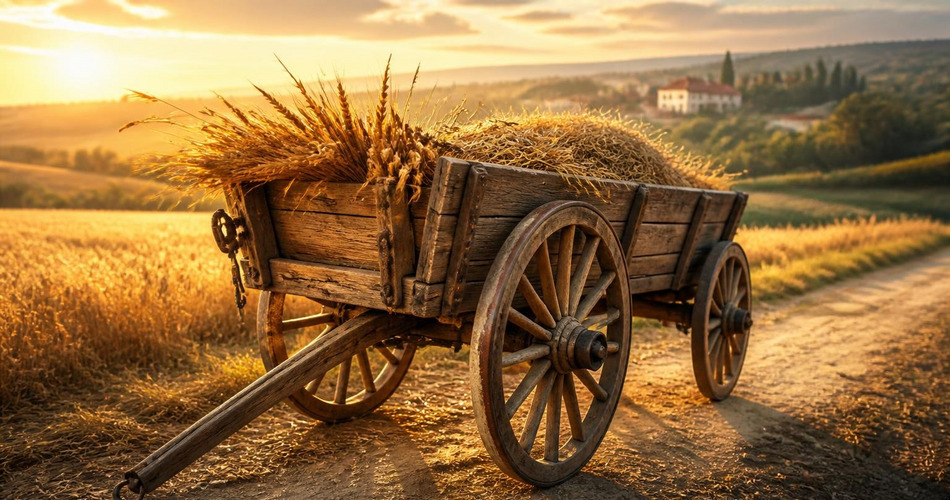
Positive associations: The cart symbolizes productivity, self-reliance, and the rewards of steady work. A fully loaded harvest cart represents abundance and prosperity, while the oxcart and farm wagon stand for humility, endurance, and the dignity of labor. The cart also carries strong meanings of cooperation — a cart moves only when people or animals pull together — and of care, since precious or fragile goods are often entrusted to it.
Negative meanings: The cart can also suggest heaviness, limitation, and being stuck. Its slow pace may symbolize poverty, drudgery, or backwardness in contrast to modern machines. The phrase of being “hitched to a cart” evokes forced labor and lack of freedom, while a broken or overturned cart suggests failure, loss, and plans that have come to nothing. In negative readings, the cart is a burden that must be pulled whether one chooses it or not.
History and Origins of Cart Symbolism
The cart is one of the oldest human inventions, and its symbolism is rooted in the practical history of transport. The earliest wheeled vehicles — solid-wheeled carts and wagons — appeared in Mesopotamia and Europe around 3500 to 3000 BCE, and they were used to carry grain, building materials, and other heavy loads. Because the cart multiplied what a single person or animal could move, it quickly became a symbol of civilization itself: a tool that turned raw effort into surplus, trade, and settled life.
In ancient societies, the cart also took on ritual meaning. Carts were used in religious processions, festivals, and funerals across many cultures. The Greek and Roman worlds both knew sacred carts and chariots associated with deities, while later European folklore preserved the idea of the death cart or the hearse that carries souls. Over time, the wheel of the cart became a symbol of the cycle of life, and the cart itself became an image of the body or the household carrying the soul or family through time.
The cart’s origins in agriculture remain central to its meaning. The farm cart, the hay wagon, and the apple cart all belong to the rhythm of planting and harvest, and in folklore they carry the sense of seasonal return. This agricultural history is why the cart so often symbolizes reward after labor — the harvest is gathered, loaded, and brought home.
Cart Symbolism in Different Cultures
In many European traditions, the farm cart is a symbol of honest work and simple life. The hay wagon appears in rural festivals, wedding processions, and songs as a place of communal joy, while the covered wagon represents migration and the search for a better life, especially in American history where settlers crossed the plains in wagon trains. In these contexts, the cart is not a luxury but a tool of hope and survival.
In South Asia, the bullock cart has been for centuries the primary means of transporting goods and people in villages. It appears in festivals, religious processions, and popular art as a symbol of traditional life, patience, and devotion. Temple carts — large, elaborately decorated wooden chariots pulled by devotees — connect the ordinary cart to the sacred realm, as in the famous Ratha Yatra festival in India, where pulling the deity’s chariot is considered an act of merit.
In Slavic and Baltic folklore, the cart is linked to seasonal cycles. The winter sleigh and the summer wagon mark the changing year, and folk songs often describe the road as a living character. In many peasant cultures, the cart carried not only goods but also the memory of the family, since the same cart might serve for a lifetime, bearing generations to market, church, and grave.
Spiritual Meaning of the Cart
Spiritually, the cart is often understood as a symbol of the soul’s journey and the burden of karma or life itself. The body has sometimes been described as a cart in religious poetry: like a vehicle, it carries the self through the world, requires care and maintenance, and eventually wears out. The idea that the driver must guide the vehicle wisely appears in spiritual teachings that compare the mind to a charioteer and the senses to restless horses.
In this spiritual reading, the cart teaches acceptance of necessary loads. Not every burden is a punishment; some are simply part of the road. The cart also symbolizes faithfulness to one’s duties — the ox does not choose the load but pulls it steadily, and the cart-owner who cares for both animal and vehicle honors the unseen work that keeps life moving. The image of the empty cart, meanwhile, can represent detachment, the state of traveling without clinging to possessions or outcomes.
The Cart in Myths and Folklore
One of the most widespread mythological images is that of the cart or chariot of the sun. In Greek mythology, Helios drives a four-horse chariot across the sky, while in Hindu tradition the sun god Surya rides a seven-horse chariot. These celestial vehicles are divine versions of the earthly cart, carrying light, time, and life across the heavens. The comparison between the daily rising of the sun and the daily labor of the wagoner gives the myth its power: both are dependable, both are necessary, and both sustain the world.
In folklore, carts appear in tales of tricksters, travelers, and supernatural encounters. Many European fairy tales feature a poor peasant with a cart who meets a stranger — often the Devil, Death, or a saint — and must bargain to keep his load or his soul. The cart in these stories is the symbol of the protagonist’s modest world, and what happens to the cart reveals his character. A well-kept cart and a well-treated animal usually signal a good person; a neglected or overloaded cart signals greed or cruelty.
Funerary carts also recur in folklore. The death cart, the black wagon, and the spectral hearse all appear in European legends as omens of death or carriers of souls to the afterlife. In some versions, the cart is driven by a mysterious figure; in others, it is heard but not seen. These tales draw on the real practice of carrying the dead to burial in a cart, turning an everyday object into a symbol of the final journey.
The Cart in Dreams
In dream interpretation, a cart generally represents the dreamer’s responsibilities, resources, and progress through daily life. Because the cart is slow and visible, it often appears when a situation requires patience or when the dreamer feels weighed down by obligations. The condition of the cart, its load, and the animal pulling it all give clues to the dream’s message.
A loaded cart in a dream may indicate that the dreamer is carrying a heavy responsibility, but it can also mean that their efforts are about to bear fruit. An empty cart may suggest a sense of emptiness, a period of waiting, or freedom from burdens — depending on the feeling in the dream. Seeing a cart moving easily suggests that one’s plans are progressing; a stuck or broken cart warns of obstacles, exhaustion, or the need to lighten one’s load.
Common Dream Scenarios
- Driving or leading a cart — you are in control of your daily responsibilities and moving steadily toward a goal.
- Riding in a cart — you are letting others carry the burden, or you are being transported by circumstances rather than directing them yourself.
- A broken or overturned cart — a plan has failed, a burden has become too great, or you need to pause and repair something before continuing.
- An empty cart — a phase of waiting, a sense of loss, or the beginning of a new journey without the old weight.
- An overloaded cart — you have taken on too much and need to set some things down.
- A cart pulled by a struggling animal — your resources or energy are being stretched beyond their limits.
- Unloading a cart — finishing a task, sharing a burden, or releasing something you have carried for a long time.
The Cart in Superstitions and Omens
In European folk belief, meeting a cart on the road could carry lucky or unlucky meanings depending on how it was loaded. A full cart was generally a good omen, especially if it was carrying grain or hay, because it promised abundance. An empty cart, by contrast, was sometimes read as a sign of loss or disappointment. The direction the cart traveled and the animal pulling it also mattered: a black horse drawing a cart was associated with funerals and could be seen as a warning.
Wedding customs gave the cart a protective role. In many rural communities, the newly married couple was driven home in a decorated wagon or cart, and the condition of the journey was believed to foreshadow the marriage. If the cart moved smoothly, the marriage would be happy; if it broke down, the couple might expect difficulties. In some regions, people also placed special objects under the cart or on the wheels to ward off misfortune.
The Cart in Art and Literature
One of the most famous literary carts is the hay wagon in English art. The painting The Hay Wain by John Constable (1821) shows a horse-drawn hay cart crossing a river in the Suffolk countryside. The picture has become an enduring symbol of rural England, calm, tradition, and the beauty of ordinary agricultural life. The same title was used by the poet Robert Browning as The Pied Piper of Hamelin is unrelated, but the image of the wain itself recurs across English poetry as a symbol of harvest and home.
William Faulkner’s novel As I Lay Dying (1930) centers on a family’s journey to bury their mother, transporting her coffin in a wagon. The cart-like wagon becomes the novel’s central symbol: it carries both a literal body and the emotional weight of the family, and the long, difficult journey exposes every character’s true nature. In this modern work, the ancient symbolism of the funeral cart is renewed for a contemporary setting.
The tarot card known as The Chariot is a related image. Although it depicts a chariot rather than a farm cart, it draws on the same symbolism of controlled movement, willpower, and the carrying of a purpose. In popular culture, the covered wagon of Western films — as in John Ford’s Stagecoach (1939) — represents the American journey westward, community under pressure, and the courage of ordinary travelers.
The Cart in Tattoo Meaning
Although less common than anchors, skulls, or roses, the cart appears in tattoo art as a symbol of rural roots, hard work, and the journey of life. A farm cart or wagon tattoo often honors family heritage, especially for people whose ancestors were farmers, tradespeople, or migrants. The covered wagon is a popular choice for those who value independence, adventure, or the pioneering spirit.
In tattoo design, the cart is frequently combined with other symbols to sharpen its meaning: wheat or hay for abundance, a setting sun for the end of a journey, or flowers for growth and memory. A broken or abandoned cart tattoo may represent a past burden that has been laid down. The cart’s slow, steady character makes it a fitting symbol for resilience — the quiet strength to keep moving even when the road is long.
Meanings of Different Types of Carts
- Farm cart or hay wagon — harvest, abundance, seasonal cycles, and the dignity of agricultural labor.
- Covered wagon — migration, pioneering, hope for a new life, and the endurance of travelers.
- Oxcart or bullock cart — traditional life, patience, humility, and the partnership between humans and animals.
- Funeral cart or hearse — death, the passage of the soul, and the final journey.
- Ceremonial or temple cart — devotion, community, and connection between the human and the divine.
- Handcart — personal responsibility, self-reliance, and carrying one’s own weight.
- Merchant’s cart — trade, exchange, and the circulation of goods and ideas.
Frequently Asked Questions
Q: What does a cart symbolize in general?
A: A cart generally symbolizes work, transport, and the carrying of burdens. It represents steady progress, the harvest of one’s efforts, and the journey of life itself.
Q: What does seeing a cart in a dream mean?
A: In dreams, a cart usually points to your responsibilities and how you are managing them. The cart’s load, condition, and movement reveal whether you feel burdened, supported, or in control of your direction.
Related Symbols
- Wheel — the moving part of the cart; represents cycles, time, and progress.
- Chariot — a faster, ceremonial relative of the cart; symbolizes willpower and victory.
- Road — the path the cart travels; symbolizes the course of life.
- Ox or horse — the pulling animal; symbolizes strength, endurance, and partnership.
- Harvest — the load the cart carries; symbolizes reward after labor.
- Burden — what the cart holds; symbolizes responsibility and the weight of obligations.