Briefly
Bracelets are among the oldest forms of personal adornment, worn across cultures for thousands of years. They symbolize a range of meanings including protection, status, love, and spiritual connection. As a versatile accessory, a bracelet can represent a personal bond, a talisman against harm, or a marker of identity and belonging.
What Does Bracelet Symbolize?
At its core, a bracelet is a circular band worn around the wrist, and its shape naturally evokes ideas of continuity, unity, and eternity. Because it encircles the wrist—a pulse point—it is often associated with life force and vitality. Bracelets serve as powerful personal symbols: they can mark a milestone, express a belief, or simply enhance beauty.
Common symbolic meanings include protection (as in evil eye or charm bracelets), love and friendship (friendship bracelets, promise bracelets), status and wealth (gold bangles, jade cuffs), healing (magnetic or gemstone bracelets), and identity (medical alert bracelets, religious beads). The material, color, and design all contribute to the specific message a bracelet conveys.
Positive and Negative Meanings of Bracelets
Positive associations: Bracelets are widely seen as tokens of affection, protection, and good fortune. They can strengthen social bonds, as with friendship bracelets exchanged between peers, or serve as spiritual tools, like mala beads used in meditation. Many people wear bracelets to attract positive energy, ward off negativity, or remind themselves of a personal goal.
Negative meanings: In some contexts, bracelets can symbolize vanity, materialism, or ostentation, especially when made of precious metals and worn to display wealth. A broken bracelet is sometimes interpreted as a bad omen or a sign of a broken relationship. Cheap or poorly made bracelets may also carry negative connotations of inauthenticity or harm (e.g., toxic materials).
History and Origins of Bracelet Symbolism
The history of bracelets stretches back to ancient civilizations. In Ancient Egypt, bracelets made of gold, faience, and leather were buried with the dead to protect them in the afterlife. Scarab bracelets symbolized rebirth. In Mesopotamia, cylinder seals were worn as bracelets to authenticate documents and denote authority. The Indus Valley civilization produced intricate shell and bead bracelets, likely used in trade and ritual.
In Ancient Greece and Rome, snake-shaped bracelets (ophidian) represented fertility and eternal life. Roman soldiers wore bracelets (armillae) as military honors. During the Renaissance, bracelets became elaborate fashion statements, often set with gemstones that carried their own symbolic meanings—rubies for passion, sapphires for wisdom.
Bracelet Symbolism in Different Cultures
In India, bangles (churi) are essential for married women, symbolizing marital status, prosperity, and good luck. Glass bangles are especially significant in Bengali traditions. In China, jade bracelets are believed to protect the wearer and promote health; the stone itself symbolizes purity and moral integrity. In many African cultures, cowrie shell bracelets represent wealth and fertility, while beaded bracelets convey tribal identity and social status.
Among Native American tribes, turquoise bracelets are valued for their healing properties and connection to the sky. In Latin America, red string bracelets (often with an evil eye charm) are worn to deflect envy and bring good luck. The Kabbalah red string bracelet, popularized in modern times, is tied to spiritual protection and divine favor.
Spiritual Meaning of Bracelets
Spiritually, the circular form of a bracelet mirrors the cycle of life, death, and rebirth. It is often used as a focus for meditation or prayer. Mala bracelets (108 beads) help count mantras and cultivate mindfulness. Chakra bracelets with seven colored stones aim to balance the body’s energy centers. In Christianity, rosary bracelets aid in prayer and symbolize devotion.
Many believe that gemstone bracelets carry the metaphysical properties of their stones—amethyst for calm, rose quartz for love, black tourmaline for protection. The act of wearing a bracelet can become a personal ritual, anchoring intention and spiritual awareness in daily life.
Bracelets in Myths and Folklore
In European folklore, bracelets were often enchanted objects. A charm bracelet with specific amulets (horseshoe, four-leaf clover, key) was thought to bring luck and ward off witches. In Norse mythology, the goddess Freya owned a famous necklace (Brísingamen), but bracelets also appear in sagas as gifts from kings to warriors, symbolizing loyalty and reward.
In Greek myth, the hero Heracles wore a bracelet given by the queen Omphale, which later became a symbol of his servitude. In many folk tales, a bracelet serves as a token of recognition—a lost heir is identified by a distinctive bracelet left at birth. These stories reinforce the bracelet’s role as a marker of identity and destiny.
Bracelets in Superstitions and Omens
Bracelets are deeply woven into superstitious beliefs worldwide:
- Breaking a bracelet is often considered an ill omen, signaling the end of a relationship or a period of bad luck.
- Red string bracelets (Kabbalah) are worn to protect against the evil eye; they are tied with seven knots while reciting prayers.
- Evil eye bracelets (nazar) are common in Turkey and Greece, believed to reflect harmful glances.
- Charm bracelets accumulate lucky symbols over time; each charm adds a layer of protection or wish fulfillment.
- Giving a bracelet as a gift is thought to transfer protective energy from the giver to the receiver.
Bracelets in Art and Literature
Bracelets appear in art as markers of status, beauty, and narrative. In Renaissance portraiture, bracelets often adorned the wrists of noblewomen. For example, in Hans Holbein the Younger’s portrait of Anne of Cleves (1539), her gold bracelet with pearls signifies her royal wealth and impending marriage. In ancient Egyptian tomb paintings, bracelets are shown as part of funerary regalia, symbolizing protection in the afterlife.
In literature, the bracelet is a recurring motif. Colette’s short story “The Bracelet” (1906) uses a lost bracelet to explore memory, love, and the passage of time. Yoshiko Uchida’s children’s book “The Bracelet” (1993) tells the story of a Japanese American girl who gives a bracelet to her friend before being sent to an internment camp, making the bracelet a symbol of enduring friendship and hope. In film, the bracelet in The Mummy (1999) is a mystical artifact that grants power but also brings a curse, illustrating the dual nature of such objects.
Bracelet Tattoo Meaning
Bracelet tattoos—bands of ink around the wrist—have become popular for their visibility and personal significance. They often symbolize eternity (an unbroken circle), commitment (similar to a wedding ring), or protection (a barrier against negativity). Many people choose bracelet tattoos to commemorate a loved one, a life-changing event, or a personal mantra. Designs range from simple black bands to intricate patterns like Celtic knots, floral vines, or barbed wire, each adding layers of meaning.
Meanings of Different Types, Colors, or Variations of Bracelets
The symbolism of a bracelet shifts with its form and material:
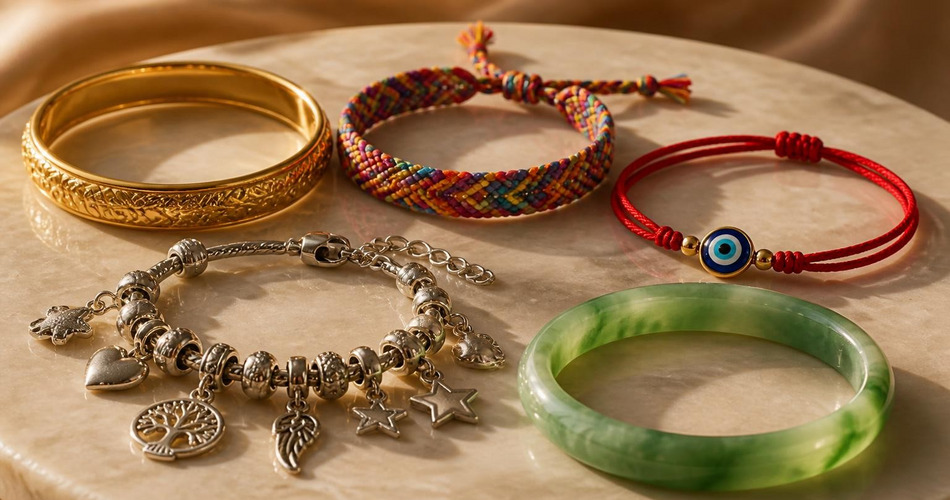
- Charm bracelets – Personal history, storytelling, accumulation of memories.
- Bangles – Cultural identity, marital status, strength (stacked bangles).
- Cuff bracelets – Authority, boldness, protection (open ends can symbolize flexibility).
- Beaded bracelets – Friendship, spirituality (color of beads matters).
- Leather bracelets – Ruggedness, rebellion, connection to nature.
- Metal bracelets (gold, silver, copper) – Wealth, status, healing (copper for arthritis).
Colors also carry meaning: red for love and protection; blue for calm and communication; green for growth and healing; black for power and mourning; white for purity and new beginnings.
Frequently Asked Questions about Bracelets
Q: What does a bracelet symbolize?
A: A bracelet commonly symbolizes protection, love, status, healing, and personal identity. Its circular shape also represents eternity and unity.
Q: What does a broken bracelet mean?
A: In many superstitions, a broken bracelet is considered a bad omen, often interpreted as the end of a relationship or a warning of misfortune. However, some see it as a release of negative energy.
Q: What is the spiritual meaning of a bracelet?
A: Spiritually, a bracelet can serve as a tool for meditation, a reminder of intentions, or a conduit for healing energy. Materials like gemstones and beads are chosen for their metaphysical properties.
Q: Why do people wear red string bracelets?
A: Red string bracelets are worn in Kabbalistic tradition for protection against the evil eye. They are tied with seven knots while reciting a blessing, and the color red is associated with life force and warding off negativity.
Related Symbols to Bracelets
- Necklace – Similar protective and status symbolism, worn around the neck.
- Ring – Circular symbol of commitment, eternity, and union.
- Anklet – Ornament for the ankle, often associated with femininity and marital status.
- Amulet – A protective charm, often worn as a pendant or bracelet.
- Talisman – An object believed to bring good luck and ward off harm.
- Charm – A small symbolic pendant, often collected on a bracelet.