Briefly
The signet ring is a powerful symbol of authority, identity, and personal legacy. Historically used to seal documents and authenticate messages, it represents trust, ownership, and social status. Worn on the finger, it serves as a portable mark of one’s commitment, family lineage, or professional position. Across cultures, the signet ring also carries protective and spiritual meanings, often believed to ward off evil or connect the wearer to ancestral roots.
What Does the Signet Ring Symbolize?
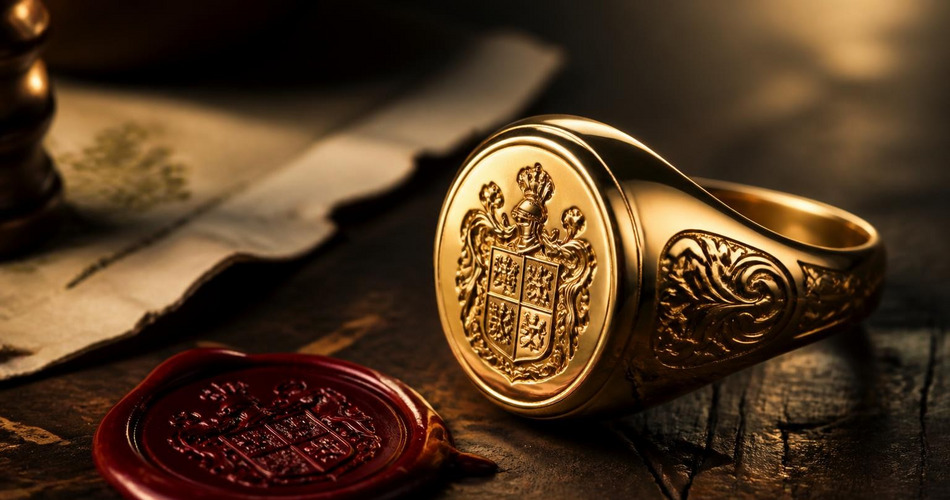
The signet ring primarily symbolizes authority and personal identity. In ancient times, the ring’s engraved design—often a family crest, monogram, or unique emblem—functioned as a signature. Pressing it into wax or clay on a document legally validated the contents, making the ring an extension of the wearer’s will. This act of sealing gave the ring profound meanings of authenticity, trust, and contractual obligation.
Beyond legal and administrative roles, the signet ring also symbolizes heritage and continuity. Passed down through generations, it marks lineage and familial bonds. It can represent membership in a group, such as a guild, fraternity, or royal house, indicating belonging and shared values. In modern contexts, it often signifies personal achievement or a rite of passage, such as reaching adulthood or completing an education.
Positive and Negative Meanings
Positive associations: The signet ring conveys authority, trustworthiness, and legacy. It empowers the wearer with a sense of identity and purpose, often serving as a tangible link to family history or professional honor. Its use in sealing documents historically ensured privacy and integrity of communication, reinforcing values of honesty and commitment.
Negative meanings: In some contexts, the signet ring can represent rigid hierarchy, elitism, or exclusion, as it historically belonged to the privileged classes. It may also symbolize secrecy or deception when used to forge documents or conceal identity. In a darker sense, it can be associated with authoritarian control or the abuse of power by those who wield it.
History and Origins of Signet Ring Symbolism
The origins of the signet ring date back to ancient Mesopotamia around 3500 BCE, where cylinder seals were rolled over clay to mark ownership. By the time of the Egyptians and Greeks, rings with engraved bezels became common. The Egyptian scarab signet ring, for example, combined the beetle motif (a symbol of rebirth) with practical sealing function. In ancient Rome, the signet ring—or anulus signatorius—was worn by all levels of society, though only freeborn citizens could wear gold versions. Slaves wore iron rings, highlighting social hierarchy.
During the Middle Ages in Europe, signet rings became essential for nobles and clergy. They were used to seal official documents, including royal decrees and papal bulls. The ring’s design often reflected the wearer’s coat of arms, and destroying a signet ring after the owner’s death symbolized the end of an era. The practice continued into the Renaissance, with signet rings evolving into personal jewelry that blended function with fashion.
Signet Ring Symbolism in Different Cultures
In Chinese history, signet rings (often called chops or seals) were carved from jade, ivory, or wood and used to stamp documents. They symbolized bureaucratic authority and were essential for legal and administrative processes. The Emperor’s seal was a symbol of supreme power and could not be counterfeited.
In Jewish tradition, the signet ring appears in biblical narratives. Judah gave his signet ring as a pledge to Tamar (Genesis 38), indicating the ring’s value as a personal identifier. In the story of Joseph, Pharaoh gave Joseph his signet ring to invest him with authority over Egypt (Genesis 41:42), underscoring the ring as a symbol of delegated power.
In Islamic culture, signet rings were worn by the Prophet Muhammad and his followers. Early Islamic rings often bore inscriptions of religious phrases, serving both as personal identifiers and as talismans for protection. They emphasized personal piety as well as social standing.
Spiritual Meaning of the Signet Ring
Spiritually, the signet ring is often seen as a protective amulet. Its circular shape symbolizes eternity and the unbroken cycle of life, while the engraved emblem is thought to carry the owner’s spiritual essence. In esoteric traditions, wearing a signet ring with a specific symbol—such as a pentagram or astrological sign—can focus one’s intentions and amplify personal power.
In some beliefs, the signet ring acts as a conduit between the physical and spiritual worlds. It is used in rituals to seal pacts, consecrate objects, or invoke divine protection. The act of stamping the ring represents the imprinting of one’s spiritual will upon matter, making it a tool for manifestation and affirmation.
Signet Ring in Myths and Folklore
In Greek mythology, the ring of Gyges granted its wearer invisibility, exploring themes of power and morality. While not a signet ring in the strict sense, it shares the idea of a ring conferring extraordinary abilities. In Norse legend, the ring Draupnir (owned by Odin) dripped new rings every ninth night, symbolizing abundance and cyclical renewal.
In European folklore, signet rings were often enchanted. Tales tell of rings that could reveal the truth, break curses, or protect their wearers from harm. A common motif is the ring being used as a test of loyalty: a lover gives their signet ring to a partner, and its presence or absence determines fidelity. These stories highlight the ring’s role as a symbol of trust and connection.
Signet Ring in Dreams
Dreaming of a signet ring often relates to personal identity, authority, or unresolved commitments. For many, it reflects the dreamer’s sense of self-worth or their role in a social or familial structure. The condition of the ring—whether intact, broken, or lost—can indicate feelings of empowerment or insecurity.
Common Dream Scenarios
- Receiving a signet ring: May symbolize gaining new responsibilities, recognition, or a sense of belonging to a group or family.
- Losing a signet ring: Often reflects fear of losing status, identity, or a meaningful relationship. It may point to feelings of inadequacy or disconnection.
- Wearing a signet ring with a clear emblem: Suggests the dreamer is confident in their identity and values, or is seeking clarity about their purpose.
Signet Ring in Superstitions and Omens
In Western superstition, a signet ring that breaks or falls off is considered an omen of misfortune or betrayal. Conversely, finding a signet ring is thought to bring good luck and a boost in social standing. In some traditions, passing a signet ring through a wedding ring before giving it to a child is believed to transfer protective energy. The ring’s power is often tied to the seal it bears; a ring engraved with a family crest is thought to carry the good fortune of the ancestors.
Signet Ring in Art and Literature
In Shakespeare’s The Merchant of Venice, the plot revolves around a signet ring given by Portia to Bassanio, which he later gives away. The ring symbolizes marital fidelity and the consequences of broken promises. In J.R.R. Tolkien’s The Lord of the Rings, the One Ring, though not a signet ring, shares the concept of a ring as an object of immense power and identity.
In visual art, signet rings appear in Renaissance portraits of nobility, where they denote status and lineage. For example, in Hans Holbein’s portrait of Thomas More, the sitter wears a signet ring, reinforcing his position as a trusted advisor. In modern film, signet rings are used as plot devices in mystery and espionage stories, where they serve as keys to secrets or markers of allegiance.
Meanings of Different Types, Colors, or Variations
- Gold signet ring: Traditionally associated with royalty and high status. Gold’s durability and luster enhance the ring’s symbolism of enduring authority and wealth.
- Silver signet ring: Often linked to intuition and purity. Silver rings were historically worn by clergy and scholars, signifying wisdom and spiritual insight.
- Family crest engraving: Represents lineage and pride in one’s heritage. Each crest’s symbols (like lions, eagles, or stars) add layers of meaning—strength, vision, or ambition.
- Monogrammed ring: Personalizes the symbol of identity, emphasizing the individual’s name or initials as a mark of self-expression.
Frequently Asked Questions
Q: What finger should a signet ring be worn on?
A: Traditionally, the signet ring is worn on the pinky finger of the non-dominant hand, as this helps protect the seal from wear. However, in many cultures, it can be worn on any finger that feels comfortable and meaningful.
Q: Can a signet ring be worn by both men and women?
A: Yes, signet rings are worn by people of all genders. Historically, they were more common among men, but today they are a popular unisex accessory, with designs ranging from classic to contemporary.
Q: Do signet rings still hold legal significance?
A: In most modern legal systems, signet rings no longer carry official legal weight. However, they remain powerful personal and cultural symbols, often used in ceremonial contexts or as family heirlooms.
Related Symbols
- Ring – General symbol of eternity, commitment, and cycles.
- Seal – Represents authentication, authority, and confidentiality.
- Family crest – Symbolizes heritage, lineage, and clan identity.
- Amulet – Protective object often worn for spiritual security.
- Coat of arms – Emblem of noble status and family history.