Briefly
The orb is a spherical object that has been used as a symbol across many cultures and eras. It often represents completeness, unity, and the infinite nature of the cosmos. In royal and religious contexts, the orb signifies authority and dominion over the world. Its perfect round shape conveys wholeness, eternity, and the cycle of life, while its use in divination tools like crystal balls adds layers of mystery and foresight.
What Does the Orb Symbolize?
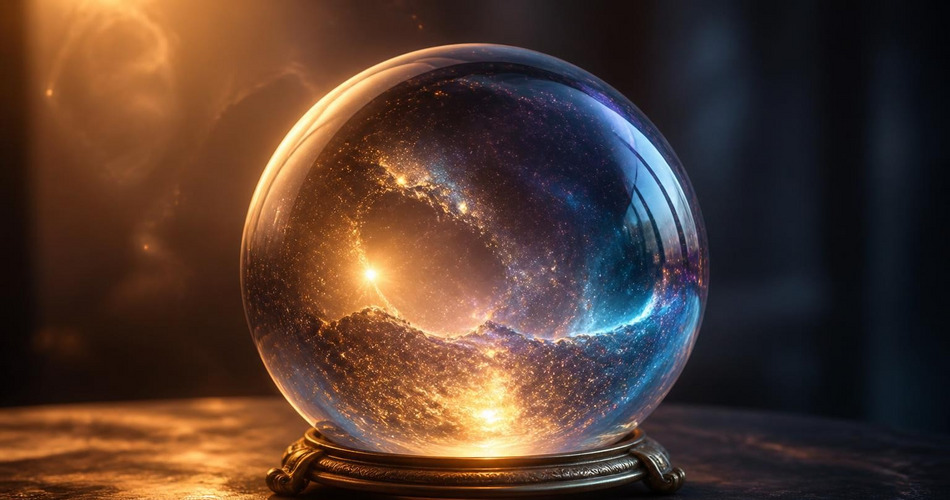
The orb primarily symbolizes completeness and unity. Its unbroken, spherical form has no beginning or end, making it a natural emblem of eternity and the infinite. In many traditions, the orb also represents the cosmos or the universe, encapsulating all of creation within its shape. As a royal object, the orb (often called the globus cruciger) signifies sovereign power and the ruler’s dominion over the earthly realm. Additionally, orbs are associated with foresight and hidden knowledge, especially when used as crystal balls for scrying or divination.
Positive and Negative Meanings
Positive associations: The orb is widely seen as a symbol of wholeness, perfection, and harmony. Its roundness evokes the cycles of nature—birth, death, and rebirth—and the eternal nature of the soul. In religious art, the orb often represents divine authority and the universe under God’s control. As a tool for divination, the crystal orb is linked to insight, clarity, and the ability to perceive hidden truths.
Negative meanings: In some contexts, the orb can symbolize isolation or emptiness, as a sphere is self-contained and separate from its surroundings. The orb’s association with surveillance or control (as in the all-seeing eye) can evoke feelings of being watched or dominated. In literature and film, orbs of power are sometimes portrayed as corrupting or dangerous, representing unchecked authority or forbidden knowledge.
History and Origins of Orb Symbolism
The orb as a symbol of power dates back to ancient Rome, where the globus cruciger—a globe surmounted by a cross—was used to represent the emperor’s authority over the world. This icon was later adopted by Christian rulers in medieval Europe, becoming a standard part of royal regalia alongside the scepter. The orb’s association with the cosmos also has ancient roots: in Greek philosophy, the sphere was considered the most perfect shape, and the universe was often depicted as a series of concentric spheres. In heraldry, orbs appear as charges on coats of arms, symbolizing global influence or universal dominion. The use of crystal orbs for scrying emerged in the Middle Ages, building on earlier traditions of using reflective surfaces for divination.
Orb Symbolism in Different Cultures
In Christian iconography, the orb (often called the globus cruciger) is held by Christ or by monarchs in coronation portraits, signifying Christ’s sovereignty over the world. The orb is also present in depictions of the Holy Trinity, where it represents the unity of the Father, Son, and Holy Spirit. In Buddhist art, the orb can symbolize the jewel of enlightenment or the cosmic egg from which the universe emerges. In Hinduism, the orb is associated with the cosmic egg (Hiranyagarbha) and the cycle of creation and destruction. In Chinese culture, the orb appears in the form of the “flaming pearl,” a symbol of spiritual energy and wisdom, often depicted in the mouths of dragons. In African traditions, spherical objects are used in ritual contexts to represent the sun, the earth, or the cycle of life.
Spiritual Meaning of the Orb
Spiritually, the orb is often seen as a symbol of the soul or the self in its most complete form. Its roundness mirrors the idea of spiritual wholeness and the journey toward enlightenment. In meditation practices, visualizing an orb of light can help focus the mind and connect with higher consciousness. Crystal orbs are used in energy healing and chakra work, where they are believed to amplify intentions and balance the aura. The orb’s association with the cosmos also ties it to the concept of the universe as a living, interconnected whole, reminding individuals of their place within the greater scheme of existence.
The Orb in Myths and Folklore
In Western mythology, the orb appears as the crystal ball of the sorceress or seer, a tool for glimpsing the future. In Arthurian legend, the Holy Grail is sometimes depicted as a glowing orb, though more commonly as a cup. In Norse mythology, the world is said to be created from the body of the giant Ymir, but orbs appear in the form of the sun and moon as divine spheres. In Slavic folklore, the “firebird” is often associated with a glowing orb that grants wishes. In modern fantasy, the palantír (seeing-stones) from J.R.R. Tolkien’s legendarium are orbs that allow communication and vision across distances, often with corrupting influence. These stories emphasize the orb’s dual nature as a source of knowledge and a potential danger.
The Orb in Art and Literature
In Renaissance painting, the orb frequently appears in portraits of rulers and religious figures. Hans Holbein the Younger’s “The Ambassadors” includes a celestial globe, symbolizing the sitters’ learning and worldly influence. In literature, the orb is central to J.R.R. Tolkien’s “The Lord of the Rings” as the palantír, a seeing-stone that plays a key role in the plot. In C.S. Lewis’s “The Chronicles of Narnia,” the silver orb appears in “The Voyage of the Dawn Treader” as a magical object that grants visions. In film, the orb is used in “The Wizard of Oz” as the crystal ball of the Wicked Witch, and in “Harry Potter” as the prophecy orbs in the Department of Mysteries. These examples show the orb as a versatile symbol of power, knowledge, and mystery.
Orb Tattoo Meaning
Orb tattoos often represent a desire for wholeness and balance in life. The spherical shape can symbolize the universe, the self, or a personal journey toward completeness. Some choose orb tattoos to represent their connection to the cosmos or their belief in the cyclical nature of existence. Crystal orb tattoos may signify a quest for insight or spiritual clarity. In combination with other elements like stars or moons, the orb tattoo can convey a sense of wonder and exploration. The design is popular in geometric and dotwork styles, emphasizing symmetry and perfection.
Meanings of Different Types of Orbs
- Crystal orb: Associated with divination, clarity, and spiritual insight. Often used in scrying and meditation.
- Royal orb (globus cruciger): Symbolizes earthly authority and divine right, often topped with a cross to indicate Christian dominion.
- Celestial orb: Represents the cosmos, the planets, and the universe. Used in astronomy and astrology.
- Flaming pearl: In East Asian art, a symbol of wisdom, spiritual energy, and the pursuit of enlightenment.
- Glass orb: Often used in decorative objects, symbolizing fragility and the delicate nature of life.
Frequently Asked Questions about Orbs
Q: What does an orb symbolize in dreams?
A: While dream interpretation varies, orbs in dreams are often seen as symbols of wholeness, potential, or a desire for clarity. They may also represent the dreamer’s inner self or a need for balance.
Q: Is the orb a religious symbol?
A: Yes, the orb appears in Christianity as the globus cruciger, representing Christ’s authority. It also appears in Buddhism, Hinduism, and other traditions as a symbol of the cosmos or enlightenment.
Q: What is the difference between an orb and a sphere in symbolism?
A: While both are spherical, the orb often carries additional connotations of power, mystery, or divination, whereas a sphere may be more abstract or geometric.
Q: Why is the orb used in royal regalia?
A: The orb in royal regalia signifies the monarch’s dominion over the world and their role as God’s representative on Earth. It is a visual reminder of the ruler’s authority and responsibility.
Related Symbols
- Globus cruciger – The Christian orb topped with a cross, symbolizing divine authority.
- Crystal ball – A transparent orb used for scrying and divination.
- Sphere – The geometric shape representing perfection and the universe.
- Circle – A two-dimensional representation of the orb, symbolizing eternity and unity.
- Cosmic egg – A mythological orb from which the universe is born.