Briefly
The forge symbolizes a place of profound transformation, where raw materials are shaped through fire and hammer into objects of utility and beauty. It represents the creative process, the mastery of craft, and the enduring strength born from trial by fire. Beyond its literal role as a blacksmith’s workshop, the forge embodies the human capacity to harness elemental forces—fire, metal, and muscle—to bring forth change and innovation.
What Does the Forge Symbolize?
The forge is primarily a symbol of transformation. It is where unrefined ore or broken tools are heated, pounded, and reshaped into something new and purposeful. This process mirrors personal growth: the application of heat (challenge) and force (effort) to forge a stronger character. The forge also signifies creation—the birth of tools, weapons, and art from the collaboration of human skill and natural energy. Additionally, the forge represents endurance; the repeated heating and hammering test the material’s integrity, much like life’s trials test human resilience.
Positive and Negative Meanings
Positive associations: The forge is linked with creativity, mastery, strength, and rebirth. It embodies the triumphant transformation of raw potential into realized achievement. In many cultures, the blacksmith’s forge is sacred, a place where the mundane becomes magical through fire and skill.
Negative meanings: The forge can also symbolize destruction, violence, and pain. The same fire that tempers steel can burn and annihilate. It may represent the harsh, unforgiving aspects of forging—the sweat, danger, and potential for failure. In historical contexts, forges were often associated with war and the forging of weapons of destruction.
History and Origins of Forge Symbolism
The symbolism of the forge dates back to the earliest human civilizations that mastered metalworking. Around 3000 BCE, the Bronze Age saw the rise of smiths as revered figures, credited with creating tools that advanced agriculture, warfare, and art. The ancient Greeks and Romans personified the forge in gods like Hephaestus and Vulcan, who crafted the weapons of heroes and the thunderbolts of Zeus. In Norse mythology, the dwarf Wayland the Smith represents the archetype of the master forger, using his forge both to create and to exact vengeance. These early associations established the forge as a liminal space between the mortal and the divine, where matter was transformed through secret knowledge and elemental power.
Symbolism of the Forge in Different Cultures
In Greek mythology, the forge of Hephaestus under Mount Etna was the source of godly artifacts, symbolizing divine craftsmanship and the harnessing of volcanic fire. Roman culture adopted this figure as Vulcan, whose forge represented the destructive yet creative power of fire. In Norse tradition, the forge is tied to the dwarves and Wayland, highlighting the themes of mastery, cunning, and the creation of legendary weapons like Thor’s hammer Mjölnir. In West African societies, the blacksmith was often a community leader and spiritual intermediary; the forge symbolized both technological innovation and mystical power. Japanese swordsmiths elevated the forge to a spiritual practice, where the folding and hammering of steel was a meditative act to create katana blades, symbolizing the warrior’s soul.
Spiritual Meaning of the Forge
Spiritually, the forge represents the inner crucible where the soul is refined through suffering and effort. The fire of the forge purifies, burning away impurities, while the hammer shapes the spirit into a stronger form. Many esoteric traditions view the forge as a symbol of alchemical transformation—the progression from base material to gold, mirroring the journey from ignorance to enlightenment. The blacksmith’s anvil is often seen as a stable foundation upon which creation occurs, and the bellows as the breath of life that fans the flames of change.
The Forge in Myths and Folklore
One of the most enduring myths is that of Hephaestus, who forged the armor of Achilles and the shield that depicted the cosmos. His Roman counterpart Vulcan was said to create weapons for the gods and lightning bolts for Jupiter. In Norse mythology, the dwarf smith Wayland was captured by a king, forced to forge treasures, but eventually escaped after enacting vengeance—a story that highlights the dual nature of the forge as a place of both servitude and liberation. In Finnish folklore, the blacksmith Ilmarinen forged the Sampo, a magical artifact that brought prosperity, showing the forge as a source of abundance. Across many cultures, the figure of the “smith” is a trickster or culture hero, using fire and metal to shape the world.
Forge in Dreams
Dreaming of a forge often signifies that the dreamer is undergoing a period of intense transformation or inner work. The fire represents passion or a challenging situation that is refining one’s character. A working forge may indicate productive effort and the potential for new beginnings, while a cold or abandoned forge can symbolize missed opportunities or a need to reignite one’s creative spark.
Common Forge Dream Scenarios
- Working at a forge: Suggests active self-improvement, learning a new skill, or shaping one’s future through hard work.
- Watching a forge from a distance: May represent being drawn to change but hesitant to get involved.
- A broken or cold forge: Indicates feelings of stagnation, burnout, or a need to reignite passion and drive.
- Getting burned by forge fire: Can symbolize the pain of transformation or the consequences of unchecked emotions.
- Forging a weapon or tool: Reflects preparation for challenges, empowerment, or the creation of something useful.
Forge in Superstitions and Omens
In many European folklore traditions, blacksmiths were believed to possess supernatural abilities. A forge was considered a place where good luck could be “hammered” into a person’s life, and tools forged there were thought to offer protection. However, it was also considered unlucky to break a contract with a smith, as the forge represented binding oaths and the irreversible nature of metalwork. In some cultures, seeing a forge in a dream was an omen of an upcoming marriage or a significant change in status.
Forge in Art and Literature
The forge has been a potent visual and literary motif. In painting, Diego Velázquez’s The Forge of Vulcan (1630) depicts the god Vulcan at work with his cyclopes, emphasizing the divine nature of craftsmanship. Francisco de Goya’s The Forge (c. 1812) shows the gritty realism of labor, highlighting the strength and dignity of workers. In literature, Seamus Heaney’s poem “The Forge” (from his 1969 collection Door into the Dark) uses the blacksmith’s shop as a metaphor for the poet’s own creative process, describing the anvil as an “altar” where metal is transformed into shape. Henry Wadsworth Longfellow’s “The Village Blacksmith” celebrates the honest toil at the forge, making it a symbol of resilience and integrity.
Forge Tattoo Meaning
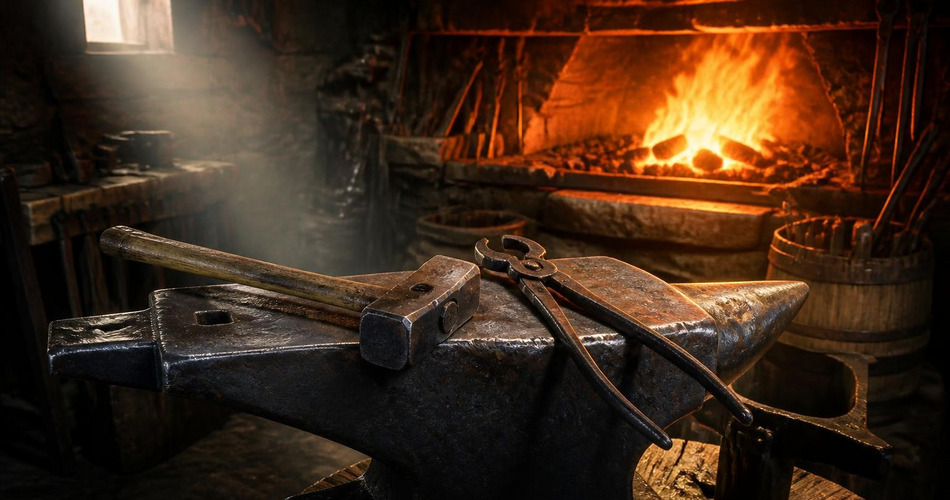
Forge tattoos often symbolize personal transformation, strength, and the ability to create one’s destiny. A common design includes an anvil and hammer, with or without flames, representing the wearer’s resilience through life’s fires. Some choose a forge scene to honor craftsmanship or a family trade, while others see it as a reminder to actively shape their own character. The imagery of the forge is also popular among those who identify with the archetype of the blacksmith—a creator and mender of both objects and lives.
Meanings of Different Types of Forges
- Coal forge: Represents tradition, ancient techniques, and the raw, primal connection to fire and earth.
- Gas forge: Symbolizes modern innovation, efficiency, and controlled transformation.
- Electric forge: Might indicate precision, industry, and the integration of technology into craftsmanship.
- Primitive forge (earth forge): Often associated with survival, resourcefulness, and the elemental origins of metalworking.
Frequently Asked Questions
Q: What does the forge symbolize in a spiritual sense?
A: The forge symbolizes the inner purification and transformation of the soul through trials, much like metal is refined by fire and hammer.
Q: Is a forge a positive symbol?
A: Yes, generally positive as a sign of creation, strength, and rebirth, but it can also represent pain and destruction when misused.
Q: What does a forge represent in dreams?
A: Often a period of intense change, personal growth, or the need to actively shape one’s life circumstances.
Q: Why is the forge important in mythology?
A: Mythological forges are the birthplaces of legendary weapons and tools, showing the interplay between divine power, skill, and the elements.
Related Symbols
- Anvil – The solid base that receives the hammer’s blows, symbolizing patience and strength.
- Hammer – The tool of force and creation, often associated with gods like Thor.
- Fire – The transformative energy that enables metalworking and purification.
- Blacksmith – The human agent who channels the forge’s power, a cultural hero and creator.
- Bellows – The breath that feeds the fire, representing vitality and inspiration.
- Metal – The raw material that undergoes transformation, symbolizing potential and endurance.