Briefly
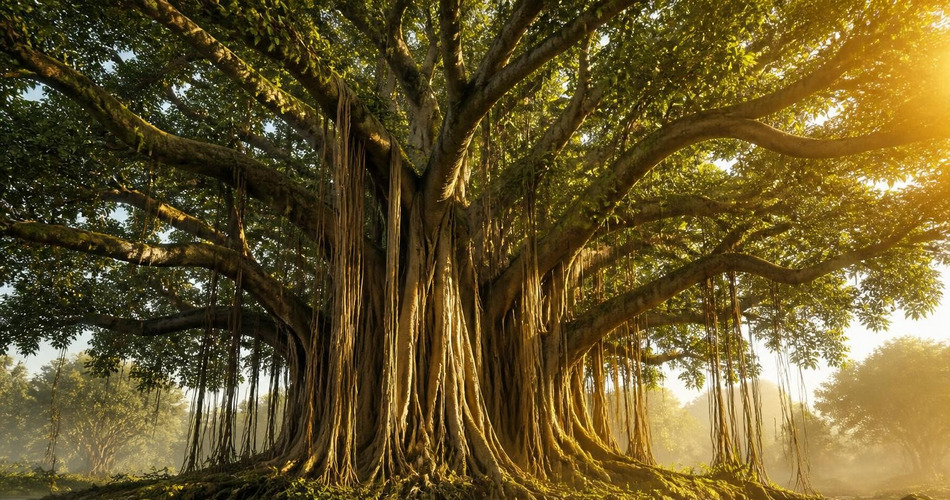
The banyan tree is a living symbol of shelter, endurance, and connection. It drops roots from its branches and grows outward until one tree becomes a grove, giving shade to people, animals, and entire communities. In South Asian tradition it has long been treated as a sacred tree, standing for immortality, wisdom, and the spiritual family of all living things.
What Does the Banyan Tree Symbolize?
The banyan tree symbolizes shelter above everything else. From its massive aerial roots rise multiple trunks, which support a wide canopy; in rural India the tree is often the true center of the village. Meetings are held beneath it, markets gather in its shade, and travelers pause under its branches. This practical shelter became a moral and spiritual image: one tree that can house and protect many is a natural figure for generosity, hospitality, and kinship.
The banyan is also a symbol of immortality and continuity. A single tree can gradually spread over a hectare or more by sending roots down from its limbs, each root becoming a new trunk. This self-renewing way of growth gives it an unusual power to live across many human generations, and it is commonly read as an image of undying life and tradition. In Hindu and Buddhist cultures, the banyan is therefore not just a plant but a place where the divine and the human meet.
Positive and Negative Meanings of the Banyan Tree
Positive associations: The banyan tree is first of all a symbol of shelter and safety. Its huge canopy can protect traders, travelers, teachers, and animals from the sun, and in village life it is a natural community hall. It is also a symbol of longevity: because a banyan spreads by lowering aerial roots, one tree can live for centuries and expand into a small forest, so it has become an emblem of immortality, patience, and the continuity of family or tradition.
Negative meanings: Like many sacred trees, the banyan has a shadow side. It begins life as an epiphyte, germinating on another tree and slowly covering it, which has made it a botanical symbol of strangling or absorption; in symbolic terms it can represent an influence that overtakes and hollows out other lives. In South Asian folklore, its dense shade is sometimes regarded at night as a dwelling place of spirits, so the same tree that is venerable by day can be uncanny after dark. Its overwhelming root system can also be read as an image of entanglement, where deep ties begin to feel like bondage.
History and Origins of Banyan Tree Symbolism
The banyan tree belongs to the fig family, and its natural range is the Indian subcontinent. It is one of the oldest respected trees in Indian civilization. In Sanskrit it was called nyagrodha, a name often interpreted as «growing downward», a description of its branches sending roots to the ground. This characteristic separated it from ordinary trees in the ancient imagination and made it a natural emblem of the sacred world tree that connects heaven and earth.
The English word banyan comes from the Portuguese banian, which was applied to Indian merchants, especially the Baniyas, who conducted business in the shade of these trees along the West Indian coast. The tree itself was later named after its most common guests. Over time the banyan became a familiar image in Indian writing and in the accounts of travelers, and in independent India it was declared the national tree, chosen for its vast growth, resilience, and deep roots in Indian life.
Banyan Tree Symbolism in Different Cultures
In Hindu culture, the banyan tree is sacred and is repeatedly associated with knowledge and blessing. It is connected to the god Shiva in his form as Dakshinamurti, the silent teacher who sits facing south beneath a banyan. It also gives its name and setting to Vat Savitri, a festival in which married women honor the tree and ask for the well-being of their husbands. For many families, the banyan is a living witness to vows, prayers, and the passing of generations.
In Buddhist tradition, the banyan tree appears among the holy places of Bodh Gaya. After his enlightenment, the Buddha is said to have spent a week in meditation under a banyan tree known as the Ajapala banyan, reflecting on the depth of what he had realized. Because of this, the banyan has become one of the trees associated with the Buddha and with the atmosphere of calm, concentrated insight.
Across much of South and Southeast Asia, banyans are planted beside temples, monasteries, and village commons. They mark boundaries, shelter travelers, and give communities a shared open-air room. This has made the banyan a symbol of common life itself: where the tree stands, people gather, and where people gather, the tree becomes part of memory and story.
Spiritual Meaning of the Banyan Tree
The spiritual meaning of the banyan tree centers on the unity underneath many forms. Its trunks grow from a single parent, and it is hard to tell where one tree ends and another begins; it becomes a picture of a shared spiritual life. For this reason, the banyan is often used as an image of the family, of the guru-disciple succession, and of the way divine creative energy descends step by step into the material world.
The tree also represents a sanctuary for meditation and teaching. The banyan’s wide, quiet shade gives it an almost architectural quality, and in Indian iconography the teacher is often placed beneath it, as Shiva Dakshinamurti is. The tree, then, does not simply symbolize transcendence; it symbolizes the conditions in which spiritual knowledge is honestly received: patient stillness, shelter from distraction, and a close relation between living things.
Banyan Tree in Myths and Folklore
In Hindu mythology, the banyan is connected to the story of Savitri and Satyavan. Savitri was a princess whose husband was destined to die, but through her devotion and presence of mind she argued with Yama, the god of death, and brought him back to life. The Vat Savitri festival, still observed in many parts of India, honors this story by having married women walk around and tie threads on a banyan tree, asking for the long life and protection of their husbands.
In iconographic tradition, Shiva as Dakshinamurti sits beneath the banyan facing south, surrounded by sages, teaching through silence. The tree is thus fixed in mythology as the place where wisdom passes from teacher to student without being reduced to words. In folk belief, banyans also stand at the edge of the known world: their huge age and tangled roots make them natural homes for spirits and invisible presences, and they are treated with respect rather than casual familiarity.
Banyan Tree in Superstitions and Omens
- Sleeping or sitting beneath a banyan tree after dark is avoided in some local traditions because spirits are thought to gather in its dense shade.
- Cutting down a banyan is considered inauspicious in many parts of India, since a sacred tree is not harmed without consequences.
- A healthy banyan shading a village is often read as a sign of community strength, while disturbing its roots during building work is believed in some places to bring bad luck.
Banyan Tree in Art and Literature
The banyan tree appears as a place of storytelling in R. K. Narayan’s collection Under the Banyan Tree. In the title story a village storyteller speaks from beneath the banyan, which in Indian village life was the natural stage for tales, debates, and teaching. The tree becomes both backdrop and character, reminding readers that the stories people tell are rooted in a particular place.
Rabindranath Tagore also wrote a poem titled «The Banyan Tree» in his cycle The Crescent Moon. In the poem, the speaker recalls the banyan standing by a pond and asks whether it remembers the child who once played at its roots. The tree is portrayed as a patient witness, a living link between childhood and age, and a symbol of the long calmness of nature against the brevity of human time.
Frequently Asked Questions about the Banyan Tree
Q: Is the banyan tree the same as the Bodhi tree?
A: No. The Bodhi tree is the sacred fig, Ficus religiosa, under which the Buddha reached enlightenment, while the banyan is Ficus benghalensis. Both are sacred fig trees and are often confused.
Q: Why is the banyan tree called immortal?
A: Because it constantly sends aerial roots down from branches, each root becoming a trunk, so a single tree can expand and regenerate for centuries. In Indian tradition this perpetual growth made it a symbol of undying life.
Q: Why do people worship the banyan tree?
A: The banyan is treated as a sacred tree in Hinduism and Buddhism. It is connected to teachings, blessings, and the festival of Vat Savitri, and its shade has always offered a natural place for prayer, gathering, and shelter.
Related Symbols of the Banyan Tree
- Peepal tree (Bodhi tree) — the closely related sacred fig associated with the Buddha’s enlightenment.
- Ashvattha — the cosmic world tree described in the Bhagavad Gita.
- Tree of Life — the universal symbol of growth, connection, and renewal.
- Kalpavriksha — the wish-fulfilling tree of Hindu mythology, often linked to the banyan.