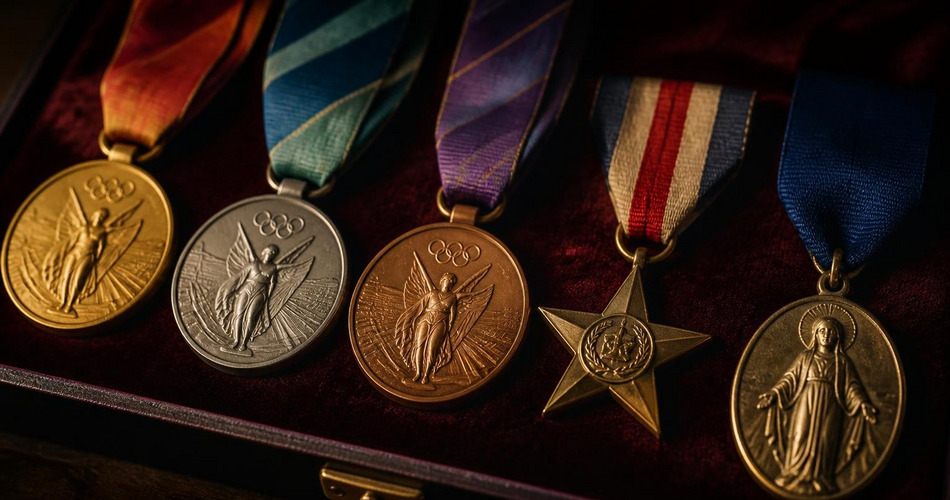
Briefly
A medal is a physical token awarded to recognize achievement, bravery, service, or commemorative significance. It symbolizes honor, excellence, and collective memory, often carrying both personal and societal meaning. While medals celebrate accomplishment and inspire aspiration, they can also represent competition, vanity, or the weight of expectation depending on context.
What Does Medal Symbolize?
At its core, a medal represents recognition—a tangible acknowledgment of merit or contribution. Medals embody values such as courage, dedication, and skill, serving as permanent reminders of a specific moment of triumph or service. They also symbolize status within a group or society, distinguishing those who have achieved exceptional feats. Beyond the individual, medals carry historical and cultural weight, often commemorating events or ideals that a community wishes to preserve.
Medals are also symbols of transition, marking a person’s passage from one state to another—such as from soldier to veteran, or from civilian to official hero. In this sense, they function as thresholds between ordinary life and an elevated position within a collective narrative.
Positive and Negative Meanings
Positive associations: Medals inspire pride, motivate effort, and provide public validation for hard work. They strengthen social bonds by celebrating shared values—valor in military settings, excellence in sports, or dedication in community service. A medal can uplift its recipient, offering a sense of purpose and belonging that transcends the object itself.
Negative meanings: Medals can foster arrogance, excessive competition, or an unhealthy focus on external validation. They may also symbolize the trauma of conflict, particularly war medals that recall loss and suffering. In some cases, medals become empty status markers when the recognition feels undeserved or politically motivated, leading to cynicism rather than admiration.
History and Origins of Medal Symbolism
The precursor to modern medals dates back to ancient Greece and Rome, where laurel wreaths and engraved coins were awarded to victorious athletes and military commanders. The ancient Greeks awarded olive wreaths at the Olympic Games as symbols of honor and divine favor. In Rome, phalerae—metal discs worn on armor—were among the earliest military decorations, representing bravery and service.
By the Renaissance, medals became popular as commemorative art pieces, often struck to celebrate political events, rulers, or intellectual achievements. The modern concept of mass-produced award medals emerged in the 18th and 19th centuries, with institutions like the Royal Society and military orders establishing formal systems of honor. The Olympic Games revived the tradition of awarding medals (gold, silver, bronze) in 1896, cementing the medal as the universal symbol of competitive excellence.
Medal Symbolism in Different Cultures
In Western military traditions, medals such as the Victoria Cross (United Kingdom) and the Medal of Honor (United States) symbolize ultimate sacrifice and heroism. They are treated with profound reverence, often accompanied by ceremonies that emphasize their gravity. In France, the Légion d’Honneur recognizes both military and civilian merit, representing national gratitude.
In East Asian cultures, medals have been adopted through modern Olympic and sporting events, but traditional forms of recognition—like jade pendants or ceremonial swords—historically carried similar symbolic weight. In many indigenous cultures, feathers, bones, or carved objects served as honors, reflecting the universal human need to mark outstanding deeds.
In civilian contexts, medals are used in academic, artistic, and community settings—such as Nobel Prize medals or Pulitzer Prize medals—representing the highest standards in human endeavor. The gold, silver, and bronze hierarchy of Olympic medals has become a globally understood language of achievement.
Spiritual Meaning
Spiritually, medals can represent divine favor or moral virtue. In Christian contexts, Saint Christopher medals are worn as protective talismans, symbolizing safe passage and guardian presence. Medals of saints or religious figures are often blessed and carried as reminders of faith, bridging the material and spiritual worlds.
In a broader sense, the act of receiving a medal may be seen as karmic reward for virtuous actions or selfless service. The durability and luster of the metal—especially gold—symbolize eternal truths and incorruptibility, aligning the medal with ideas of spiritual purity and everlasting recognition beyond earthly life.
In Myths and Folklore
While ancient myths rarely feature medals as we know them, the concept of a mark of honor appears frequently. In Greek mythology, the golden apple of Eris served as a prize that sparked discord—a warning that tokens of honor can bring conflict as well as glory. Norse legends speak of magical rings and arm rings (armilla) that conferred status and power, similar to modern medals.
In European folklore, medals and medallions often appear as enchanted objects that protect the wearer or grant special abilities. St. George’s medal, for example, was believed to protect soldiers in battle. These stories reflect a deep belief in the symbolic power of engraved metal to carry meaning beyond its physical form.
In Dreams
Dreaming of medals often relates to themes of self-worth, achievement, or unresolved recognition. A medal in a dream may indicate a desire for validation or a reflection of recent accomplishments. Conversely, it can highlight fears of inadequacy or the pressure to live up to expectations.
Common Dream Scenarios
- Receiving a medal: Symbolizes acknowledgment, personal success, or the culmination of efforts. It may suggest that the dreamer feels deserving of praise.
- Losing a medal: Represents fear of failure, forgotten achievements, or a sense of lost identity. It may indicate anxiety about not being recognized.
- Wearing a medal that does not belong to you: Suggests imposter syndrome or guilt over undeserved recognition. It may also mean the dreamer is taking on someone else’s burden.
- A broken or tarnished medal: Points to disappointment, betrayal, or the fading value of past honors. It can reflect a need to redefine self-worth beyond external awards.
In Superstitions and Omens
Medals are often treated as good luck charms, especially religious medals such as those of St. Christopher, St. Benedict, or the Miraculous Medal. Carrying a medal from a significant event is believed to preserve the luck or sanctity of that moment.
Some superstitions hold that awarding a medal should be done with a specific hand—right hand for honor, left for protection—though practices vary. In military cultures, there are superstitions about never polishing a medal until it is awarded, lest the honor be lost. Finding a medal unexpectedly is sometimes thought to be an omen of forthcoming recognition or a sign from a departed loved one.
In Art and Literature
Medals appear prominently in literature as symbols of honor and its costs. In “The Red Badge of Courage” by Stephen Crane, the protagonist’s yearning for a wound—a metaphorical medal—reflects the complex relationship between glory and trauma. John Dryden’s satirical poem “The Medal” (1682) uses a commemorative medal to critiquepolitical corruption, highlighting how medals can be manipulated as propaganda.
In visual art, Renaissance painters like Hans Memling included medals in portraits to denote status and virtue. More recently, the photograph “The Falling Soldier” by Robert Capa—while not a medal itself—immortalized the moment of sacrifice that medals often represent. In film, the pursuit of the Medal of Honor figures in dramas such as “The Great Santini” and “Hacksaw Ridge”, examining the weight of such recognition on individual lives.
Tattoo Meaning
Medal tattoos are common among military veterans, athletes, or anyone who wishes to permanently mark a significant achievement. The design often includes the specific medal shape or a generic medal icon. Such tattoos symbolize pride, resilience, and commitment. They serve as a permanent reminder of trials overcome and goals reached, and may also represent fallen comrades or a turning point in life. In some cases, a medal tattoo can indicate membership in a particular order or brotherhood.
Meanings of Different Types, Colors, or Variations
- Gold medal: Symbolizes the highest achievement, victory, and perfection. Gold is associated with the sun, wealth, and incorruptibility.
- Silver medal: Represents second place or excellence, often linked to the moon, reflection, and adaptability.
- Bronze medal: Stands for resilience, endurance, and the value of participation. Bronze is a durable alloy, suggesting strength in adversity.
- Military medal: Typically signifies bravery, sacrifice, and national service. Specific colors and ribbons further denote the nature of the action (e.g., purple heart for wounds).
- Commemorative medal: Marks a historical event, anniversary, or person. Its symbolism centers on memory and collective identity.
- Religious medal: Carries spiritual protection and devotion. Each saint or figure adds its own layer of meaning (e.g., St. Benedict for exorcism, St. Christopher for travel).
Frequently Asked Questions
Q: What does it mean when you dream about a medal?
A: Dreaming of a medal often relates to feelings about self-worth, the desire for recognition, or recent accomplishments. It can also indicate fears of not measuring up.
Q: Are medals considered good luck?
A: Many people view medals, especially religious ones, as good luck charms that protect the wearer and bring positive energy. However, this belief is cultural or personal rather than universal.
Q: What is the difference between a medal and a trophy?
A: A medal is typically a flat, round disc worn on a ribbon or chain, while a trophy is often a cup, statue, or plaque. Both serve as awards, but medals emphasize the act of wearing honor publicly.
Q: Why are medals given in threes (gold, silver, bronze)?
A: This tradition originated with the modern Olympic Games, inspired by ancient Greek awards. The three-level system recognizes top performers while still honoring second and third places, and the metal grades convey hierarchy and value.
Related Symbols
- Medallion – A larger medal-like ornament, often worn as jewelry or decorative piece, symbolizing identity or membership.
- Ribbon – Often attached to a medal, the ribbon’s colors carry additional symbolic meaning (e.g., red for courage, blue for loyalty).
- Laurel Wreath – The ancient precursor to medals, representing victory, peace, and intellectual achievement.
- Badge – Another emblem of office, rank, or achievement, often worn on uniforms.
- Honor – The abstract concept that medals concretely represent; related to ideas of integrity, reputation, and virtue.