Briefly
A tapestry is more than a decorative textile; it is a woven narrative that captures stories, histories, and values within its threads. As a symbol, tapestry represents the intricate interconnectedness of life, where each individual thread contributes to a larger, unified whole. It often stands for collaboration, community, and the preservation of cultural memory, while also hinting at the complexity of human experience and the layering of time and events.
What Does Tapestry Symbolize?
Tapestry is a profound symbol of interconnectedness. Every thread is essential to the overall design; if one breaks or fades, the entire picture is altered. This makes tapestry a metaphor for community, where individual actions and roles weave together to create a shared existence. It also symbolizes storytelling and the recording of history, as tapestries have long been used to depict epic tales, battles, genealogies, and religious narratives. In a broader sense, tapestry embodies the concept of destiny or fate, as if life itself is a fabric being woven by unseen hands, blending joy and sorrow, light and dark, into a coherent whole.
Positive and Negative Meanings
Positive associations: Tapestry is widely seen as a symbol of unity, collaboration, and cultural richness. Its intricate, time-consuming creation process represents patience, skill, and dedication. The completed work conveys harmony, order, and the beauty that arises when diverse elements are brought together purposefully. It also signifies heritage and continuity, preserving the wisdom and artistry of past generations for the future.
Negative meanings: On the downside, tapestry can symbolize concealment or the deliberate hiding of truth. The dense weave can obscure what lies beneath, making it a metaphor for secrets, illusion, or a fabricated version of reality. In some contexts, the complexity of a tapestry may represent confusion, entanglement, or being trapped in a situation where the threads are too tangled to unravel. The fragility of the medium also hints at the vulnerability of memory and the ease with which history can be altered or lost.
History and Origins of the Symbolism
The symbolism of tapestry is deeply rooted in its practical and cultural history. Tapestries were produced as early as ancient Egyptian, Greek, and Chinese civilizations, but they reached their symbolic peak in medieval and Renaissance Europe. Large-scale tapestries, such as the Bayeux Tapestry (11th century), were not only decorative but served as narrative documents—chronicling historical events, battles, and royal lineages. Because they were portable, tapestries traveled with nobles and monarchs, making them symbols of status, power, and courtly culture. In many societies, the weaver or patron who commissioned a tapestry was seen as a patron of the arts, and the finished piece became a legacy. The metaphor of weaving as a creative force appears in numerous mythologies, from the Greek Fates (who spin, measure, and cut the thread of life) to the Norse Norns, reinforcing the idea of tapestry as a symbol of destiny and the interconnected fabric of existence.
Symbolism in Different Cultures
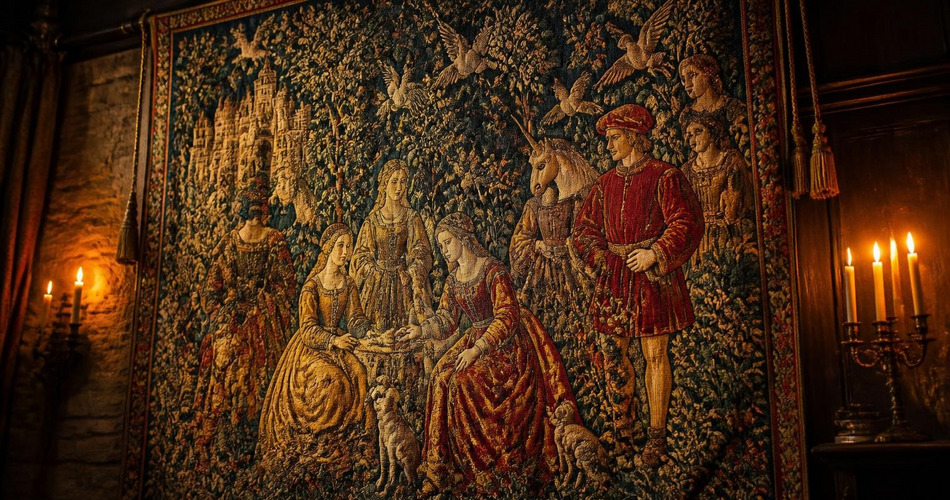
In European tradition, tapestries often depicted religious scenes from the Bible or the lives of saints, serving both as decoration and as a tool for religious instruction in a largely illiterate population. The Unicorn Tapestries, a series from the late Middle Ages, are rich in allegorical symbolism, representing both secular courtly love and Christian themes of purity and sacrifice. In various Indigenous cultures of the Americas, such as the Navajo, weaving is a sacred act. The Navajo rug or tapestry is not merely an object; it embodies spiritual concepts of harmony (hózhó), balance, and the connection between the weaver and the cosmos. In many Asian cultures, woven textiles and tapestries often carried symbols of rank, status, and auspicious meanings—dragons, phoenixes, and floral motifs representing power, renewal, and prosperity. Across these diverse settings, the common thread is that tapestry represents a bond between the material and the spiritual, the individual and the community, the past and the present.
Spiritual Meaning
Spiritually, tapestry symbolizes the weave of fate or divine plan—the idea that every life, event, and choice is a thread in a larger pattern known only to a higher power. This concept appears in many philosophical and religious traditions, where the universe is envisioned as a vast, intricate tapestry being woven by a creator or cosmic force. The act of weaving itself can be seen as a meditative or prayerful practice, with each thread representing an intention or a blessing. In this sense, tapestry encourages reflection on one’s own place within the greater whole, fostering a sense of purpose and belonging while also reminding individuals of their responsibility to contribute positively to the fabric of life.
In Myths and Folklore
Tapestry and weaving appear prominently in global mythology. In Greek myth, the goddess Athena was the patron of weaving, and the story of Arachne—a mortal weaver who challenged Athena to a contest—serves as a cautionary tale about pride and the dangers of hubris. Arachne’s tapestry depicted the gods’ misdeeds, leading to her transformation into a spider. This myth highlights tapestry as a medium for both artistic excellence and subversive commentary. In Norse mythology, the Norns wove the threads of fate at the base of Yggdrasil, the world tree, determining the destinies of gods and humans. In many folk traditions, textile arts were associated with magic and protection; woven garments or hangings could be imbued with protective symbols or blessings, and were used in rites of passage and healing ceremonies.
In Dreams
Dreaming of a tapestry often reflects the dreamer’s perception of their own life’s complexity. A beautiful, intact tapestry may signify harmony, a sense of fulfillment, and the successful integration of various life experiences. It can indicate a time of peace and satisfaction with the larger picture of one’s existence. Conversely, a torn, tangled, or unfinished tapestry in a dream may point to unresolved issues, confusion, or a feeling that certain events or relationships are incomplete. The act of weaving in a dream can represent the dreamer’s creative efforts to shape their future or to mend broken connections. As with all dream symbols, the context and emotional tone of the dream are crucial for personal interpretation.
Common Dream Scenarios
- Creating a tapestry: This often symbolizes a phase of active construction in one’s life—building relationships, career, or personal growth through deliberate, careful steps.
- Viewing an old or historical tapestry: May indicate reflection on past experiences, family history, or ancestral influences that shape current identity.
- A fraying or torn tapestry: Suggests a fear of losing control, the unraveling of plans, or damage to important relationships or projects.
- A tapestry with a chaotic pattern: Could represent confusion, inner turmoil, or a sense that life lacks direction or coherence.
In Superstitions and Omens
Historically, tapestries and woven items were often included in folk superstitions. Some traditions held that a tapestry or wall hanging depicting negative scenes (like battles or mournful figures) could attract misfortune. Conversely, tapestries with protective symbols—such as the tree of life, geometric patterns, or religious iconography—were believed to ward off evil spirits and bring good luck. In parts of Eastern Europe, a woven cloth placed on a threshold could be a charm against unwanted visitors or spirits. In some folklores, if a weaver’s family experienced sudden bad luck, it might be attributed to a mistake or a curse woven into a recently completed tapestry. However, these beliefs varied widely by region and era.
In Art and Literature
Tapestry symbolism has been prominent in Western art and literature for centuries. The Bayeux Tapestry is perhaps the most famous historical example—a 68-meter-long embroidery (technically not a woven tapestry, but often referred to as one) that narrates the Norman conquest of England in 1066. It has served as an artistic and historical document, influencing later perceptions of medieval warfare and politics. In literature, the metaphor of weaving and tapestry appears in works such as Ovid’s Metamorphoses (the story of Arachne), where the woven image becomes a powerful political and artistic statement. In modern fiction, the concept of a “tapestry of time” or “life’s tapestry” is a recurring theme in novels that explore interconnected lives and destinies, such as in the works of authors like Charles Dickens, where individual stories are interwoven with the fate of society. In contemporary art, fiber artists like Sheila Hicks have expanded the definition of tapestry, using weaving as a way to explore color, texture, and spatial relationships, continuing the tradition of tapestry as a medium for deep symbolic expression.
Meanings of Different Types, Colors, or Variations
- Medieval narrative tapestries: Heavily allegorical, often blending religious, political, and moral messages; they symbolized the power and piety of their patrons.
- Millefleurs (thousand flowers) style: A background covered in small floral motifs, symbolizing the beauty, transience, and abundance of nature, often used in courtly and allegorical works.
- Geometric or abstract tapestries: Common in Indigenous and modern art, these emphasize harmony, pattern, and the spiritual significance of symmetry and repetition.
- Colors in tapestries: Red often symbolizes passion, power, or Christ’s blood in Christian contexts; blue represents heaven, royalty, or the Virgin Mary; gold denotes divinity, wealth, or enlightenment; black can signify mourning, mystery, or the unknown.
Frequently Asked Questions
Q: What does a tapestry symbolize in a dream?
A: A tapestry in a dream typically symbolizes the dreamer’s perception of their life’s complexity: a beautiful, complete tapestry indicates harmony and satisfaction, while a torn or ragged one points to unresolved issues or a need to repair aspects of one’s life.
Q: Is a tapestry the same as a weaving?
A: While all tapestries are weavings, not all weavings are tapestries. Tapestry is a specific form of weaving where the weft threads are not continuous and are used to create detailed pictorial designs; it is distinguished by its structural technique and often narrative content.
Q: What is the spiritual meaning of a tapestry?
A: Spiritually, tapestry represents the interconnectedness of all life and the idea of a greater plan or destiny, with each individual being a thread contributing to a larger, meaningful whole designed by a higher power or cosmic force.
Related Symbols
- Weaving – The creative act of bringing together separate elements into a unified whole
- Thread – Represents continuity, connection, and the fragile line linking events and people
- Loom – Symbolizes structure, framework, and the process of creation
- Fabric – Denotes covering, shelter, and the material aspect of culture
- Knot – Represents binding, union, or complex relationships