
Briefly
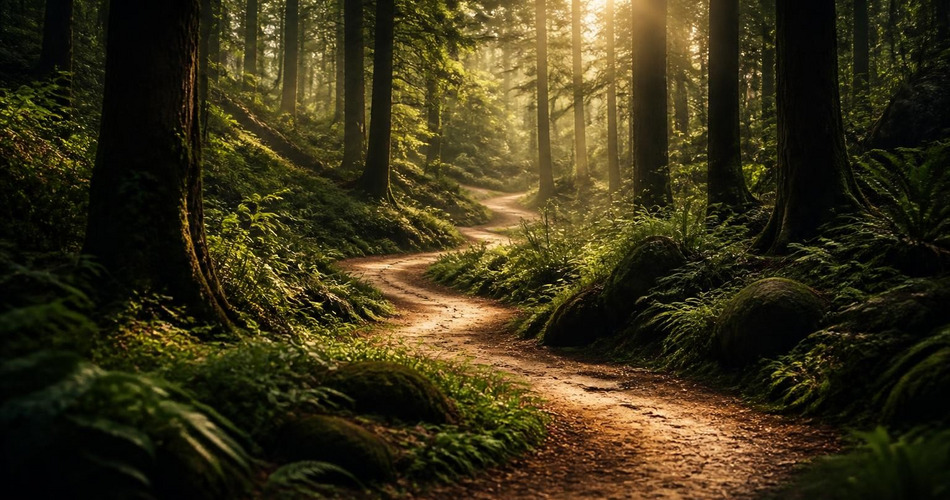
The winding path is a powerful and universal symbol representing the journey of life, spiritual seeking, and personal transformation. Unlike a straight road, which implies directness and a clear destination, the winding path suggests a journey filled with unexpected turns, challenges, and discoveries. It embodies the idea that progress is not always linear and that the journey itself holds as much meaning as the destination. This symbol often appears across cultures in myths, literature, and spiritual traditions to represent the complex, meandering nature of existence and the search for deeper understanding.
What Does the Winding Path Symbolize?
The winding path is primarily a symbol of life’s journey. It represents the individual’s unique course through existence, marked by choices, obstacles, and moments of clarity. It symbolizes the non-linear nature of personal growth, where setbacks and detours are integral parts of the learning process. The path’s twists and turns can represent the unforeseen events, both positive and negative, that shape a person’s character and destiny. Furthermore, it often symbolizes a spiritual quest, where the seeker must navigate a complex inner landscape to reach enlightenment or self-discovery. The labyrinth, a specific type of winding path, is a classic example of this, where the goal is not to get lost but to find one’s way to the center and back out again, symbolizing death and rebirth.
Positive and Negative Meanings of the Winding Path
Positive associations: The winding path is seen as a symbol of adventure, discovery, and resilience. It suggests a rich, full life filled with diverse experiences. It implies that a person is not afraid to take risks or explore the unknown. The path’s meandering nature can also symbolize creativity, as it allows for unexpected connections and new perspectives. In a spiritual context, it represents the dedicated seeker who is willing to undergo trials to achieve higher wisdom.
Negative meanings: Conversely, the winding path can symbolize confusion, delay, and getting lost. It can represent a lack of clear direction or purpose, leading to wasted time and effort. In a more ominous sense, it can be a symbol of deception or a trap, where the twists and turns are designed to disorient and ensnare the traveler. The feeling of being on a winding path without end can evoke anxiety and frustration, representing a struggle without a clear resolution.
History and Origins of the Winding Path Symbolism
The symbolism of the winding path is ancient and deeply embedded in human consciousness. The earliest known examples are the petroglyphs of labyrinths, found in locations as diverse as the Mediterranean and the American Southwest, dating back thousands of years. These early symbols were not merely decorative; they were likely used in rituals and as spiritual tools. The famous labyrinth of Greek mythology, built by Daedalus to contain the Minotaur, established the winding path as a symbol of a dangerous, confusing journey that requires courage and wit to navigate. The story of Theseus, who uses a thread to find his way out, highlights the need for guidance and inner knowledge to successfully traverse the winding path of life. In the East, the concept of the Tao in Chinese philosophy is often described as a “Way” or “Path” that is not a straight line but a natural, harmonious flow that winds like a river.
Winding Path Symbolism in Different Cultures
In Christianity, the winding path often represents the pilgrimage of life, full of temptations and trials that test one’s faith. The labyrinth was adopted into medieval cathedrals, such as Chartres, where it served as a symbolic pilgrimage for those who could not travel to the Holy Land. Walking the winding path of the labyrinth was a form of prayer and meditation, representing the soul’s journey to God. In Native American traditions, the winding path is often seen in the context of the “Red Road” or the “Good Red Road,” a spiritual path that is not always straight but is guided by the wisdom of the ancestors and the natural world. The meandering of a river is seen as a model for how life should be lived: adapting, flowing, and finding the path of least resistance while still moving forward. In Eastern philosophies like Taoism and Zen Buddhism, the winding path is a direct representation of the Tao, the fundamental nature of the universe. The famous Zen rock gardens, with their raked gravel patterns that wind around stones, are designed for contemplation, encouraging the viewer to appreciate the beauty of the journey itself rather than fixating on a final goal.
Spiritual Meaning of the Winding Path
Spiritually, the winding path is a profound symbol of the quest for enlightenment. It acknowledges that spiritual growth is rarely a straight line. The twists and turns represent the challenges, doubts, and lessons that are necessary for the soul’s evolution. Walking a winding path requires faith, as one cannot see what lies around the next corner. This teaches trust in a higher power or the universe. The path also symbolizes the process of individuation in Jungian psychology, where the individual must navigate the winding corridors of their own unconscious to integrate the shadow self and achieve wholeness. The journey into the labyrinth and back out is a powerful metaphor for the spiritual cycle of descent, transformation, and return.
The Winding Path in Myths and Folklore
The most prominent myth featuring the winding path is the Greek myth of the Labyrinth and the Minotaur. The labyrinth, a complex, winding underground structure, was built to imprison the half-man, half-bull Minotaur. The hero Theseus volunteers to kill the monster and navigates the winding paths using a ball of thread given to him by Ariadne. This myth powerfully illustrates the winding path as a symbol of confronting one’s deepest fears and the chaos within (the Minotaur). The thread represents the guidance or inner wisdom needed to navigate the difficult journey and find one’s way back to the light. In many fairy tales, the protagonist must enter a dark, winding forest or follow a twisting road to find a hidden treasure or rescue a loved one, symbolizing the trials that must be overcome to achieve a desired outcome. The “winding road” is a common trope in folklore, representing the unpredictable nature of fate.
Winding Path in Dreams
In the realm of dreams, a winding path is a rich and common symbol. It generally represents the dreamer’s current life journey and their subconscious feelings about its direction. The condition of the path (overgrown, smooth, dark, sunny) provides crucial context for interpretation. Dreaming of walking on a winding path often suggests that the dreamer is navigating a complex situation in their waking life. It can indicate a period of exploration, uncertainty, or personal growth.
Common Dream Scenarios Involving a Winding Path
- Walking a winding path uphill: This often symbolizes a difficult but rewarding journey towards a significant goal or higher spiritual understanding. The effort required reflects the challenges of the waking world.
- Running on a winding path: This can represent a feeling of being rushed or pressured in life, or an attempt to escape from something. The winding nature of the path makes the escape more difficult and uncertain.
- Losing the winding path: Losing sight of the path in a dream can symbolize a feeling of being lost in life, confusion about one’s purpose, or a fear of making the wrong decision.
- A winding path leading to a door or light: This is a very positive symbol, suggesting that the dreamer’s journey is leading them to a new opportunity, a solution to a problem, or a state of enlightenment.
The Winding Path in Art and Literature
The winding path is a central motif in countless works of literature and art. In Dante Alighieri’s “The Divine Comedy”, the poem opens with the narrator lost in a dark wood, having “lost the straight path.” This immediately establishes the winding, difficult journey through Hell, Purgatory, and Paradise as a metaphor for spiritual redemption. In John Bunyan’s “The Pilgrim’s Progress”, the protagonist Christian travels a road that is fraught with obstacles and misleading byways, a classic allegory of the winding path of the Christian life. Robert Frost’s poem “The Road Not Taken” famously contemplates two diverging paths in a yellow wood, a powerful meditation on choice and the unknown outcomes of life’s winding journey. In visual art, the winding path is a staple of landscape painting, from the works of the Hudson River School, where it invites the viewer into the scene and symbolizes the nation’s journey into the wilderness, to the surrealist landscapes of artists like Salvador Dalí, where melting, winding paths represent the fluidity and strangeness of the subconscious mind. The labyrinth itself has been a subject of art for millennia, from ancient mosaics to modern installations.
Winding Path Tattoo Meaning
A winding path tattoo is a deeply personal and popular design. It often symbolizes the wearer’s unique life journey, acknowledging that their path has not been a straight line. It can represent overcoming significant obstacles, surviving a difficult period, or embracing a life of adventure and exploration. The tattoo often includes other elements like trees, mountains, or stars to add layers of meaning. A path leading to a mountain peak can symbolize ambition and achievement, while a path disappearing into a forest can represent mystery and the unknown future. It is a powerful statement of resilience, accepting that the twists and turns of life are what make the journey meaningful.
Frequently Asked Questions About Winding Path Symbolism
Q: What is the main difference between a straight path and a winding path in symbolism?
A: A straight path typically symbolizes directness, purpose, discipline, and a clear moral or life direction. A winding path, in contrast, symbolizes a more complex, exploratory journey filled with unexpected experiences, challenges, and personal growth.
Q: Why is the winding path a powerful symbol in spirituality?
A: It powerfully represents the non-linear nature of spiritual growth. It acknowledges that the journey to enlightenment involves setbacks, detours, and periods of confusion, all of which are essential for deep, lasting transformation.
Q: What does a labyrinth symbolize that a simple winding path does not?
A: While both represent a journey, a labyrinth has a specific, single path to a center and back out. It is a symbol of a controlled, meditative journey of death and rebirth, whereas a winding path can be more open-ended, representing the general unpredictability of life.
Related Symbols
- Labyrinth: A specific, often unicursal winding path representing a spiritual pilgrimage and rebirth.
- Straight Path: The direct opposite, symbolizing a clear, righteous, or predetermined route.
- Crossroads: A point where paths meet, symbolizing a critical choice or decision in life’s journey.
- River: Like a winding path, a river meanders, symbolizing the flow of life, time, and change.
- Spiral: A path that winds around a central point, symbolizing growth, evolution, and the cyclical nature of life.
