Briefly
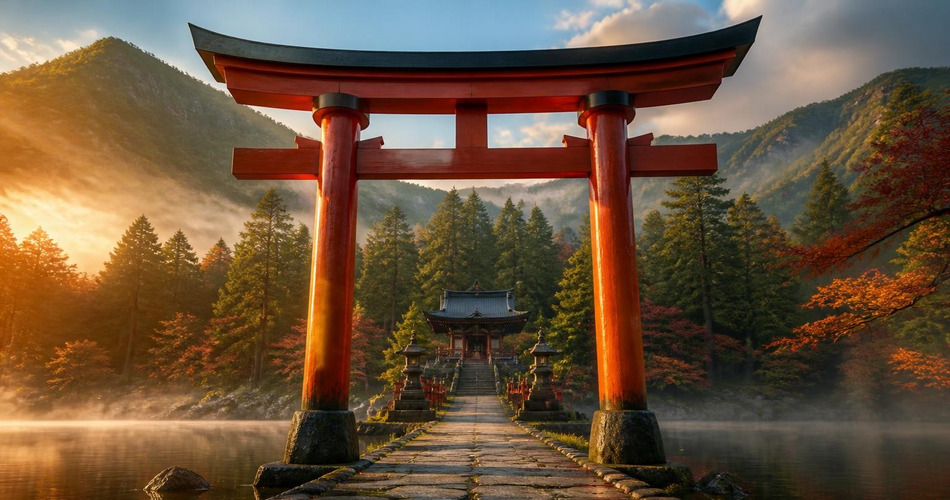
The Torii Gate is a traditional Japanese structure that marks the entrance to a sacred Shinto space, most commonly a shrine. Its primary symbolism is the transition from the profane, everyday world to the sacred realm of the kami (spirits or gods). Recognizable by its two upright pillars and two horizontal crossbars, the torii gate serves as a physical and spiritual boundary, inviting purification and reverence. While deeply rooted in Shinto tradition, its iconic form has become a global symbol of Japanese culture, spirituality, and the concept of entering a liminal space.
What Does the Torii Gate Symbolize?
The Torii Gate primarily symbolizes the boundary between the secular and the sacred. It is a threshold that marks the point where the human world ends and the divine realm begins. Passing through a torii is an act of purification and preparation, signaling to visitors that they are entering a space that demands respect, humility, and a clear mind. The gate itself does not contain the divine; rather, it frames and announces the sacred territory beyond.
The structure of the gate is also rich in symbolism. The two vertical pillars represent the pillars of the world or the connection between heaven and earth. The upper lintel (kasagi) and the second crossbar (nuki) often curve slightly upward at the ends, a design thought to represent the wings of a bird or the arms of a deity welcoming worshippers. The color red (vermillion) commonly used for torii gates is believed to be a protective color, warding off evil spirits and symbolizing life force and vitality.
Positive and Negative Meanings
Positive associations: The Torii Gate is overwhelmingly a positive symbol. It represents a sacred passage, spiritual purification, good fortune, and the presence of the divine. It is a welcoming structure that invites individuals to step away from worldly concerns and enter a space of peace, prayer, and harmony with nature. In a broader cultural context, it symbolizes the rich traditions of Japan, resilience, and the beauty of spiritual architecture.
Negative meanings: The Torii Gate itself carries no inherently negative symbolism. However, it can represent a strict boundary or a point of no return in some narratives. In folklore, the area beyond a torii is the domain of the kami, and failing to show proper respect (such as not bowing before passing through) can be seen as an invitation for misfortune. In modern contexts, its image is sometimes used to evoke a sense of the mysterious, the ancient, or the intimidating power of tradition.
History and Origins of the Torii Gate Symbolism
The origins of the torii gate are ancient and somewhat obscure, with theories tracing back to the Heian period (794–1185) or earlier. One prominent theory links the torii to the *torii* bird (a type of bird, often associated with roosts or perches in ancient texts). The word “torii” itself is traditionally said to mean “bird perch,” suggesting that gates were originally built for birds to land on, which were considered messengers of the gods or even divine spirits themselves.
Another theory proposes that the torii was influenced by similar gate structures found in other Asian cultures, such as the Indian *torana* or the Chinese *paifang*, which also serve as ceremonial gateways. Regardless of its exact origin, the torii became firmly established as the primary symbol of a Shinto shrine. The most famous example, the Fushimi Inari Taisha in Kyoto, features thousands of vermillion torii gates lining a network of trails up a sacred mountain, creating a breathtaking tunnel of gates donated by individuals and businesses seeking blessings and gratitude.
Torii Gate Symbolism in Different Cultures
While the torii gate is uniquely Japanese in its specific form and primary religious context, its core symbolism—a portal between worlds—is a universal archetype. In Japan, it is exclusively associated with Shinto, though it can also be found at some Buddhist temples (Buddhist temples in Japan often have a main gate called a *mon*, but may incorporate torii if they also enshrine a Shinto kami).
Outside of Japan, the torii gate has been adopted as a symbol of Japanese culture, Zen Buddhism, and Eastern spirituality in general. It is often used in gardens, restaurants, and cultural centers worldwide to evoke a sense of peace, tradition, and exoticism. In the West, it has been absorbed into popular culture as a symbol of transition, mystery, and the entrance to another world, often stripped of its specific religious context but retaining its powerful symbolic function as a gateway.
Spiritual Meaning of the Torii Gate
The spiritual meaning of the Torii Gate is deeply connected to the Shinto concept of *kegare* (impurity) and *harae* (purification). The gate marks the line where one leaves the impurities of the everyday world behind. Before entering, visitors perform a simple purification ritual at the *chozuya* (water pavilion), washing their hands and mouth. The act of passing under the torii is the final step of this spiritual preparation.
The torii also represents the connection between the human realm and the kami. It is not a door that can be closed, but an open invitation, signifying that the divine is always accessible to those who approach with a sincere heart. The upward-curving beams of the gate are often interpreted as a gesture of welcome, and the entire structure serves as a reminder of the thin veil between the material and spiritual worlds.
Torii Gate in Myths and Folklore
In Japanese folklore, the torii gate is a common feature in stories about the supernatural. It is often depicted as the boundary between the human world and the spirit world. In the famous folktale of Urashima Tarō, the protagonist’s journey to the undersea palace of the Dragon God might be framed by a torii, though the story itself predates the standard imagery. More directly, torii gates are central to the mythology of Inari, the kami of rice, sake, and prosperity. Foxes (*kitsune*), the messengers of Inari, are often depicted in front of or near torii gates.
A well-known superstition holds that one should never run through a torii gate, as it is disrespectful to the kami. Furthermore, it is said that if you walk through a torii without bowing, you might be cursed or followed by a spirit. The torii is so strongly associated with the boundary between worlds that it is a staple in Japanese horror stories (*kaidan*), where crossing through a torii at night might lead one into a realm of ghosts and demons.
Torii Gate in Dreams
Dreaming of a Torii Gate often carries powerful symbolic weight, generally relating to transition, spiritual journey, and entering a new phase of life. The specific meaning can depend on the context of the dream.
Common Dream Scenarios
- Passing through a Torii Gate: This is the most common and positive dream scenario. It symbolizes a major life transition, a spiritual awakening, or the decision to embark on a new path. It suggests the dreamer is ready to leave behind old habits and enter a more sacred or meaningful phase of life.
- Seeing a Torii Gate from a distance: This can represent a goal, an aspiration, or a spiritual calling that the dreamer is aware of but has not yet committed to. It symbolizes potential and the promise of transformation.
- A ruined or broken Torii Gate: This might symbolize a lost connection to one’s spirituality, a broken promise, or a barrier that has fallen. It can also represent the decay of tradition or a feeling of being disconnected from one’s cultural or spiritual roots.
- Walking through a tunnel of Torii Gates: This dream, inspired by places like Fushimi Inari, represents a long spiritual journey, a path of continuous learning, or the many stages of life. It suggests perseverance and the accumulation of blessings over time.
- A Torii Gate in an unexpected place: Finding a torii gate in a modern city or a foreign landscape can symbolize the presence of the sacred in the mundane. It is a reminder to seek out moments of peace and spirituality in everyday life.
Torii Gate in Superstitions and Omens
- Bowing: It is customary to bow once before passing through a torii gate and again after passing through. Failing to bow is considered disrespectful and may bring bad luck or offend the kami.
- Walking in the center: Traditionally, the center of the torii gate is reserved for the kami. Visitors are expected to walk on the left or right side of the path to show respect.
- Color and Condition: A bright, well-maintained vermillion torii is a positive omen, signifying protection and vitality. A faded, peeling, or fallen torii can be seen as a sign of neglect, decay, or a weakening of spiritual protection.
- Donations: Donating a torii gate to a shrine is considered a highly meritorious act, believed to bring good fortune, success in business, and the fulfillment of wishes. The thousands of gates at Fushimi Inari are a testament to this belief.
Torii Gate in Art and Literature
The Torii Gate is a powerful and recurring motif in Japanese art and has been adopted globally. In the famous woodblock print series *Thirty-six Views of Mount Fuji* by Katsushika Hokusai, the torii gate is often used as a framing device, placing the sacred mountain within a context of spiritual passage. The print *Fuji from the series 100 Views of Fuji* explicitly features a torii gate.
In literature, the torii gate appears in Yukio Mishima’s novel *The Temple of the Golden Pavilion*, where it represents the boundary between the mundane world of the protagonist and his obsessive, destructive pursuit of beauty. In modern cinema, the torii gate is a central visual symbol in films like *Memoirs of a Geisha* (the scene at Fushimi Inari) and *Enter the Void*, where a torii gate in Tokyo serves as a recurring visual motif representing the cycle of life, death, and rebirth. The anime *Spirited Away* by Studio Ghibli uses a tunnel and a torii-like structure to mark the entrance to the spirit world.
Torii Gate Tattoo Meaning
The Torii Gate is a popular subject in traditional Japanese tattooing (Irezumi) and modern tattoo art. As a tattoo, it carries deep symbolic weight. It represents a threshold in the wearer’s life, a commitment to a spiritual path, or a connection to Japanese heritage. It can symbolize overcoming a great challenge and entering a new chapter.
Often combined with other traditional elements like koi fish, cherry blossoms, or dragons, the torii gate tattoo grounds the design in a narrative of struggle, transition, and enlightenment. It is also chosen for its aesthetic beauty, representing strength, tradition, and the mystery of the unknown. A torii gate tattoo can serve as a permanent reminder of one’s values, resilience, and the sacred journey of life.
Frequently Asked Questions
Q: What is the purpose of a Torii Gate?
A: The primary purpose of a Torii Gate is to mark the entrance to a sacred Shinto space, symbolizing the transition from the profane world to the divine realm of the kami.
Q: Why are Torii Gates usually red?
A: The vermillion color is believed to have protective properties, warding off evil spirits and negative energies. It is also associated with life force, vitality, and the sun.
Q: Is it disrespectful to walk through a Torii Gate?
A: It is not disrespectful to walk through a torii gate, but it is customary to bow slightly before entering and to walk on the side of the path, avoiding the very center, which is considered the path for the kami.
Q: What is the difference between a Torii Gate and a Buddhist Temple Gate?
A: A Torii Gate is specifically associated with Shinto shrines, while Buddhist temples in Japan typically have a different style of gate called a *mon* (such as a *sanmon*). However, torii gates can sometimes be found within Buddhist temple complexes.
Related Symbols
- Kami: The spirits or gods to whom the torii gate grants access.
- Shimenawa: A sacred rope that marks a sacred space, often found on torii gates.
- Komainu: Lion-dog guardians often placed at shrine entrances alongside torii gates.
- Torana: A similar gateway structure in Hindu and Buddhist architecture from India.
- Paifang: A traditional Chinese ceremonial gateway with similar functions.
- Threshold: The universal concept of a boundary between two spaces.