Briefly
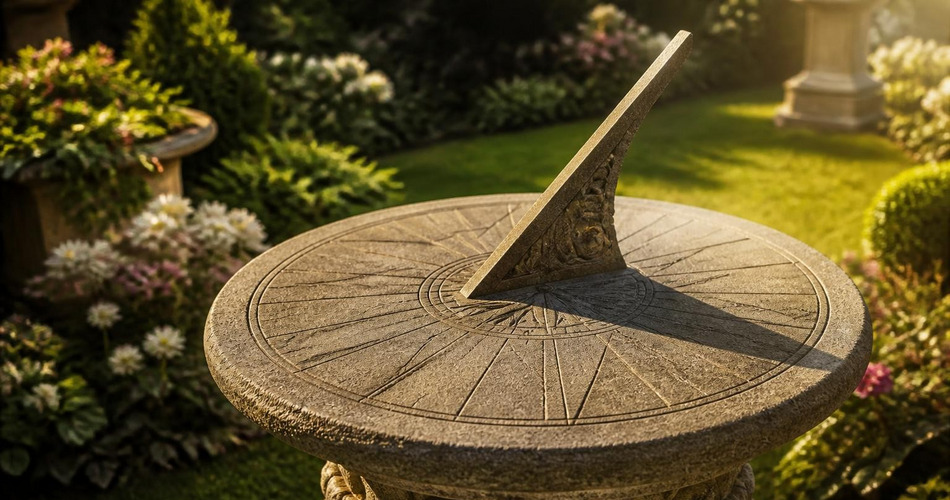
The sundial is one of humanity’s oldest timekeeping instruments, using the position of the sun’s shadow to indicate the hour. As a symbol, it represents the passage of time, the inevitability of mortality, and the cyclical nature of days and seasons. Sundials also embody human ingenuity in measuring and ordering life, while reminding us of the sun’s central role in our existence. Their stillness and reliance on natural light give them a contemplative quality, often associated with patience, precision, and the transient beauty of each moment.
What Does the Sundial Symbolize?
The sundial primarily symbolizes time and its relentless forward movement. Unlike modern clocks that hide the mechanism, a sundial makes the passage of time visible through the moving shadow, linking human experience directly to the sun’s daily arc. This visibility also connects the sundial to ideas of truth and clarity, as it relies on an unchanging natural phenomenon. Additionally, sundials symbolize mortality and the finite nature of life, often inscribed with mottos like tempus fugit (time flies) or carpe diem (seize the day). They represent a harmonious blend of science, art, and philosophy, standing as quiet monuments to the human desire to understand and mark time.
Positive and Negative Meanings
Positive associations: The sundial is often seen as a symbol of order, wisdom, and harmony with nature. It encourages mindfulness of time and appreciation for the present moment. Its reliance on sunlight evokes warmth, life, and energy, while its precise measurement reflects human achievement in astronomy and mathematics.
Negative meanings: On the darker side, the sundial can represent the pressure of time, the approach of death, or the futility of trying to hold back the hours. Its fixed shadow may feel like a countdown, reminding viewers of deadlines, aging, and the irreversible nature of the past. In some contexts, a sundial that no longer functions (e.g., in shade or disrepair) symbolizes neglect or the decay of knowledge.
History and Origins of the Sundial Symbolism
The earliest known sundials date back to ancient Egypt and Mesopotamia around 1500 BCE. These were simple shadow-casting sticks or obelisks used to divide the day into parts. The ancient Greeks refined the design, creating hemispherical and conical sundials that could tell time more accurately. The Romans spread sundials across their empire, often placing them in public squares and gardens. Throughout the Middle Ages, sundials remained essential timekeepers, especially in monasteries where they regulated prayer schedules. The symbolism of the sundial as a memento mori (reminder of death) became prominent in Renaissance Europe, when sundials were frequently installed in cemeteries and inscribed with moralizing verses. This historical depth gives the sundial a rich symbolic layer: it is not just a tool but a cultural artifact that carries centuries of human reflection on time.
Sundial Symbolism in Different Cultures
In ancient Egypt, the sundial (or shadow clock) was associated with the sun god Ra and the concept of Ma’at, or cosmic order. The daily movement of the shadow mirrored the sun’s journey across the sky, reinforcing the pharaoh’s role in maintaining harmony. In Chinese culture, sundials were used alongside water clocks and incense clocks; they symbolized the emperor’s authority to regulate time and seasons. In Islamic civilization, sundials were highly developed for prayer times, and their precision reflected the importance of astronomical observation in Islamic science. In European folklore, sundials were sometimes seen as magical objects that could stop time or reveal hidden truths, though such beliefs were not widespread. In Indian tradition, sundials (like the Jantar Mantar observatories) represent the union of science and spirituality, with time viewed as a manifestation of divine order. Across cultures, the sundial consistently symbolizes the link between celestial cycles and human life.
Spiritual Meaning of the Sundial
Spiritually, the sundial invites contemplation of the eternal now. Its shadow moves without haste, teaching patience and acceptance of life’s rhythms. Many spiritual traditions see the sun as a source of life and enlightenment, so the sundial becomes a tool for aligning oneself with cosmic energy. In Christian symbolism, sundials have been used to represent God’s eternal nature contrasted with human temporality; the sundial’s fixed gnomon (the shadow-casting part) can symbolize the unchanging divine, while the moving shadow represents the fleeting world. In modern spirituality, the sundial is a reminder to live authentically in the present, free from regret for the past or anxiety about the future.
Sundial in Myths and Folklore
Sundials appear in various myths and folk tales, though not as prominently as other symbols. In Greek mythology, the sundial is sometimes linked to the story of Prometheus, who brought fire and knowledge to humanity, including the measurement of time. A lesser-known Roman legend tells of a sundial that could only be read by the pure of heart, otherwise its shadow would spin wildly. In European folklore, it was believed that a sundial placed in a graveyard would stop the spirits from rising at night, as time was thought to hold them in place. These stories reinforce the sundial’s association with truth, order, and the boundary between life and death.
Sundial in Dreams
Dreaming of a sundial often relates to the dreamer’s perception of time and life’s pace. A clear, sunny sundial may indicate a sense of order and control, while a broken or shadowed sundial can suggest feeling rushed, stuck, or out of sync. The dream may be prompting reflection on how time is being spent or the approach of an important deadline. Because sundials are ancient, they can also symbolize a connection to the past or ancestral wisdom.
Common Dream Scenarios
- Seeing a sundial in sunlight: Represents clarity, purpose, and being in harmony with natural rhythms.
- A sundial in shadow or overgrown: Suggests neglect, wasted time, or a need to reassess priorities.
- Reading the time on a sundial: Indicates a moment of decision or awareness of a deadline.
- A broken or cracked sundial: May symbolize fear of aging, loss of control, or the end of a phase.
- Multiple sundials showing different times: Reflects confusion, conflicting schedules, or inner division.
Sundial in Superstitions and Omens
In some European traditions, a sundial that stopped working was considered a bad omen, foretelling misfortune or death. Conversely, finding a sundial in good condition was thought to bring longevity and order to a household. In rural areas, it was sometimes believed that touching a sundial at noon would grant a wish, as the sun was at its most powerful. These superstitions, while not universal, highlight the sundial’s role as a boundary marker between the ordinary and the extraordinary.
Sundial in Art and Literature
The sundial has inspired numerous works of art and literature. In poetry, Andrew Marvell‘s To His Coy Mistress uses the image of time’s winged chariot, though not a sundial directly, but the theme of time’s urgency is central. A more direct example is Henry Wadsworth Longfellow‘s poem The Sundial, which personifies the sundial as a silent teacher of life’s brevity. In painting, the Renaissance artist Hans Holbein the Younger included a sundial in his work The Ambassadors as part of a complex still life of scientific instruments, symbolizing human knowledge and its limits. In modern literature, Gabriel García Márquez mentions sundials in One Hundred Years of Solitude to evoke the cyclical nature of time in Macondo. These examples show the sundial’s enduring power as a symbol of time’s passage and human reflection.
Meanings of Different Types of Sundials
Sundials come in many forms, each carrying slightly different symbolic nuances. A horizontal sundial (flat on the ground) emphasizes the earth’s rotation and is often seen in gardens, symbolizing rootedness and natural cycles. A vertical sundial (on a wall) points upward, suggesting aspiration and the connection between earthly time and the heavens. A portable sundial (like a pocket ring dial) represents personal control over time and the ability to carry wisdom. An equatorial sundial (with a tilted gnomon parallel to Earth’s axis) symbolizes precision and scientific understanding. The material also matters: a stone sundial conveys permanence, while a metal one may suggest craftsmanship and durability.
Frequently Asked Questions
Q: What does a sundial symbolize in a tattoo?
A: A sundial tattoo often represents a personal philosophy of time, a reminder to live in the moment, or a connection to history and nature. It can also symbolize a significant date or the wearer’s belief in fate.
Q: Is a sundial a religious symbol?
A: While not inherently religious, sundials have been used in Christian, Islamic, and other traditions to mark prayer times and symbolize divine order. They can carry spiritual meaning without being tied to a specific faith.
Q: Why are sundials often found in cemeteries?
A: In the 17th-19th centuries, sundials were placed in graveyards as memento mori, reminding visitors of the shortness of life and the certainty of death. The shadow’s movement echoed the passage of souls.
Q: Can a sundial tell time accurately?
A: A properly designed and positioned sundial can be accurate to within a few minutes, but it shows solar time, which varies from standard time due to the equation of time and longitude.
Related Symbols
- Clock: Both measure time, but the clock is mechanical and detached from nature.
- Hourglass: Represents the flow of time and mortality, often paired with the sundial in art.
- Sun: The source of the sundial’s function, symbolizing life, energy, and divinity.
- Shadow: The moving element of the sundial, symbolizing the transient and the unseen.
- Compass: Another ancient instrument that uses natural forces (magnetism) to provide direction, akin to the sundial’s use of sunlight.