Briefly
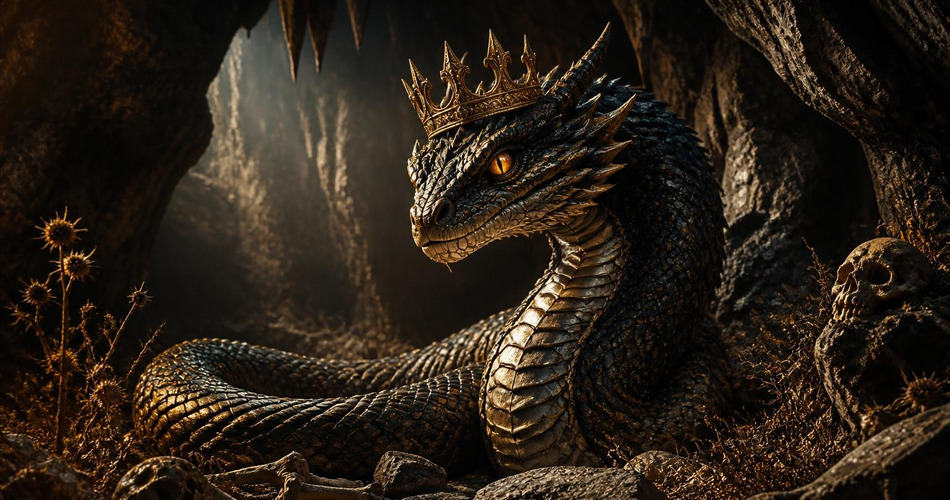
The basilisk is a legendary reptile often called the king of serpents, famed for its deadly gaze and toxic breath. In myth and folklore, it represents lethal power, fear of the unknown, and the peril of unchecked authority. Across cultures, the basilisk has been a symbol of both menace and protection, appearing in ancient texts, medieval bestiaries, and modern fantasy. Its meaning ranges from pure evil and destruction to a warning against arrogance and misuse of power.
What Does the Basilisk Symbolize?
The basilisk is primarily a symbol of deadly power and absolute fear. Its ability to kill with a glance or a breath makes it a representation of inescapable danger and the ultimate predator. It embodies the idea that some threats are so potent they cannot be confronted directly, forcing a response of either flight or total annihilation.
In medieval Christian symbolism, the basilisk was often associated with the devil and the forces of darkness. It represented sin, heresy, and the corrupting influence of evil. Its venomous nature was seen as a metaphor for the spread of false teachings or moral decay that could destroy the soul.
On a more positive note, the basilisk can also symbolize protection when its image is used as a ward against evil. In some traditions, the creature’s terrifying aspect was believed to frighten away lesser malevolent spirits or enemies.
Positive and Negative Meanings
Positive associations: In certain contexts, the basilisk’s fearsome nature is harnessed as a protective symbol. Amulets or carvings depicting the basilisk were sometimes used to guard against harm, poison, or witchcraft. Its association with the sun and fiery elements gave it a purifying quality, capable of burning away corruption.
Negative meanings: Most commonly, the basilisk represents pure evil, destruction, and deadly deception. Its gaze is synonymous with petrification — both literal and figurative — meaning a sudden, paralyzing confrontation with terror. It stands for the ruthless exercise of power that leaves no room for mercy, and its presence in folklore often heralds doom or plague.
History and Origins of the Basilisk
The earliest recorded description of the basilisk comes from ancient Greece. Pliny the Elder, writing in the first century CE, described the catoblepas, a creature with a heavy head and deadly gaze — a likely antecedent. But the definitive basilisk was detailed in Pliny’s Natural History: a small serpent no more than twelve inches long, with a white crown-like marking on its head, capable of killing plants, animals, and even men simply by looking at them or breathing near them.
During the Roman and medieval periods, the basilisk was integrated into Christian bestiaries, which often moralized its deadly nature as a warning against sin and heresy. The creature was said to be so venomous that its presence withered grass and cracked stones, and it could only be killed by the weasel or by its own reflection.
By the Renaissance, the basilisk became a fixture in heraldry and emblem books, where it stood for terror and absolute power. Its image appeared on coats of arms to intimidate enemies.
Basilisk Symbolism in Different Cultures
In European folklore, the basilisk was a creature of terror, often linked to the corruption of nature. Some accounts claimed it was born from a cock’s egg incubated by a toad or serpent, blending elements of the unnatural and the monstrous. This birth myth emphasized its hybrid and unnatural origins.
In medieval France and England, the basilisk sometimes appeared in folk medicine as a creature whose ashes or body parts could cure certain ailments, highlighting a paradox of using evil to fight evil.
In alchemy, the basilisk represented the poison that could be transformed into medicine, and its image was used to symbolize the volatile, dangerous phase of a chemical process that could lead to enlightenment if handled properly.
Spiritual Meaning of the Basilisk
In spiritual symbolism, the basilisk often represents the shadow self — the buried fears, destructive impulses, and hidden aspects of the psyche that threaten to overwhelm the conscious mind. Encountering a basilisk in a spiritual context can signify the need to confront one’s deepest anxieties without being destroyed by them.
Some esoteric traditions view the basilisk as a symbol of initiation. Its deadly gaze is seen as a test: only those with pure intentions or sufficient spiritual strength can look upon the basilisk and survive, emerging transformed and purified.
Basilisk in Myths and Folklore
The most famous myth about the basilisk involves the weasel, often the only creature capable of killing it. According to Pliny, weasels could attack and kill the basilisk, though the weasel itself would die. The weasel’s ability to survive the basilisk’s poison was sometimes attributed to its eating of rue, an herb that provided immunity.
In Polish folklore, the basilisk was known as the Bazyliszek, a monstrous creature that haunted cellars and wells. One of the most famous stories tells of a basilisk in the city of Warsaw that terrorized residents until a man with a mirror trapped it so its own gaze killed it.
In medieval bestiaries, the basilisk’s hiss was said to be audible from a distance, causing birds to fall dead from the air. These tales emphasized the indiscriminate and overwhelming nature of its destructive power.
Basilisk in Art and Literature
The basilisk appears in William Shakespeare’s play Richard III, where Queen Margaret curses Richard by comparing him to a basilisk: “Thou elvish-mark’d, abortive, rooting hog! … That when the basilisk hath kill’d his object, he turns the venom backward on himself.” This use underscores the creature’s association with treachery and self-destruction.
In modern literature, the basilisk is perhaps best known from J.K. Rowling’s Harry Potter and the Chamber of Secrets, where a giant basilisk serves as the monster living in Hogwarts’ hidden chamber. It retains its legendary deadly gaze (now causing petrification if viewed indirectly) and adds a serpentine totem for the dark wizard Salazar Slytherin.
Visual artists from the medieval period often depicted the basilisk in bestiaries and illuminated manuscripts, showing a crowned serpent or a dragon-like creature. Its image appeared in emblem books like Andrea Alciato’s Emblemata (1531), where it symbolized the destructive power of envy and slander.
Frequently Asked Questions
Q: What is the difference between a basilisk and a cockatrice?
A: In medieval folklore, the cockatrice is often considered a similar but distinct creature, sometimes born from a cock’s egg and having features of a rooster (comb and legs), while the basilisk is usually described as a pure serpent with a crown-like crest. Many modern sources blur the distinction.
Q: Is the basilisk based on a real animal?
A: Some scholars suggest that the basilisk’s legend may have been inspired by the spitting cobra, a snake that can spray venom and cause blindness, or by the Egyptian cobra, which has a hood that may resemble a crown.
Q: What does seeing a basilisk in a dream mean?
A: Dreaming of a basilisk often represents encountering a terrifying situation or inner fear that feels paralyzing. It may indicate the need to confront a seemingly insurmountable challenge or to look at one’s own destructive tendencies.
Related Symbols
- Cockatrice – A dragon-like creature with similar deadly abilities.
- Serpent – General symbol of danger, wisdom, and regeneration.
- Gorgon (Medusa) – Another monster with a gaze that turns viewers to stone.
- Dragon – A powerful reptilian symbol of chaos and treasure-guarding.
- Weasel – The basilisk’s natural enemy in folklore.