The Sphinx is a mythical creature with the body of a lion and the head of a human (or other animal), best known from ancient Egyptian and Greek traditions. As a symbol, it represents guardianship, mystery, wisdom, and the threshold between worlds. The Sphinx poses riddles and demands answers, embodying both the protective power of a sentinel and the dangerous enigma of the unknown.
What Does the Sphinx Symbolize?
The Sphinx primarily symbolizes guardianship — its most ancient role was as a protector of sacred spaces, tombs, and temples. The lion’s body conveys strength and royal authority, while the human head suggests intelligence and consciousness. This combination creates a symbol of enlightened power, where brute force is guided by reason. The Sphinx also represents mystery and the unknown, often associated with riddles, secrets, and the passage between life and death. Its position at temple entrances or tomb thresholds marks it as a boundary figure, one that both welcomes the worthy and challenges the unworthy.
Sphinx Symbolism: Positive and Negative Meanings
Positive associations: The Sphinx is seen as a wise guardian, a benevolent keeper of knowledge, and a protector of sacred truths. In Egyptian culture, it was a royal symbol of strength and intelligence, often linked to the sun god Ra and the pharaoh’s divine authority. The Sphinx’s riddle represents the challenge of self-knowledge — those who answer correctly prove their worth.
Negative meanings: In Greek myth, the Sphinx was a destructive creature that devoured those who failed to answer its riddle. Here, the Sphinx symbolizes fear of the unknown, lethal intellect, and the danger of ignorance. It can represent an unyielding obstacle or a merciless judge of human worth.
History and Origins of the Sphinx Symbol
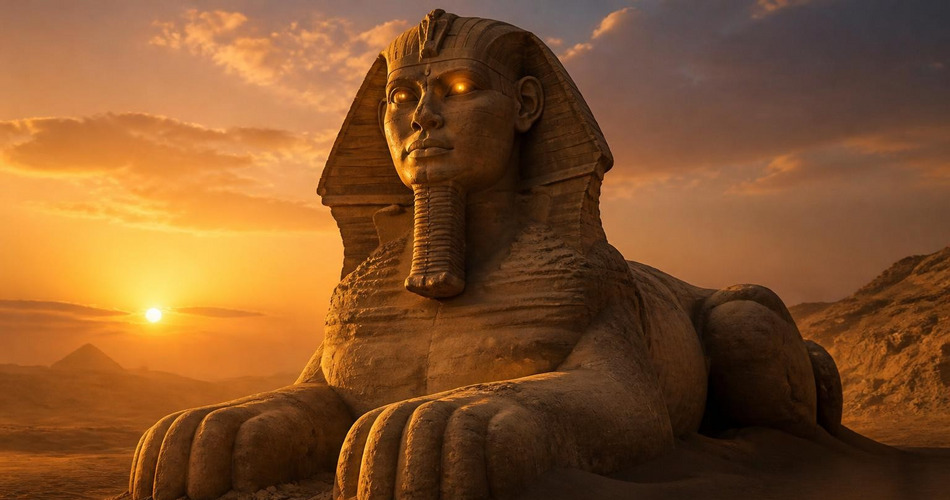
The earliest known sphinxes come from ancient Egypt, where the Great Sphinx of Giza (c. 2500 BCE) is the most famous example. Carved from limestone, it has the body of a lion and a human head thought to represent Pharaoh Khafre. Egyptian sphinxes were typically male and depicted with a nemes headdress, symbolizing royal power and protection. In contrast, the Greek sphinx was female, with the head and breasts of a woman, the body of a lion, and wings of an eagle. The Greek version appears first in the writings of Hesiod (8th century BCE), who describes it as a monstrous offspring of Orthus and the Chimera. Over time, the Sphinx spread into Near Eastern and Asian art, often taking on local features and meanings.
Symbolism of the Sphinx in Different Cultures
In Egypt, the Sphinx was a benevolent guardian of temples and tombs, especially associated with the sun and the pharaoh’s divine nature. The Great Sphinx faces east, watching the rising sun, and was linked to the god Harmachis (Horus of the Horizon). In Greek culture, the Sphinx became a female monster that terrorized Thebes, posing a riddle to all travelers. Her story is central to the myth of Oedipus. In Asian traditions, especially in India and Southeast Asia, similar lion-human hybrids (often called “purushamriga” or “narasimha”) appear as temple guardians, again emphasizing protection and spiritual watchfulness. The Sphinx thus consistently symbolizes a threshold guardian across cultures.
Spiritual Meaning of the Sphinx
Spiritually, the Sphinx represents the union of human intellect with animal instinct — the integration of mind and body on the path to enlightenment. As a guardian of sacred spaces, it marks the boundary between the material world and the divine. The Sphinx’s riddle challenges seekers to look inward, confront their own nature, and achieve self-knowledge. In esoteric traditions, the Sphinx is sometimes seen as a keeper of hidden knowledge or a symbol of the four elements (earth, air, fire, water) embodied in its composite form: lion (earth), eagle (air), human (water), and bull (fire), though variations exist.
The Sphinx in Myths and Folklore
The most famous myth involving the Sphinx is the Greek story of Oedipus. The Sphinx sat outside Thebes, demanding that travelers answer her riddle: “What creature walks on four legs in the morning, two legs at noon, and three legs in the evening?” Oedipus answered correctly: “Man — as a baby he crawls on all fours, as an adult he walks on two legs, and in old age he uses a staff.” Upon hearing the correct answer, the Sphinx killed herself. This myth highlights the Sphinx’s role as a marker of human development and the danger of failing to understand one’s own life. In Egyptian myth, the Sphinx does not pose riddles but serves as a silent protector, often associated with the sun god Ra and the afterlife.
Sphinx in Dreams
Dreaming of a Sphinx often points to a personal challenge or a hidden truth the dreamer needs to confront. The Sphinx may appear as a guardian of knowledge, indicating that the dreamer is on the verge of an important realization. Alternatively, it can represent a fear of the unknown or a sense of being tested. The dream’s context matters greatly: a friendly Sphinx suggests wisdom and protection, while a hostile one may indicate unresolved fears or obstacles.
Common Sphinx Dream Scenarios
- Being asked a riddle by a Sphinx: Reflects a real-life situation where you must solve a problem or make a difficult decision.
- Seeing a statue of a Sphinx: May signify that hidden knowledge or a secret from the past is about to be revealed.
- A Sphinx blocking your path: Represents an obstacle you perceive as overwhelming, often related to fear or lack of self-knowledge.
- A Sphinx speaking to you: Suggests an inner voice of wisdom or intuition trying to guide you.
- Defeating or passing a Sphinx: Indicates personal growth and the overcoming of a major challenge.
The Sphinx in Art and Literature
The Sphinx has been a powerful motif in Western art and literature for centuries. In ancient Greek pottery and sculpture, the Sphinx often appears as a funerary monument or a decorative element. The Great Sphinx of Giza itself has inspired countless travelers, artists, and writers. In literature, the Sphinx appears in Sophocles’ play Oedipus Rex (c. 429 BCE) as the monster defeated by Oedipus. The poem “The Sphinx” by Oscar Wilde (1894) explores the creature’s ancient mystery. In modern times, the Sphinx appears in J.K. Rowling’s Harry Potter series, where a Sphinx guards the Triwizard Cup and poses a riddle. The painting Oedipus and the Sphinx by Gustave Moreau (1864) is a famous artistic representation, and the French symbolist poet Stéphane Mallarmé also used the Sphinx as a symbol of poetic enigma.
Sphinx Tattoo Meaning
A Sphinx tattoo often represents mystery, intelligence, and personal strength. It can signify a person who has overcome a major challenge or who values wisdom above brute force. The Egyptian Sphinx is chosen for its protective qualities and connection to royalty, while the Greek Sphinx appeals to those interested in riddles, fate, and self-discovery. Placement and style vary, but the Sphinx is frequently depicted in a seated, guardian pose.
Frequently Asked Questions
Q: What does the Sphinx symbolize?
A: The Sphinx symbolizes guardianship, mystery, wisdom, and the threshold between the known and unknown, life and death.
Q: Why does the Sphinx have a human head and lion body?
A: The combination represents the union of human intelligence with animal power and strength, creating a symbol of enlightened authority.
Q: What is the Sphinx’s riddle?
A: The riddle is: What creature walks on four legs in the morning, two legs at noon, and three legs in the evening? Answer: a human.
Q: Is the Sphinx male or female?
A: In Egyptian tradition, the Sphinx is typically male; in Greek tradition, it is female.
Q: What does a Sphinx tattoo mean?
A: A Sphinx tattoo often symbolizes mystery, intelligence, protection, and overcoming challenges.
Related Symbols
- Griffin — similar composite guardian with eagle head and lion body
- Chimera — another composite monster from Greek myth
- Lion — represents strength, royalty, and protection
- Oedipus — the hero who solved the Sphinx’s riddle
- Guardian statues — such as lamassu in Mesopotamian culture