Briefly
The black dog is a powerful and ancient symbol found in folklore and mythology across Europe and beyond. It often represents a guardian of the spirit world, a psychopomp guiding souls, or an omen of death and misfortune. In positive contexts, the black dog symbolizes protection, loyalty, and transformation, while negative interpretations associate it with fear, depression, and supernatural danger. Its meaning varies greatly by culture and context, making it one of the most complex animal symbols.
What Does Black Dog Symbolize?
The black dog primarily symbolizes the threshold between life and death. As a liminal creature, it appears at crossroads, graveyards, and boundaries, acting as a guide or guardian. It also represents the shadow self—the hidden, instinctual aspects of the psyche. In many traditions, the black dog embodies loyalty and protection, especially as a faithful companion to heroes or as a guardian of sacred spaces. Conversely, it can signify depression, fear, and the unknown, often appearing as a harbinger of tragedy.
Positive and Negative Meanings
Positive associations: The black dog is seen as a protective spirit that wards off evil and guides lost souls. In Celtic mythology, it is a loyal guardian of the underworld and a helper in times of transition. Its dark color symbolizes the mysterious and the powerful, and encountering a black dog can signify a period of transformation or spiritual awakening.
Negative meanings: More commonly, the black dog is feared as an omen of death, disaster, or illness. In British folklore, sightings of a spectral black dog often precede a death in the community. It is also linked to the concept of the “black dog” of depression, a metaphor popularized by Winston Churchill, representing a heavy, dark mood that shadows one’s life.
History and Origins of the Symbolism
The black dog appears in ancient European folklore, with roots in pre-Christian beliefs about spirit animals and death omens. In Norse mythology, the black dog is associated with the goddess Hel and the underworld. In Celtic regions, the Cŵn Annwn (hounds of the Otherworld) are described as black dogs that hunt souls. The figure became prominent in medieval English folklore, where stories of black dogs like the Black Shuck of East Anglia and the Barghest of Yorkshire emerged. These tales were often used to explain unexplained deaths or strange occurrences, and the black dog became a fixture in local ghost lore.
Symbolism in Different Cultures
In British folklore, the black dog is most famously known as the Black Shuck, a large, ghostly hound said to roam the coasts and countryside, often as a portent of death. The Barghest in Northern England is a similar creature, sometimes appearing with glowing eyes. In Welsh mythology, the Cŵn Annwn are white with red ears, but black dogs also appear as guardians of the underworld. In Germanic folklore, the black dog is associated with the Wild Hunt and the god Woden. In some Native American traditions, a black dog appears as a spirit guide in vision quests, representing inner strength and protection. In Japanese folklore, the black dog (kuro inu) is sometimes a guardian of temples and a symbol of fidelity.
Spiritual Meaning
Spiritually, the black dog is often viewed as a psychopomp—a guide that helps souls transition from life to death. It can also represent the shadow self, urging individuals to confront their fears and hidden emotions. In shamanic traditions, encountering a black dog in a vision or dream may signal a need for inner transformation or a call to explore the unknown. As a spirit animal, the black dog teaches loyalty, protection, and the courage to face darkness.
In Myths and Folklore
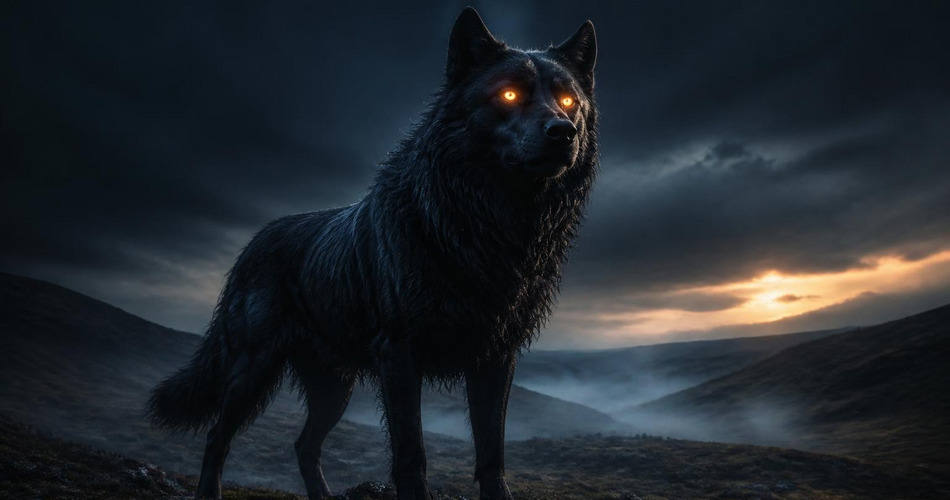
The black dog is central to many European myths. The most famous is the Black Shuck of East Anglia, a giant black dog with fiery eyes that is said to appear before storms or deaths. In Yorkshire, the Barghest is a black dog that haunts lonely roads and is considered a death omen. The Gurt Dog of Somerset is a benevolent black dog that protects travelers. In the Isle of Man, the Moddey Dhoo is a black dog that haunts Peel Castle. These myths often share common traits: the dog is large, silent, and appears at night, usually as a warning or a guardian.
In Dreams
Dreaming of a black dog often symbolizes fear, depression, or hidden emotions. It may represent a part of the dreamer’s psyche that is being ignored or repressed. A friendly black dog in a dream can indicate loyalty, protection, or a need for companionship. An aggressive or threatening black dog may reflect internal struggles, anxiety, or a sense of being pursued by one’s own shadow. The context and behavior of the dog are crucial for interpretation.
Common Dream Scenarios
- Black dog chasing you: Suggests you are running from a problem or fear that needs to be confronted.
- Black dog barking or growling: Indicates a warning about a situation or person in your waking life.
- Black dog sitting calmly: Represents inner peace, protection, or a loyal companion in your life.
- Black dog leading you somewhere: Symbolizes guidance toward a new path or spiritual insight.
- Black dog attacking: May reflect feelings of being overwhelmed by depression or a threatening situation.
In Superstitions and Omens
- Seeing a black dog at night: In many parts of Britain, this is considered an omen of death or disaster.
- A black dog crossing your path: Some traditions view this as bad luck, while others see it as a protective sign.
- Black dog howling: Believed to foretell a death in the neighborhood.
- Black dog appearing near a graveyard: Often thought to be a guardian of the dead or a restless spirit.
- Black dog following you home: In some folklore, this means you have been marked for death; in others, it means you are being protected.
In Art and Literature
The black dog appears in several notable works. In Sir Arthur Conan Doyle’s The Hound of the Baskervilles (1902), a spectral black dog is central to the mystery, representing ancestral guilt and supernatural terror. Winston Churchill famously referred to his depression as his “black dog,” a metaphor that has since become widespread in discussions of mental health. In D.H. Lawrence’s poem “The Black Dog,” the creature symbolizes raw, instinctual life force. The black dog also appears in modern fantasy literature, such as in J.K. Rowling’s Harry Potter series, where the Grim is a black dog that portends death. In visual art, the black dog is depicted in medieval manuscripts and folk art as a symbol of the devil or as a guardian of the underworld.
Tattoo Meaning
A black dog tattoo often symbolizes protection, loyalty, and overcoming fear. It can represent a personal guardian spirit or a tribute to a beloved pet. For some, it signifies a battle with depression and the strength to endure. The design may incorporate elements like glowing eyes, Celtic knots, or graveyard scenes to emphasize its supernatural or protective nature.
Meanings of Different Types, Colors, or Variations
- Black dog with glowing eyes: Often associated with supernatural power, warning, or otherworldly vision.
- Large black dog: Magnifies the symbolism of strength, fear, or protection depending on context.
- Black dog with a white patch: In some folklore, this indicates a benevolent spirit or a dog that can be seen by the pure of heart.
- Black dog in chains: Represents a bound spirit or a curse, common in tales of the Barghest.
- Black dog with no eyes: Sometimes appears in ghost stories as a particularly ominous variant.
Frequently Asked Questions
Q: Is a black dog always a bad omen?
A: No, while many traditions view it as a death omen, in Celtic and some Native American beliefs, the black dog is a protective spirit and a guide.
Q: What does it mean if I dream of a friendly black dog?
A: A friendly black dog in a dream often symbolizes loyalty, protection, or a need for companionship. It may also represent a part of yourself that is faithful and strong.
Q: How is the black dog connected to depression?
A: The phrase “black dog” as a metaphor for depression was popularized by Winston Churchill, but it has older roots in folklore where the creature embodies a heavy, dark mood.
Q: What is the difference between Black Shuck and the Barghest?
A: Black Shuck is specific to East Anglia and often appears as a large, shaggy dog with fiery eyes. The Barghest is from Yorkshire and is sometimes described as a black dog with chains or a headless form, but both are death omens.
Related Symbols
- Hellhound – A supernatural dog that guards the underworld, often black.
- Cerberus – The three-headed dog of Greek mythology, guardian of Hades.
- Grim – A black dog in Harry Potter that portends death.
- Cŵn Annwn – The hounds of the Welsh Otherworld, sometimes black.
- Shadow self – The dark, unconscious aspects of the psyche, symbolized by the black dog.