Briefly
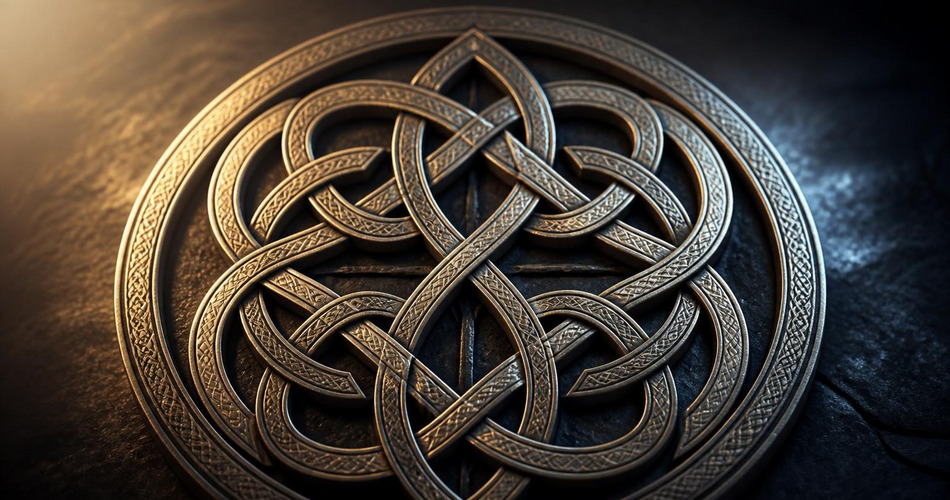
The Celtic knot is a decorative design characterized by continuous, interlacing lines with no beginning or end. It symbolizes eternity, the interconnectedness of life, and the cyclical nature of existence. Originating in early medieval Celtic art, these knots appear in stone carvings, illuminated manuscripts, and metalwork, often carrying spiritual and protective meanings.
What Does Celtic Knot Symbolize?
At its core, the Celtic knot represents eternity and the unending cycle of life, death, and rebirth. The endless loops convey the idea that all things are connected and that time is a continuous flow. In Celtic Christianity, the knot also symbolizes the Holy Trinity – Father, Son, and Holy Spirit – especially in the triquetra (three-cornered knot). Beyond religious contexts, the knot stands for protection, unity, and the binding together of people or ideas.
The intricate interlacing is often seen as a metaphor for the complexity of life’s journey. Each line crossing another suggests that every action and relationship is intertwined with others, creating a whole that is greater than its parts. This makes the Celtic knot a powerful emblem of interdependence and harmony.
Positive and Negative Meanings of Celtic Knot
Positive associations: The Celtic knot is overwhelmingly viewed as a positive symbol. It evokes eternity, enduring love, spiritual connection, and protection. Many people wear Celtic knot jewelry as a talisman for good luck, safety, and to honor their heritage. In weddings, the knot is used to represent the unbreakable bond between partners.
Negative meanings: Negative interpretations are rare, but some see the knot’s endless complexity as a symbol of confusion or being trapped in a cycle. When the design becomes tangled or chaotic, it can suggest entanglement in difficult circumstances or an inability to find a clear path. However, these negative readings are not traditional and are largely modern, personal associations.
History and Origins of Celtic Knot Symbolism
The earliest known Celtic knots appear in the 5th century AD, evolving from earlier spiral and step patterns found in La Tène culture. They flourished in early medieval Ireland and Britain, especially in illuminated manuscripts such as the Book of Kells (c. 800 AD) and the Lindisfarne Gospels (c. 700 AD). These manuscripts used intricate knotwork to decorate religious texts, often framing the first letters of important passages.
Celtic knots also appear on stone crosses, such as the high crosses of Ireland (e.g., the Cross of Muiredach at Monasterboice), where they served as both decoration and a visual representation of Christian theology. In metalwork, the Ardagh Chalice and the Tara Brooch feature fine knotwork patterns, demonstrating the skill of Celtic artisans. The tradition continued through the Middle Ages and experienced a revival in the 19th and 20th centuries as part of the Celtic Revival movement, which reclaimed these symbols as emblems of national and cultural identity.
Symbolism in Different Cultures
While the Celtic knot is most strongly associated with Celtic cultures, similar interlacing patterns appear in other traditions. In Norse and Viking art, for example, knotwork is common on runestones and jewelry, often representing protection and the interconnectedness of the nine worlds. In Islamic art, geometric interlacing (girih) serves a similar purpose of expressing the infinite nature of God, though it uses straight lines and stars rather than continuous curves.
Within Celtic cultures, the knot took on specific meanings depending on the region. In Ireland, the triquetra became a symbol of the Holy Trinity and is still used in Christian iconography. In Scotland, the Dara knot (from the Gaelic “doire,” meaning oak) represents strength and endurance, drawing on the oak tree’s symbolism. The knotwork on the Celtic cross combines the cross with a circular knot, merging Christian and pre-Christian sun symbolism.
Spiritual Meaning of Celtic Knot
The spiritual meaning of the Celtic knot centers on the idea of oneness with the divine and the universe. The unbroken line suggests that the soul is eternal and that life continues beyond physical death. In Celtic Christianity, the knot was used as a meditation tool to contemplate the mystery of the Trinity and the interconnectedness of all creation.
For those who follow modern pagan or druidic paths, the Celtic knot represents the cycles of nature – the turning of the seasons, the phases of the moon, and the journey of the soul through multiple lifetimes. Wearing or drawing a Celtic knot is believed to create a protective barrier, as the continuous loops are thought to confuse and trap negative energies or evil spirits.
Celtic Knot in Myths and Folklore
Celtic knots appear in several myths and folk traditions. In Irish legend, the triquetra is sometimes associated with the goddess Brigid and the three aspects of the feminine (maiden, mother, crone). The knot’s three points also correspond to the elements of earth, sea, and sky in some Celtic cosmological beliefs.
Folklore holds that Celtic knots were used as protective charms. Warriors would carve knots into their shields and swords to ensure victory and safety in battle. Homes were decorated with knotwork over doorways to prevent evil from entering. In some tales, a person who could draw a perfect, unbroken knot was considered blessed or specially favored by the gods. The knot also appears in the story of the Salmon of Wisdom – the salmon’s scales are sometimes depicted as interlacing patterns, symbolizing the interconnected knowledge of the world.
Celtic Knot in Dreams
Dreaming of a Celtic knot can carry several meanings, often related to the dreamer’s current life situation. Because the knot has no beginning or end, it may reflect a sense of being caught in a repeating pattern or cycle – either positive (a happy routine) or negative (a problem that keeps recurring). The complexity of the knot can indicate a situation that feels tangled or overwhelming.
If the knot appears beautifully formed and symmetrical, it may symbolize harmony and balance in relationships or personal growth. A broken or incomplete knot might suggest a need to resolve unfinished business or to find closure. The specific color or material of the knot in the dream can also add nuance: a golden knot could represent spiritual wealth, while a dark, tangled knot might warn of confusion or hidden obstacles.
Common Dream Scenarios
- Seeing a single, clear Celtic knot: Represents unity, eternal bonds, or a spiritual connection that is strong and unbroken.
- A tangled or messy knot: Suggests confusion, a complicated relationship, or a situation that needs careful untangling.
- Drawing or creating a Celtic knot: Indicates a desire to bring order to chaos or to express creativity in solving a problem.
- Receiving a Celtic knot as a gift: Symbolizes a lasting promise, friendship, or commitment from someone.
- A knot that glows or emits light: Points to spiritual awakening, enlightenment, or divine guidance.
Celtic Knot in Superstitions and Omens
In traditional Celtic cultures, the knot was considered a powerful omen of protection. It was common to place a knot over the cradle of a newborn to ward off evil spirits and ensure a healthy life. Sailors would tattoo or carve knots onto their ships for safe passage, believing the endless pattern would guide them home.
Some superstitions held that if you found a natural knot in wood (a “witch’s knot”), it was a sign of hidden danger or a trickster spirit nearby. Conversely, finding a perfectly formed knot in a piece of jewelry or stone was seen as a good omen, indicating that the wearer was under divine protection. Even today, many people wear Celtic knot rings or pendants as a charm to bring good luck and to keep negative energies at bay.
Celtic Knot in Art and Literature
The most famous examples of Celtic knotwork in art are the Book of Kells and the Lindisfarne Gospels. In the Book of Kells, the Chi-Rho page features elaborate interlacing patterns that fill the entire background, symbolizing the infinite nature of Christ. The Lindisfarne Gospels include intricate knotwork borders that frame each Gospel, with each knot unique in its design.
In literature, Celtic knots appear in J.R.R. Tolkien’s The Lord of the Rings – the doors of Moria are decorated with interlocking patterns reminiscent of Celtic art, though Tolkien drew from a mix of Norse and Celtic sources. More recently, the knot has been used in fantasy series like Outlander by Diana Gabaldon, where Celtic knot jewelry appears as symbols of clan loyalty and eternal love. In poetry, the knot often serves as a metaphor for the intertwining of fates or the enduring nature of love, as seen in the works of W.B. Yeats and other Irish poets.
Celtic Knot Tattoo Meaning
Celtic knot tattoos are among the most popular choices for those seeking body art with deep symbolism. The tattoo often represents eternity, a commitment to one’s heritage, or a spiritual belief. Many people choose the triquetra to signify faith, while the Dara knot is favored for its association with inner strength and resilience.
The continuous line of the knot makes it an ideal symbol for everlasting love or friendship, and couples sometimes get matching Celtic knot tattoos to represent their unbreakable bond. The placement of the tattoo can also add meaning: a knot on the wrist may symbolize a connection to the divine, while one on the chest or back can represent protection over the heart. Because the knot has no end, it is also a popular choice for memorial tattoos, honoring a loved one whose memory lives on.
Meanings of Different Types of Celtic Knot
- Triquetra (Trinity Knot): Three-pointed knot representing the Holy Trinity, the triple goddess, or the three elements (earth, sea, sky). Symbolizes unity and spiritual balance.
- Dara Knot: Derived from the oak tree, this knot symbolizes strength, endurance, and wisdom. Often used to represent a strong foundation or inner power.
- Quaternary Knot: A four-cornered knot that can represent the four seasons, the four directions, or the four Gospels. Symbolizes completeness and the cycle of life.
- Shield Knot: A square or rectangular knot used as a protective symbol, often placed on weapons or shields. Represents safety and defense against harm.
- Love Knot: Two interlocking loops symbolizing the union of two people. Popular in wedding rings and romantic jewelry.
- Spiral Knot: A single continuous line that spirals inward, representing growth, evolution, and the journey of the soul.
Frequently Asked Questions
Q: What does a Celtic knot symbolize?
A: A Celtic knot primarily symbolizes eternity, interconnectedness, and the cyclical nature of life. It can also represent protection, faith, and unity, depending on the specific design.
Q: Is the Celtic knot a Christian symbol?
A: The Celtic knot was used in both pre-Christian and Christian contexts. In Celtic Christianity, it became a symbol of the Holy Trinity, but it also has pagan roots representing nature cycles and the divine feminine.
Q: What is the difference between a triquetra and a Celtic knot?
A: A triquetra is a specific type of three-cornered Celtic knot. All triquetras are Celtic knots, but not all Celtic knots are triquetras – there are many variations with different numbers of corners and interlacing patterns.
Q: Can I wear a Celtic knot if I’m not of Celtic heritage?
A: Yes, the Celtic knot is a universal symbol of eternity and connection. Many people wear it for its aesthetic beauty and spiritual meaning, regardless of their ancestry.
Q: What does a Celtic knot tattoo mean?
A: A Celtic knot tattoo often represents eternal love, protection, heritage, or spiritual faith. The specific meaning can vary based on the type of knot and the wearer’s personal intention.
Related Symbols
- Triquetra – a three-pointed knot representing the Trinity or triple goddess
- Celtic Cross – a cross with a circular knot, merging Christian and sun symbolism
- Triskelion – a three-spiral symbol representing motion, progress, and cycles
- Spiral – a continuous curve symbolizing growth and evolution
- Interlace – a broader category of decorative knotwork found in many cultures
- Claddagh – a traditional Irish symbol of love, loyalty, and friendship (though not a knot, often combined with knotwork)