Briefly
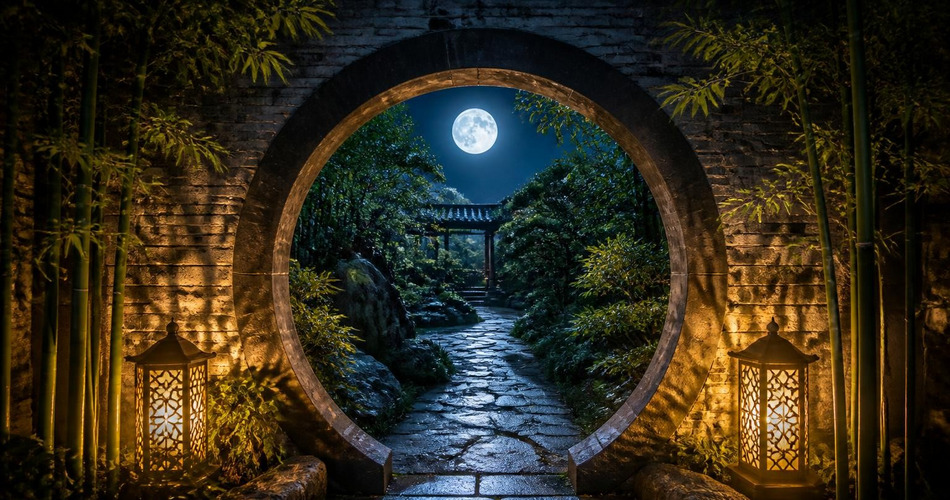
A moon gate is a circular opening in a wall or garden, traditionally used in Chinese and East Asian landscapes. It symbolizes a threshold between worlds, inviting passage from the mundane to the sacred. As a symbol, it represents harmony, balance, and the cyclical nature of life, often flanked by yin-yang duality. Moon gates are also associated with good fortune, protection, and spiritual renewal.
What Does a Moon Gate Symbolize?
A moon gate is a circular opening that serves as both a literal and metaphorical passageway. In traditional Chinese gardens, it frames a view beyond, symbolizing a transition from one realm to another—often from the secular world into a more contemplative or spiritual space. The circle itself is a powerful geometric shape, representing wholeness, unity, and the infinite cycle of life, death, and rebirth.
Moon gates are also linked to the concept of yin-yang balance, with the circular form echoing the full moon, a symbol of completeness and harmony. In garden design, they create a sense of mystery and anticipation, as they partially reveal what lies beyond, encouraging exploration and introspection.
Positive and Negative Meanings
Positive associations: Moon gates evoke feelings of tranquility, balance, and spiritual connection. They symbolize a welcoming threshold, inviting passage into a peaceful garden or sacred space. The circular shape is often seen as a protective barrier that keeps negative energies at bay while allowing positive flow.
Negative meanings: In some contexts, the moon gate can represent a barrier or separation—an entrance that is not freely accessible, especially when locked or guarded. The circular opening may also suggest a limited perspective, as the view is confined to what is framed within the circle, potentially symbolizing restricted vision or opportunity. In certain superstitions, a moon gate oriented incorrectly or placed inauspiciously can be thought to disrupt feng shui energy, blocking good fortune.
History and Origins of Moon Gate Symbolism
The moon gate originated in traditional Chinese garden architecture during the Ming and Qing dynasties, when garden design became a refined art form emphasizing harmony with nature. These circular doorways were often created by wealthy scholars and aristocrats as part of private retreats meant to evoke a sense of serenity and cosmic balance.
The symbolism of the moon gate is deeply tied to feng shui, the ancient Chinese practice of arranging space to channel beneficial energy. The circular shape is considered auspicious, promoting the flow of chi (qi) while curving around negative influences. Over time, moon gates spread to Japan, Korea, and other parts of East Asia, where they were adapted into Buddhist temple gardens and Japanese tea gardens, maintaining their role as thresholds between the everyday and the sacred.
Symbolism in Different Cultures
In Chinese culture, moon gates are synonymous with the concept of “the moon gate” as a frame for viewing gardens—often called “moon-viewing gates” during the Mid-Autumn Festival. They symbolize reunion, as the full moon is a metaphor for family gatherings and completeness. In Japanese gardens, moon gates (called “tsukimigata” or moon-viewing openings) serve similar purposes, integrated into tea houses and stroll gardens to frame natural scenery like cherry blossoms or autumn leaves, symbolizing the ephemeral beauty of nature.
Outside East Asia, moon gates were adopted in 18th and 19th century European garden designs, especially in England, influenced by chinoiserie trends. In the West, they are often seen as exotic decorative features in public parks, botanical gardens, and private estates, associated with tranquility and Eastern philosophy.
Spiritual Meaning of the Moon Gate
Spiritually, moon gates represent a portal between the material world and a more enlightened state of being. Passing through a moon gate is akin to a symbolic rebirth—leaving behind the clutter of daily life and entering a space of meditation or introspection. The circular form evokes the Buddhist concept of the “full moon” of enlightenment, and in Daoist thought, it reflects the harmony of yin and yang.
In contemporary spiritual practice, moon gates are sometimes used in outdoor meditation gardens or labyrinths, where walking through the gate marks a transition into a sacred space. They can also represent the womb-like nature of the universe, offering protection and a sense of returning to the source.
Moon Gate in Myths and Folklore
In Chinese folklore, the moon gate is sometimes associated with the Moon Goddess Chang’e, who lives on the moon. Gardens with moon gates were believed to be places where the goddess might appear during the full moon, bringing blessings of fertility and longevity. In some legends, passing through a moon gate at midnight during a lunar eclipse was thought to grant wishes or open a path to a parallel world.
In Japanese folklore, the moon gate is linked to the rabbit on the moon (the tsuki no usagi), a motif in the story of the Moon Rabbit pounding mochi. The circular gate frames the moon in a way that connects the garden viewer to this celestial tale, reinforcing themes of patience and sacrifice.
Moon Gate in Dreams
Dreaming of a moon gate often signals a transition or new phase in life. The gate represents a choice or threshold that the dreamer must step through, and the circular shape suggests that this transition may lead to a more balanced, rounded perspective. If the gate is open, it indicates welcome opportunities; if closed or blocked, it may reflect hesitation or obstacles.
Common Dream Scenarios
- Walking through a moon gate: Symbolizes taking a step into the unknown, often associated with personal growth or spiritual awakening.
- Seeing a moon gate from a distance: Suggests a goal or destination that is not yet reached, prompting patience and perseverance.
- Moon gate that is broken or damaged: May indicate a fractured sense of harmony or a disruption in life’s cycles.
Moon Gate in Superstitions and Omens
In traditional Chinese feng shui, a moon gate placed at the entrance of a home or garden is believed to attract prosperity and positive energy. However, if the gate faces a sharp corner or road, it can be considered an omen of misfortune, as it may channel negative energy (sha chi) into the space. In some rural Chinese communities, it is said that a moon gate should never be installed in a bedroom or directly facing a kitchen, as this disrupts the flow of chi for sleep and sustenance.
Moon Gate in Art and Literature
In visual art, moon gates appear frequently in traditional Chinese ink paintings, such as those from the Ming dynasty, where they frame landscapes of bamboo, rocks, and water. A notable example is the painting “Moon Gate” by the artist Gui Fu (18th century), which depicts a garden scene with a moon gate as the central compositional element, symbolizing tranquility and the harmony of nature.
In literature, moon gates are referenced in the Chinese classic “The Dream of the Red Chamber” by Cao Xueqin, where they form part of the elaborate garden setting, representing the boundary between the main characters’ inner emotional world and the outside social realm.
Frequently Asked Questions
Q: What does a moon gate symbolize?
A: A moon gate symbolizes transition, harmony, and spiritual passage, often serving as a threshold between the mundane and the sacred in garden architecture.
Q: Is a moon gate good luck?
A: In feng shui, a properly placed moon gate is considered very auspicious, promoting the flow of positive chi and protecting from negative energies. However, incorrect placement can have the opposite effect.
Q: Can moon gates be found outside of Asia?
A: Yes, moon gates became popular in Europe and North America from the 18th century onward, especially in chinoiserie garden designs and botanical gardens.
Related Symbols
- Circle: The moon gate’s shape evokes the circle as a symbol of unity and eternity.
- Gateway: A broader symbol of thresholds and transitions in architecture and lore.
- Yin-Yang: Duality and balance, often reflected in the circular moon gate.
- Full Moon: Completeness, illumination, and cyclical renewal, directly connected to the moon gate’s name and shape.