Briefly
The number five is a symbol of balance, humanity, and the physical world. It represents the five senses, the five fingers, and the five elements in many traditions. As a number that sits at the midpoint of the decimal system, five is often associated with harmony, adaptability, and the human experience. It appears in religious texts, folklore, and everyday life as a marker of completeness and order.
What Does Number Five Symbolize?
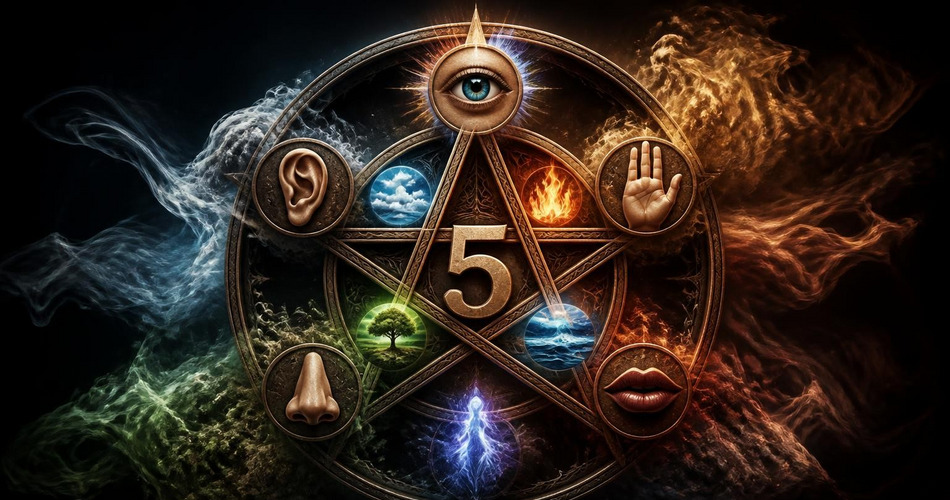
The number five symbolizes the human being and the physical realm. It is linked to the five senses (sight, hearing, touch, taste, smell) and the five extremities (two arms, two legs, head). In many cultures, five represents the five elements: earth, water, fire, air, and spirit (or ether). This makes five a symbol of wholeness and the integration of body and soul. In numerology, five is associated with adventure, freedom, and change. It is a dynamic number that encourages exploration and adaptability.
Beyond the physical, five also represents the midpoint between the spiritual and material. Its appearance in sacred geometry—especially the pentagram—links it to protection and divine order. The number five is often seen as a bridge between the known and the unknown, inviting growth through experience.
Positive and Negative Meanings
Positive associations: Five is seen as a number of balance, health, and vitality. It represents the human capacity for growth, learning, and sensory experience. In many systems, five is considered lucky and protective, such as the five-pointed star (pentagram) used for warding off evil. In numerology, five brings energy, curiosity, and the courage to embrace change.
Negative meanings: Five can also symbolize restlessness, conflict, and instability. Its association with change can lead to unpredictability and a lack of commitment. In some contexts, the pentagram is linked to dark magic or inverted meanings, especially when turned upside down. The number five’s dual nature reflects both the freedom of exploration and the chaos of constant movement.
History and Origins of Number Five Symbolism
The symbolism of five dates back to ancient civilizations. The Pythagoreans revered five as the number of marriage because it combines the first even number (two, female) and the first odd number (three, male). In ancient China, five was central to the Wu Xing system of five elements (wood, fire, earth, metal, water). The pentagram was used in Mesopotamia as a symbol of protection and was later adopted by Greek philosophers.
The number five appears in the five books of the Torah (Pentateuch) and the five pillars of Islam. In Christianity, the five wounds of Christ are a powerful symbol of sacrifice and grace. These historical roots show five’s enduring significance across cultures and belief systems.
Number Five Symbolism in Different Cultures
In Chinese culture, five is associated with the five elements (Wu Xing) and the five directions (north, south, east, west, center). It also appears in the five virtues (benevolence, righteousness, propriety, wisdom, fidelity). In Hinduism, five is sacred, representing the five elements (Pancha Bhoota) and the five senses. The pentagram is a common symbol in Western occult traditions, often representing the five wounds of Christ in Christianity or the elements in Wicca.
In Japanese culture, the five rings (Godai) represent earth, water, fire, wind, and void. In Native American traditions, five often appears in sacred patterns and the five directions (including above and below). The number five is also prominent in Islamic art, where the five pillars are a central tenet of faith.
Spiritual Meaning of Number Five
Spiritually, the number five represents the connection between the physical and the divine. It is the number of the human being as a microcosm of the universe. In many spiritual paths, five is a number of grace, as seen in the five wounds of Christ or the five virtues in Sikhism. The pentagram is used in Wicca and other pagan traditions to symbolize the elements and spirit.
Five encourages spiritual growth through experience and sensory awareness. It reminds us that the physical world is a classroom for the soul. In meditation and energy work, five is often associated with the throat chakra (fifth chakra), which governs communication and truth. The number five thus serves as a guide for integrating body, mind, and spirit.
Number Five in Myths and Folklore
The number five appears in many myths. In Greek mythology, the five ages of man are described by Hesiod: Golden, Silver, Bronze, Heroic, and Iron. The five rivers of the underworld (Styx, Lethe, Acheron, Phlegethon, and Cocytus) are part of Greek lore. In Norse mythology, there are five elements or realms in some accounts. In folklore, five-leaf clovers are considered extremely lucky, and five-pointed stars are used in protective charms.
The number five is also common in fairy tales, such as the five brothers who each have a special skill, or the five tasks a hero must complete. In many cultures, the number five is a threshold number—enough to create a pattern but not so many as to overwhelm. This makes it a recurring motif in stories of transformation and quest.
Number Five in Dreams
Dreaming of the number five may symbolize change, adventure, or a need for balance. It can indicate a period of transition or the need to use all five senses. Common dream scenarios include seeing the number five on a clock, a house number, or in a sequence. However, dream interpretation is subjective and varies by context.
Common Dream Scenarios
- Seeing the number five on a clock: may indicate a need for change or awareness of time.
- Finding five coins: could represent abundance or value.
- A five-pointed star: may symbolize protection or spiritual guidance.
- Five people in a dream: might represent social connections or teamwork.
Number Five in Superstitions and Omens
The number five is often considered lucky in many cultures. Friday the 13th is unlucky, but Friday itself (the fifth day) is sometimes seen as favorable. In some traditions, a five-leaf clover is extremely lucky. The pentagram is used as a protective symbol against evil. However, in some Western contexts, an inverted pentagram is associated with Satanism and considered an omen of darkness.
Five is also the number of points on a star, often used in flags and emblems to represent unity and aspiration. In gambling, the number five appears on dice and cards, sometimes carrying a neutral or positive connotation. Overall, five is more often seen as a protective and fortunate number than a negative one.
Number Five in Art and Literature
The number five appears in many works of art and literature. In literature, the five books of the Torah are foundational to Judaism and Christianity. Shakespeare’s plays are structured in five acts, a convention that emphasizes dramatic arc and resolution. In art, the pentagram is a common geometric figure in Renaissance works, such as Leonardo da Vinci’s Vitruvian Man, which explores human proportions based on five.
In modern culture, the five rings of the Olympic Games symbolize the unity of five continents. The number five is also central in Enid Blyton’s The Famous Five series, where five children share adventures. In music, the fifth interval (perfect fifth) is fundamental to harmony. These examples show how five continues to shape creative expression.
Number Five Tattoo Meaning
The number five is a popular tattoo choice. It can represent a person’s five senses, five family members, or a significant date. The pentagram tattoo is common in pagan and occult communities, symbolizing protection and the elements. A five-pointed star tattoo often signifies achievement or guidance. Some people tattoo the number five to mark a life-changing event or to embody the energy of change and freedom.
In minimalist designs, the Roman numeral V is used to represent five. The number five tattoo can also be combined with other symbols, such as the five elements or a compass, to deepen its meaning. As with any tattoo, the personal significance of five varies widely, but its core associations with balance and humanity make it a versatile symbol.
Meanings of Different Variations of Number Five
While the number five itself carries consistent symbolism, its visual representations can add nuance. The pentagram (a five-pointed star) is the most common geometric form, often used in protective and spiritual contexts. The Roman numeral V is associated with victory and strength. In Chinese culture, the character 五 (wǔ) is used in calligraphy and carries the same elemental meanings.
In color symbolism, five is not directly tied to a single color, but in systems like the five elements, each element has a color: wood (green), fire (red), earth (yellow), metal (white), water (black). These color associations can influence the meaning of five in art and design.
Frequently Asked Questions
Q: Why is the number five considered lucky?
A: In many cultures, five represents balance and the human senses, and it appears in protective symbols like the pentagram. It is also the midpoint of the decimal system, associated with harmony.
Q: What does the number five mean in the Bible?
A: In Christianity, five symbolizes grace, as seen in the five wounds of Christ and the five books of the Torah. It also appears in the five loaves and two fish miracle.
Q: Is the number five a good number for numerology?
A: In numerology, five is considered a dynamic number representing change, freedom, and adventure. It is generally positive but can indicate restlessness.
Q: What is the spiritual meaning of five?
A: Spiritually, five represents the human being as a bridge between the physical and spiritual worlds, often linked to the five elements and the senses.
Related Symbols
- Pentagram
- Five Elements
- Five Senses
- Five-pointed Star
- Wu Xing