Briefly
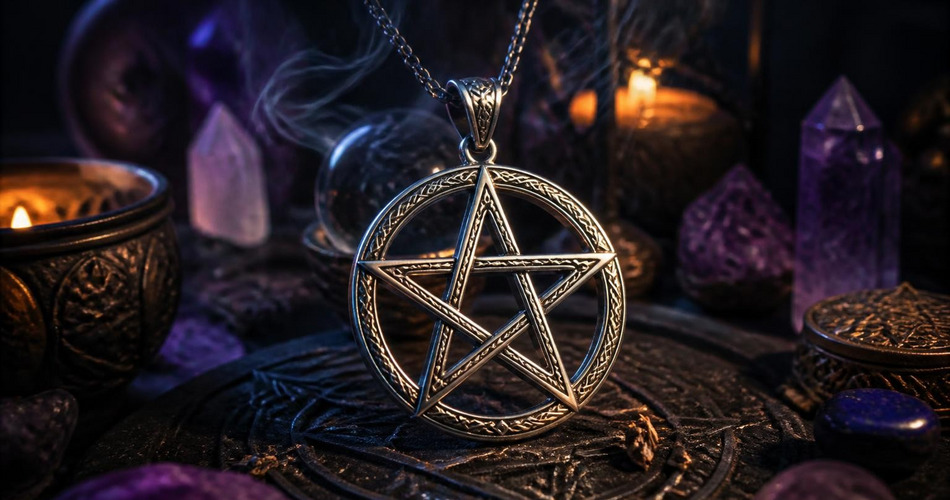
The pentacle is a five-pointed star enclosed within a circle, a symbol with roots in ancient mathematics, ritual magic, and modern religious movements. In contemporary Wicca and Paganism, it represents the four classical elements of earth, air, fire, and water, crowned by spirit, and is worn or used as a protective amulet. Historically, the pentagram was also a Christian symbol of the five wounds of Christ and a magical sign in medieval grimoires. Its meanings shift with context: a symbol of balance and protection to some, a misunderstood sign of evil to others.
What Does the Pentacle Symbolize?
The pentacle is most broadly understood as a symbol of balance — the harmonious relationship between the physical and spiritual worlds. The five points have been interpreted in many ways: the five senses, the five elements, or the five sacred wounds of Christ. The enclosing circle suggests wholeness, eternity, and protection, containing the star’s power within a closed boundary.
In Western esoteric traditions, the pentacle is a tool of ritual focus. As a physical disc, it can be placed on an altar to represent earth, while the drawn or inscribed pentagram is used to invoke or banish energies. Its geometric perfection — the golden ratio appears naturally within the star — has also given it a long association with divine proportion and cosmic order.
Positive and Negative Meanings
Positive associations: The pentacle is most often regarded as a protective emblem. In Wicca, it is a symbol of faith, worn openly by practitioners to signal their spirituality and to guard against harmful influences. Its five points, aligned with the elements plus spirit, represent a complete and integrated worldview. Many people use it as a focus for meditation, a representation of personal transformation, or a reminder of the connection between self and universe.
Negative meanings: Because it was later adopted by occult groups and popularized in horror media, the inverted pentacle came to be widely associated with Satanism and evil. This association was cemented by the nineteenth-century occultist Éliphas Lévi, who linked the inverted star to the demonic, and reinforced throughout the twentieth century by films and sensational literature. For many people, any form of the pentacle still reads primarily as a threatening or anti-Christian symbol, regardless of its original meaning.
History and Origins of the Pentacle Symbol
The word pentacle likely derives from the Old French pentacule or the Latin pentaculum, meaning a figure of five — but the actual symbol is far older. The pentagram appears on Mesopotamian pottery and on ancient Greek coins, where it was associated with health and the goddess Hygieia. It also appeared on early Christian seals and amulets, where it was read as an allegory of the five senses or the five wounds of Christ.
During the medieval period, the pentacle became a standard magical diagram in European grimoires. Texts such as the Key of Solomon instructed practitioners to draw pentacles on parchment or metal to summon spirits, gain invisibility, or obtain protection. By the Renaissance, scholars linked the star to the five Platonic elements and to the Pythagorean tradition, where the pentagram served as a secret sign of recognition among followers.
The modern revival of the pentacle came through the Hermetic Order of the Golden Dawn and later through Gerald Gardner, the founder of Wicca in the 1950s. Gardner adapted the ceremonial magic of the Golden Dawn into a religious framework, making the pentacle a central altar tool and wearable symbol for Wiccans and other Pagans. Since then, the pentacle has grown from a niche occult emblem into a widely recognized sign of modern nature-based spirituality.
Pentacle Symbolism in Different Cultures
Although the pentacle is now strongly identified with Western esotericism and Wicca, its symbolism has varied considerably across cultures and eras. In ancient China and Japan, the pentagram appeared as a geometric motif with cosmological associations, though without the specific magical or religious meanings it acquired in Europe.
Among early Christians, the pentagram was used discreetly to represent the five wounds of Christ and, by extension, truth and protection. The Emperor Constantine reportedly used the seal of five in his own signet ring. In Islamic art, the five-pointed star appears in geometric ornament as a symbol of the five pillars of Islam, though it is not identical to the Western pentacle.
In Celtic and Germanic folklore, the pentagram — often called the fairy’s foot or druid’s foot — was traced on doorways and cattle to keep away fairies, witches, and other harmful beings. These folk customs show how the pentacle’s protective function was deeply embedded in common culture long before its modern occult reputation.
Pentacle Spiritual Meaning
In contemporary spiritual practice, the pentacle is a concrete and practical symbol. The upward-pointing pentagram is said to align spirit above matter, representing the soul’s ascent and the proper ordering of the elements. The downward-pointing variant, in modern Wiccan interpretation, is associated with initiation or the descent of spirit into matter — though it carries no inherently evil meaning within these traditions.
As an altar tool, the pentacle disc is often consecrated to represent the element earth. It is used to consecrate food, charging it with intention before ritual meals, or to draw down energy from the divine. For many practitioners, the pentacle also functions as a devotional object, worn as jewelry to express faith and offer ongoing protection to the wearer. It symbolizes not only belief but participation in a living religious tradition centered on nature, balance, and personal responsibility.
Pentacle in Myths and Folklore
Folk traditions from the British Isles and northern Europe portray the five-pointed star as a deterrent against supernatural beings. In Scotland, the pentagram was known as the fairy’s foot and was engraved on stones or carved into wood to prevent fairies from stealing livestock or leading travelers astray. Similar beliefs appeared in Germany, where the pentagram was called Drudenfuß, or “drude’s foot,” named after a kind of malevolent night spirit.
These customs placed the pentacle on thresholds, cradles, and stable doors as a boundary that evil could not cross. The circle drawn around the star strengthened that boundary, marking the pentacle as a closed sacred space. Over time, these folk meanings blended with learned magic, so that the pentacle served both village people and ceremonial magicians as a symbol of warding and control.
Pentacle in Dreams
Dreams involving a pentacle are often interpreted by modern spiritual writers as signals of balance, protection, or an awakening interest in esoteric knowledge. A pentacle appearing in a dream may point to a need for harmony between competing parts of life — work and rest, body and mind, material and spiritual concerns. Because the symbol is also linked to the element earth, it can indicate groundedness or, conversely, a lack of it.
Given the pentacle’s controversial reputation, dream meaning depends heavily on the dreamer’s personal feelings. Someone raised in a Christian or conservative environment may dream of the pentacle as a disturbing or frightening image, reflecting anxiety about occult influences. A Pagan or spiritually curious dreamer, by contrast, may experience the same symbol as reassuring and empowering. Context, emotional tone, and the orientation of the star all matter in personal dream interpretation.
Common Pentacle Dream Scenarios
- Finding a pentacle: May suggest discovery of a hidden inner strength or an invitation to explore spiritual topics.
- Wearing a pentacle: Often reflects commitment to a set of values, or a desire to be recognized for one’s beliefs.
- A broken or fallen pentacle: May point to feeling disconnected, unbalanced, or uncertain in one’s spiritual path.
- An inverted pentacle: Can evoke fear or guilt if the dreamer associates it with evil, or signal a radical transformation if the dreamer views it positively.
- Drawing a pentacle: Suggests an urge to take control of one’s circumstances, create boundaries, or begin a ritual of personal change.
Pentacle in Superstitions and Omens
In folk superstition, the pentacle has consistently been treated as a defensive sign. It was nailed to doors to block witchcraft, carved into cradle posts to protect infants, and placed on sickbeds to ward off disease. The circle around the star was a key part of the magic: it closed the symbol, preventing evil from slipping between the points. In this light, seeing a pentacle was generally understood as a good omen, a sign that protection was near.
The inverted pentacle, however, became an omen of the opposite kind in modern popular culture. Beginning with Éliphas Lévi’s 1855 book Dogme et Rituel de la Haute Magie, the two-horned inverted star was presented as a symbol of evil and was subsequently adopted by groups identifying as Satanist. Today, many people view an upside-down pentacle as an ill omen or a declaration of hostile intent, even though this interpretation was invented relatively recently and is not shared by most modern Pagans.
Pentacle in Art and Literature
One of the most prominent literary appearances of the pentacle is in Johann Wolfgang von Goethe’s Faust (1808), where a pentagram drawn on the scholar’s doorway prevents Mephistopheles from leaving the room. Goethe used the folk belief in the pentagram as a binding symbol, and the scene continues to shape how many readers imagine the symbol’s magical power.
In visual art, Renaissance and Baroque painters occasionally included pentagrams to signal divine proportion or hidden knowledge. Albrecht Dürer’s interest in geometry and proportion reflects the intellectual world in which the pentagram was studied as a symbol of cosmic harmony. The pentacle also appears throughout nineteenth-century occult illustration, most famously in the works of Éliphas Lévi, whose engravings of the Baphomet placed a pentagram on the figure’s forehead and fixed the symbol’s modern occult identity.
In contemporary fiction, the pentacle is a staple of fantasy and horror. Films such as The Exorcist (1973) and television series like Supernatural use pentacles and pentagrams to signal demonic presence, ritual power, or protective magic. These works have largely replaced older folk traditions in the popular imagination, which is why the symbol now carries such a conflicted set of associations.
Pentacle Tattoo Meaning
Pentacle tattoos are worn for many of the same reasons the symbol is used in jewelry and ritual: protection, faith, and identity. For Wiccans and Pagans, a pentacle tattoo is often a permanent expression of dedication to their path, a public statement of belief that also serves as a lasting protective mark on the body. It may be placed over the heart, on the wrist, or on the back, depending on the wearer’s intention.
Outside religious circles, the pentacle tattoo may represent an interest in the occult, a love of fantasy culture, or a personal connection to the symbol’s geometric beauty. An upright pentacle generally carries positive meanings, while an inverted pentacle tattoo is often chosen deliberately to provoke or to signal rebellion against mainstream religion. As with all tattoos, the meaning is shaped by the wearer — but the pentacle remains a distinctive and heavily loaded choice.
Meanings of Different Pentacle Variations
- Pentagram without a circle: The bare five-pointed star; represents the elements and spirit, or the individual human form, without the enclosing boundary of the circle.
- Pentacle with a circle: The classic protective symbol; the circle adds wholeness, eternity, and containment of the star’s power.
- Inverted pentacle: In modern popular culture, associated with evil and Satanism; among some Pagans, it is a symbol of second-degree initiation or the descent of spirit into matter.
- Silver pentacle jewelry: Silver is linked to the moon, the feminine, and intuition, making it a popular choice for ritual jewelry.
- Wooden or clay pentacle discs: Used on altars to represent the element earth; often decorated with symbols of the four quarters.
Frequently Asked Questions
Q: What is the difference between a pentagram and a pentacle?
A: A pentagram is a five-pointed star usually drawn with a single continuous line. A pentacle is the same five-pointed star enclosed in a circle, though some traditions use the term to refer specifically to the physical disc used on altars.
Q: Is the pentacle associated with Satanism?
A: In modern popular culture, the inverted pentacle is often linked to Satanism, but this interpretation only dates from the nineteenth century. Most Wiccans and Pagans consider the pentacle a positive symbol of faith and protection.
Q: What do the five points of a pentacle represent?
A: In modern Wicca and many Pagan traditions, the points represent the four classical elements — earth, air, fire, and water — with the top point standing for spirit. Other interpretations include the five senses, the five wounds of Christ, or the human head, arms, and legs.
Q: Is it offensive to wear a pentacle if I am not Wiccan or Pagan?
A: Many Wiccans and Pagans see the pentacle as an open symbol of nature and balance, but it is also a sacred sign of their religion. Wearing one simply for fashion can be seen as cultural appropriation, so it is best to understand and respect its meaning first.
Q: What does an upside-down pentacle mean?
A: In popular culture, it is often called the “Goat’s Head” and associated with evil. Within some Wiccan traditions, however, the inverted pentagram is a symbol of initiation or spiritual advancement, carrying no negative connotation.
Related Symbols
- Pentagram — the five-pointed star alone, without the circle.
- Hexagram — a six-pointed star, also used in ritual magic and as the Star of David.
- Circle — the enclosing boundary that gives the pentacle its protective meaning.
- Triquetra — a three-pointed Celtic symbol, sometimes used in similar spiritual contexts.
- Hamsa — a protection amulet from the Middle East and North Africa, like the pentacle worn to ward off harm.