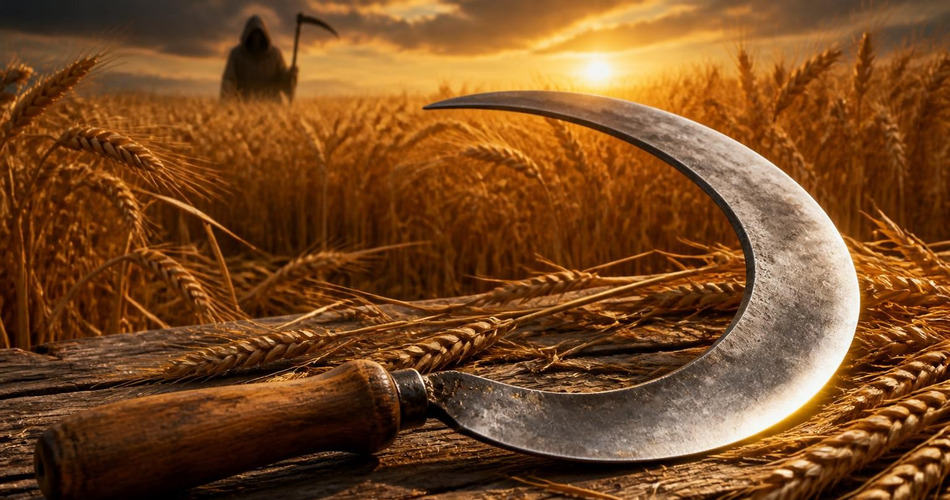
The sickle is a hand-held agricultural tool with a curved blade designed for reaping grain. Its distinctive shape has made it a powerful symbol across many cultures, representing both the life-giving act of harvesting and the finality of death. As a tool that cuts through stalks, it embodies the duality of creation and destruction — the end of one growth cycle and the provision of sustenance. The sickle also became a potent political symbol in the 20th century, most famously as part of the hammer and sickle emblem of communism, representing the industrial worker and the peasant farmer.
What Does the Sickle Symbolize?
The sickle primarily symbolizes harvest and the bounty of the earth. It represents the culmination of agricultural labor — the gathering of crops after a season of growth. This connection to the harvest cycle gives the sickle meanings of abundance, fertility, and the reward of hard work. At the same time, the sickle is a cutting tool, and its action of severing plants from their roots links it to themes of death and endings. In many traditions, the sickle is the implement of the Grim Reaper, a personification of death who “reaps” human souls. This dual significance makes the sickle a symbol of transition — the end of one phase and the beginning of another. In a broader sense, the sickle represents transformation: what is cut down can be stored, processed, and used for new life.
Positive and Negative Meanings of the Sickle
Positive associations: The sickle is a symbol of abundance, fertility, and the successful completion of agricultural work. It signifies the culmination of effort, the gathering of resources, and the prosperity that results from cooperation with nature. In many cultures, the harvest sickle is also a symbol of hope and the cyclical bounty of the earth.
Negative meanings: The sickle is strongly associated with death and destruction, both through its use as a weapon and its role in the Grim Reaper imagery. It can represent the cutting short of life, the inevitability of mortality, and the violent overthrow of established orders. In political contexts, the hammer and sickle has been a polarizing symbol, evoking revolution, class struggle, and the upheaval of traditional society.
History and Origins of the Sickle Symbolism
The sickle has been used since the Neolithic period for harvesting grain. Its symbolic power likely began with early agricultural societies that depended on the annual harvest for survival. The moon’s crescent shape is often compared to a sickle, linking the tool to lunar cycles and fertility myths. In ancient Greece, the sickle was central to the myth of Cronus (Roman Saturn), who used a sickle (or harpe) to castrate his father Uranus, separating heaven and earth and ushering in a new age. This story imbues the sickle with themes of usurpation, generational change, and the violent breaking of old structures. Later, in medieval European art, Death was portrayed carrying a scythe — a larger version of the sickle — which became the iconic Grim Reaper. In the 20th century, the hammer and sickle became the state emblem of the Soviet Union, representing the unity of industrial workers (hammer) and peasants (sickle) in the communist revolution. This political symbolism spread globally, making the sickle a shorthand for revolutionary socialism.
Sickle Symbolism in Different Cultures
In ancient Greek culture, the sickle was associated with Cronus and the Golden Age, as well as with agricultural deities. The symbol of a sickle or scythe appeared on coins and as a sacred attribute. In Roman tradition, Saturn (the equivalent of Cronus) was revered during the Saturnalia festival, a time of feasting and role reversal, and his scythe/sickle was a reminder of the harvest and the cycles of time. In Chinese culture, the sickle is less prominent symbolically, but agricultural tools in general represent the virtue of hard work and the foundation of society. In Hindu mythology, Parashurama, an avatar of Vishnu, wields a battle axe that sometimes resembles a curved blade akin to a sickle, symbolizing the destruction of evil and the restoration of order. In African agricultural societies, the sickle is a practical tool for harvesting, and its symbolic meaning centers on sustenance, community labor, and ancestral blessings. In modern Western culture, the sickle retains its dual meaning: it appears in harvest festivals as a symbol of abundance, and in Halloween imagery as the tool of the Grim Reaper, representing the darker side of the cycle of life and death.
Spiritual Meaning of the Sickle
In spiritual contexts, the sickle represents the reaping of what one has sown — a universal principle of cause and effect. It can symbolize divine judgment, the harvesting of souls, or the gathering of spiritual fruits after a period of growth. In some traditions, the sickle is seen as a tool that separates the wheat from the chaff, teaching lessons about discernment and the need to let go of what no longer serves one’s higher purpose. The crescent shape of the sickle also connects it to the moon, which governs tides, cycles, and the subconscious. Meditatively, the sickle can be used to visualize cutting away negative attachments, fears, or old patterns, making way for renewal. The spiritual sickle is a reminder that endings are natural and necessary for new beginnings.
The Sickle in Myths and Folklore
The most famous myth involving a sickle is the Greek story of Cronus. According to Hesiod’s Theogony, the Titan Cronus used a sickle given by his mother Gaia to castrate his father Uranus. This act separated Heaven and Earth, allowing the Titans to rule. The sickle thus became a symbol of rebellion, filial action, and the violent overthrow of an oppressive parent. In later folklore, the Grim Reaper — often shown carrying a scythe or sickle — is a personification of Death who comes to “reap” souls. This image likely derives from the Black Death era in Europe, where mass death was likened to a great harvest. In Slavic folklore, the sickle appears in tales of the harvest goddess Mokosh, and in some traditions it is used in protective rituals against evil spirits. The sickle’s curved shape also appears in fairy tales as a magical tool that can cut through any obstacle, symbolizing the power to overcome challenges.
The Sickle in Superstitions and Omens
- In some European folk traditions, finding a sickle in a field was considered a good omen for a bountiful harvest. It was believed to bring prosperity and protect the grain from pests.
- Conversely, dreaming of a broken sickle was seen as a warning of crop failure or financial loss in agricultural communities.
- Leaving a sickle outdoors overnight was sometimes thought to attract malevolent spirits, as the tool’s association with death made it a conduit for supernatural forces.
- In certain regions, a sickle placed under a baby’s cradle was believed to protect the child from being taken by fairies (changelings), as iron tools were thought to repel supernatural beings.
- The appearance of a sickle in a dream was often interpreted as a sign that a major change or ending was approaching — either the completion of a project or the death of a relationship.
The Sickle in Art and Literature
The sickle appears in numerous well-known works. In Greek pottery and sculpture, the sickle is the identifying attribute of Cronus, used in the scene of Uranus’s castration. In medieval art, the Grim Reaper became a common motif in danse macabre (dance of death) paintings and woodcuts, such as those by Hans Holbein the Younger. The sickle/scythe is a central prop in Albrecht Dürer’s engraving The Four Horsemen of the Apocalypse (1498), where Death rides with a pitchfork or scythe. In literature, the sickle features prominently in the poetry of the Romantic era, especially in works about the harvest, such as John Clare’s poems. In modern literature, the hammer and sickle emblem is a recurring symbol in dystopian fiction like George Orwell’s Animal Farm and Nineteen Eighty-Four, representing oppressive totalitarian regimes. In film, the sickle appears most memorably in Ingmar Bergman’s The Seventh Seal (1957), where the figure of Death is portrayed with a scythe, playing chess with a knight. The sickle’s visual simplicity makes it a powerful icon in propaganda posters, notably Soviet and Chinese revolutionary art, where it represents the peasant class united with the worker.
Sickle Tattoo Meaning
The sickle tattoo can carry multiple meanings depending on its context and accompanying imagery. A solitary sickle often symbolizes harvest, the fruits of one’s labor, or a connection to agricultural roots. When paired with a hammer, it becomes a political statement representing communism, revolution, or solidarity with the working class. A sickle combined with a skull or Grim Reaper imagery evokes death and mortality, serving as a memento mori. In some designs, the sickle is crossed with another tool, such as a pitchfork, to emphasize the duality of creation and destruction. The curved blade can also be stylized in a tribal or neo-traditional style, emphasizing its shape as a symbol of sweeping change. Overall, the sickle tattoo is chosen by those who identify with cycles of growth and decay, revolutionary ideals, or a reverence for the natural world.
Frequently Asked Questions About the Sickle
Q: What does the hammer and sickle symbol mean?
A: The hammer and sickle is an emblem of communism, representing the unity of industrial workers (hammer) and agricultural peasants (sickle) in the revolutionary struggle for a classless society. It was adopted by the Soviet Union and many other communist parties worldwide.
Q: Why is the sickle associated with death?
A: The sickle is associated with death because of the Grim Reaper — a personification of Death who uses a scythe or sickle to “reap” souls, likening human mortality to the harvesting of grain. This imagery became widespread in medieval Europe after the Black Death.
Q: Is the sickle a positive or negative symbol?
A: The sickle is both positive and negative. Positively, it symbolizes harvest, abundance, and the reward of labor. Negatively, it represents death, destruction, and revolutionary overthrow. Its meaning depends on the cultural and personal context.
Q: What is the difference between a sickle and a scythe?
A: A sickle is a small, handheld curved blade used for cutting grain or grass with one hand. A scythe is a larger, two-handed tool with a long handle and a curved blade, used for mowing hay or reaping larger areas. In symbolism, both are interchangeable as tools of harvest and death, though the scythe is more often associated with the Grim Reaper.
Q: What does a sickle mean in dreams?
A: In dream interpretation, a sickle can symbolize the need to cut away something from your life — bad habits, relationships, or outdated beliefs. It may also indicate that a period of effort is coming to fruition, or it could be a warning of an impending end or loss. The exact meaning depends on the dream’s context and the dreamer’s personal associations.
Related Symbols
- Scythe — larger version of the sickle, strongly associated with the Grim Reaper and death symbolism.
- Hammer — when paired with the sickle, represents industrial labor and communism.
- Cornucopia — horn of plenty, symbolizing the abundance that comes from a successful harvest.
- Wheat — the grain itself is often shown with a sickle, representing sustenance and the cycle of life.
- Falx — an ancient curved blade used as both a farming tool and a weapon in Thracian and Roman contexts.
- Cronus (Saturn) — the Titan who used a sickle to overthrow his father, making him a central mythological figure for sickle symbolism.