Briefly
The white horse is one of the most potent cross-cultural symbols, representing purity, nobility, freedom, and spiritual ascent. From the pale horse of Revelation to the divine steeds of Greek myth, the white horse often signals a moment of transformation or revelation. Across folklore, dreams, and art, it carries both triumphant and ominous meanings, making it a rich subject for symbolic exploration.
What Does the White Horse Symbolize?
At its core, the white horse symbolizes purity and innocence, a reflection of its unblemished color. In many traditions, it also embodies heroism and victory, as white horses were often reserved for kings, warriors, and divine messengers. The horse itself already signifies strength, endurance, and freedom, and the white hue elevates these qualities to a higher, often sacred, plane.
Beyond that, the white horse can represent a journey — both physical and spiritual. It appears as a guide that carries souls across thresholds, such as in shamanic traditions or in the imagery of the rider on the white horse in the Book of Revelation. It is also a symbol of awakening, urging the dreamer or the observer to embrace a higher purpose or a new phase of life.
Positive and Negative Meanings
Positive associations: The white horse is universally linked to positive ideals: purity of heart, spiritual enlightenment, noble courage, and unbridled freedom. It is a sign of victory and triumph, whether in battle, in personal struggles, or in the quest for meaning. In many cultures, seeing a white horse in a dream or in life portends good fortune, elevation, or the arrival of a hero.
Negative meanings: Yet the white horse also carries darker undertones. In Christian eschatology, the pale horse of Revelation brings death and devastation. In some folklore, a white horse appears as a ghostly apparition, an omen of doom or a messenger of death, often tied to spectral riders. Its very rarity can signal the abnormal or the supernatural, which may evoke fear rather than comfort.
History and Origins of the Symbolism
The symbolic weight of the white horse stretches back thousands of years. Ancient Indo-European cultures revered the horse as a solar animal, and a white horse was especially potent — it was associated with the sun, light, and the sky gods. In Greek mythology, the sun god Helios drove a chariot drawn by four white horses, and the winged horse Pegasus, born from Medusa’s blood, became a symbol of poetic inspiration and ascent to the heavens.
In Norse mythology, Odin’s eight-legged steed Sleipnir is not described as white, but white horses were sacred to the god and used in temple sacrifices. Among the Celts, a white horse symbolized the goddess Epona, connected to fertility and the underworld. The famous White Horse of Uffington, a prehistoric hill figure in England, attests to the ancient reverence for the white horse as a territorial and protective emblem. Over time, this imagery merged with Christian iconography, where the white horse became a symbol of the Church, the triumphant Christ, or even the Antichrist in different interpretations.
White Horse Symbolism in Different Cultures
Across Europe, the white horse appears in heraldry as a symbol of valor, honor, and aristocracy. Saxon and Danish kings used white horses on their standard, and the modern emblem of the German region of Lower Saxony still bears a white horse. In Chinese culture, the white horse is less common but appears in Buddhist texts as the bodhisattva’s mount, representing wisdom and the path to enlightenment. In India, the white horse is associated with the sun god Surya and the Kalki avatar — the final incarnation of Vishnu, who arrives on a white horse to end the age of darkness.
In Islamic tradition, the Buraq, a white creature with a horse’s head, carried the Prophet Muhammad during the Night Journey, symbolizing swift spiritual transport. Among Native American peoples, white horses, rare and prized, were considered sacred and often associated with the Great Spirit or the thunder beings. These varied but consistent associations highlight the white horse as a universal sign of the sacred and the heroic.
Spiritual Meaning of the White Horse
Spiritually, the white horse represents the ascent of the soul toward the divine. It is a vehicle for transcendence, moving the spirit from the earthly realm to the heavenly. In many esoteric traditions, the white horse stands for the awakened consciousness that has purified itself of earthly desires and fears. It embodies the balance between physical strength and spiritual grace, urging the seeker to harness both power and humility.
The white horse also appears as a psychopomp — a guide of souls — especially in death visions and near-death experiences. Its presence can signify that the soul is ready to cross a threshold or that a major spiritual initiation is at hand. For those on a path of self-development, the white horse may appear in meditation or dreams as a sign that they are ready to embrace their highest truth.
White Horse in Myths and Folklore
Mythology is replete with white horses. In Greek lore, Pegasus — the divine white horse — springs from the blood of Medusa and later carries the hero Bellerophon to slay the Chimera, symbolizing the triumph of light over chaos. The great white horses of the Hindu sun god Surya draw his chariot across the sky each day, lighting the world. In Buddhist tradition, the white horse carries the Bodhisattva of Compassion, Chenrezig, and appears in the Jataka tales as a faithful steed that saves the king.
Folklore, too, is filled with spectral white horses. In the British Isles, the legend of the Lady Godiva features a naked ride on a white horse through Coventry as a protest. In Slavic folklore, the white horse is often the mount of the hero or a magical helper that understands human speech and offers counsel. The white horse also appears in the tales of King Arthur, where it is said that the return of the king will be accompanied by a white horse. These stories reinforce the horse’s role as a bridge between the mundane and the miraculous.
White Horse in Dreams
In dream interpretation, the white horse is a powerful archetype that often reflects the dreamer’s spiritual state or life circumstances. It commonly appears during periods of transition, decision-making, or personal growth. A white horse may indicate that the dreamer is on the verge of a breakthrough, or it may be a call to embrace one’s own strength and purity. Because the horse is also a symbol of instinct and drive, a white horse in a dream can point to a conflict between the pure ideals and the raw passions of the self.
While interpretations vary, certain recurring scenarios have been noted by dream analysts and symbolists:
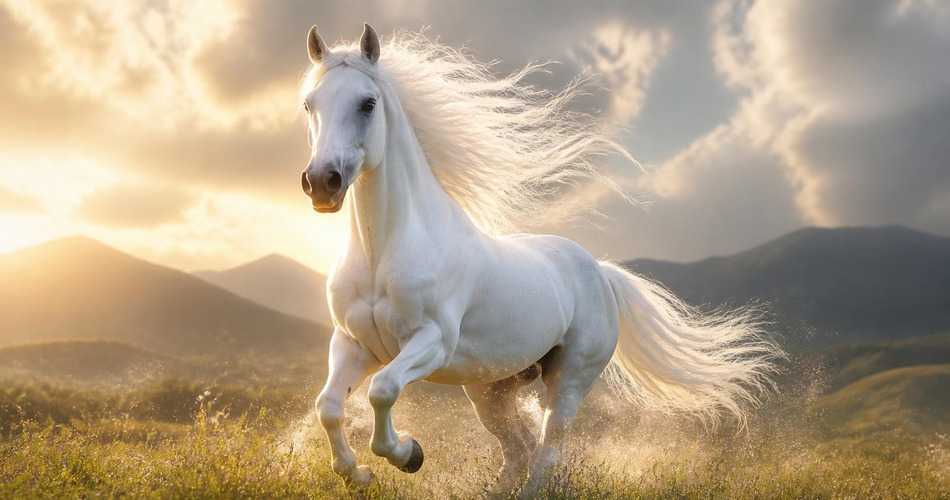
- A white horse running freely in a field — often a sign of liberation, success, or the beginning of a new enterprise.
- Riding a white horse — suggests control over one’s destiny, or the need to take charge of a situation with integrity.
- A calm white horse standing — reflects inner peace and alignment with one’s higher self.
- A white horse carrying a rider away — can indicate being overwhelmed by responsibilities or a fear of losing control.
- A wounded or dying white horse — may signal loss of innocence, a failed aspiration, or a warning of spiritual exhaustion.
Like all dream symbols, the specific context and emotional tone are crucial. A white horse can be a positive messenger or a cautionary specter, but it always carries significance.
White Horse in Superstitions and Omens
Folklore and superstition have long attached portents to the white horse. In many parts of Europe, seeing a white horse was considered lucky — a sign of prosperity and protection. Some traditions hold that making a wish at the sight of a white horse makes it come true, especially if you spit and cross your fingers. In other regions, however, a white horse is a harbinger of death, particularly when it appears in a dream or near a home.
Common superstitions include:
- If a white horse enters a village, it may herald a coming war or famine.
- In Ireland, a white horse was said to bring a blessing, but a white horse running toward you was an ill omen.
- In maritime lore, a white horse seen at sea predicted a storm.
- The appearance of a white horse at a funeral was sometimes regarded as a good sign, guiding the soul to the afterlife.
These beliefs reflect the dual nature of the white horse: a bringer of grace and a harbinger of the inevitable, never neutral.
White Horse in Art and Literature
Art and literature have immortalized the white horse. In the Bible, the Book of Revelation describes a rider on a white horse — variously interpreted as Christ victorious or as the Antichrist, making it a potent apocalyptic image. The white horse is also central to the medieval legend of Saint George, who tames and rides a white horse to slay the dragon, a scene depicted in countless paintings.
In secular art, John Constable’s 1819 painting The White Horse depicts a tow-horse being ferried across a river, capturing the tranquil yet powerful presence of the animal. In literature, the white horse appears as Shadowfax in J.R.R. Tolkien’s The Lord of the Rings — the “lord of all horses,” who carries Gandalf and becomes a symbol of hope and freedom. In C.S. Lewis’s The Chronicles of Narnia, the white horse (or unicorn-like creature) appears in the final battle as a symbol of loyalty and triumph. These examples show the white horse as a vehicle for themes of salvation, courage, and divine intervention.
White Horse Tattoo Meaning
In modern symbolism, the white horse tattoo has become a popular design for those who identify with its characteristics. It often represents the wearer’s pursuit of freedom, their inner strength, or their spiritual awakening. Because the horse is a noble animal, a white horse tattoo can also signify leadership, independence, and a rebellious spirit that refuses to be tamed. It may be chosen to commemorate a life-changing journey or a personal victory over adversity.
Some choose the white horse as a tribute to a beloved horse or as a memorial, linking the animal to loyalty and friendship. The design can be rendered in a minimalist outline, a dynamic galloping pose, or as part of a mythological scene (like riding alongside a knight). The white horse tattoo thus carries both personal and universal significance, blending the wearer’s story with the timeless archetype.
Meanings of Different Types, Colors, and Variations
While the white horse serves as a singular symbol, variations add nuance. An albino horse, with pink skin and pale blue or pink eyes, is often viewed with even greater rarity and mystery, sometimes seen as a ghost or a fairy horse. In contrast, a gray horse that appears white may be considered “white” in common speech but lacks the genetic rarity, so its symbolism is less acute.
The white horse also appears in mythical forms: the unicorn, a horse-like creature with a single horn, is considered the purest of symbols, representing chastity and divine grace. The winged white horse, Pegasus, adds the dimension of flight and transcendence. In heraldry, the white horse (called “argent” in tincture) may be shown rampant, passant, or rearing, each pose conveying different qualities: rearing for defiance, passant for peaceful advancement, and rampant for battle-readiness.
Frequently Asked Questions
Q: What does it mean when you see a white horse in real life?
A: In many cultures, it can symbolize good luck, spiritual elevation, or a call to personal transformation, though local folklore may vary.
Q: Is a white horse always a positive sign?
A: No, it can also be a negative omen, especially in dreams or in contexts of death and apocalyptic imagery, such as the pale horse of Revelation.
Q: What is the difference between a white horse and an albino horse in symbolism?
A: The albino, with its pink eyes, is often considered even more mystical and rare, sometimes linked to supernatural folklore, while a standard white horse carries more familiar positive meanings.
Q: How should I interpret a white horse in my dream?
A: Consider the horse’s behavior and your emotional response. A peaceful horse suggests harmony and spiritual progress; a galloping or anxious horse may point to inner drives or impending changes.
Related Symbols
- Horse Symbolism — the broader meaning of the horse in general
- Unicorn — the mythical white horse with a horn, representing purity
- Pegasus — the winged white horse of Greek myth
- White Color Symbolism — the color white and its meanings
- Victory — the white horse as an emblem of triumph
- Freedom — the horse as a symbol of liberation