Briefly
The number two is one of the most fundamental symbols in human thought, representing duality, balance, and the dynamic tension between opposites. It appears across cultures and eras as a marker of partnership, choice, and the complementary forces that shape existence. While it can signify harmony and cooperation, it also carries connotations of division and conflict. Understanding the symbolism of two offers insight into how we perceive relationships, choices, and the very structure of reality.
What Does the Number Two Symbolize?
The number two is primarily a symbol of duality — the idea that reality is composed of paired opposites that define each other. Light and dark, male and female, life and death, good and evil: the number two captures the fundamental binary structure that appears in nearly every system of thought. It represents the moment of separation from unity, the first division that creates multiplicity and difference.
Beyond opposition, two also symbolizes partnership and relationship. It is the number of the couple, the pair, and the alliance. In this sense, it speaks to connection, cooperation, and the synergy that arises when two distinct entities come together. It is the number of dialogue, exchange, and mutual recognition.
Two is also associated with choice and decision. With two options, a fork in the road appears, and the act of choosing becomes necessary. This gives the number an inherent tension — it is the number of both possibility and uncertainty, of paths diverging and the need to commit to one direction.
Positive and Negative Meanings
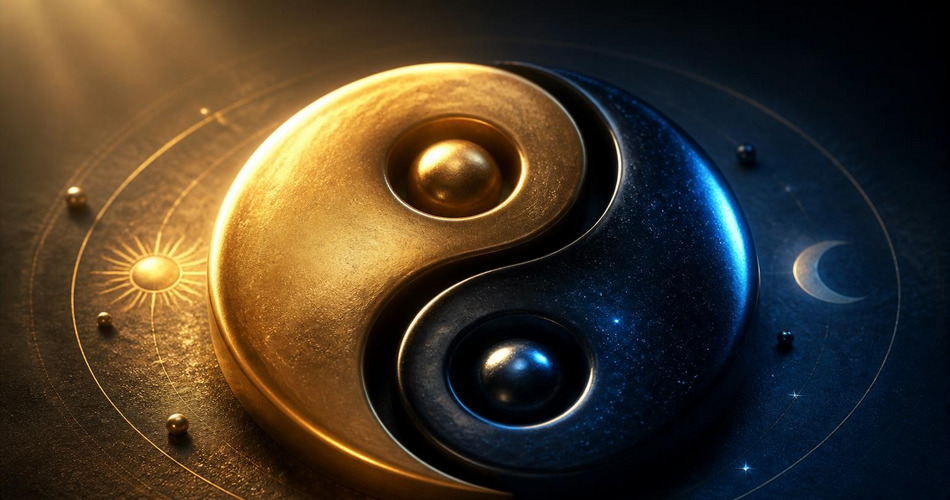
Positive associations: The number two is often seen as a positive symbol of balance, harmony, and cooperation. It represents the ideal of partnership — marriage, friendship, and teamwork — where two individuals complement each other and achieve more together than alone. It embodies the concept of yin and yang, where opposing forces are not in conflict but in a dynamic equilibrium that sustains life. Two also signifies patience and diplomacy, as it requires listening, compromise, and the ability to see another’s perspective.
Negative meanings: On the negative side, two can symbolize division, conflict, and indecision. It is the number of the split, the schism, and the opposing camps that cannot find common ground. It can represent betrayal or the breaking of a bond, as when a partnership turns to rivalry. Two may also indicate a state of being torn between two choices, leading to paralysis and doubt. In some contexts, it is associated with deceit or double-dealing, as in the phrase “two-faced.”
History and Origins of the Symbolism
The symbolic importance of the number two dates back to the earliest human civilizations. In ancient Mesopotamia, the number two was associated with the goddess Ishtar and the planet Venus, symbolizing fertility and the union of opposites. The Babylonians developed a base-60 number system that included a strong binary element, and their mythology featured many pairs of gods representing complementary forces.
In ancient China, the concept of yin and yang, which is fundamentally about the interplay of two opposing but complementary forces, became a cornerstone of philosophy, medicine, and cosmology. The I Ching, or Book of Changes, is built on the interaction of two lines — solid and broken — that combine to form all possible situations. This binary framework influenced everything from Chinese medicine to martial arts.
In Pythagorean thought, the number two was called the “first even number” and was associated with opinion, while one was truth. The Pythagoreans saw two as the number of division and diversity, the first step away from the monad, or the One. This idea influenced later Western philosophy, where the number two often represented the material world as opposed to the spiritual unity of the One.
Symbolism in Different Cultures
In many cultures, the number two holds a special place in creation myths and cosmologies. In ancient Egyptian mythology, the god Atum created the first pair, Shu (air) and Tefnut (moisture), from whom all other gods descended. This pair represented the fundamental duality of existence — the dry and the wet, the masculine and the feminine.
In Norse mythology, the world was created from the meeting of fire and ice, two opposing primordial forces. The great world tree Yggdrasil has two roots that reach into different realms, and many of the gods are paired in opposition, such as Odin and Loki, order and chaos. The number two thus embodies the creative tension that gives rise to the cosmos.
In Hinduism, the number two is significant in the concept of dvaita, or dualism, which distinguishes between the individual soul (atman) and the supreme soul (Brahman). This duality is seen as a fundamental aspect of the material world, while non-duality (advaita) is the ultimate spiritual goal. The number two also appears in the many pairs of deities, such as Radha and Krishna, representing the divine feminine and masculine.
In Western culture, the number two is deeply embedded in Christian theology, with the two testaments, the two great commandments, and the dual nature of Christ as both human and divine. It also appears in the concept of the two witnesses in the Book of Revelation. In secular contexts, two is the number of the couple, the pair, the dyad, and is central to ideas of democracy (two parties), justice (two sides), and science (binary logic).
Spiritual Meaning
Spiritually, the number two is often seen as a symbol of the soul’s journey from unity into multiplicity and back. It represents the illusion of separation that the ego creates, and the spiritual work of reconciling opposites within oneself. Many spiritual traditions teach that enlightenment comes from transcending duality, from realizing the underlying oneness of all things.
In numerology, the number two is associated with the Moon, receptivity, and the feminine principle. It is considered a nurturing, intuitive number that values harmony and relationships. People with a life path number two are often seen as peacemakers, diplomats, and sensitive souls who thrive in partnerships.
In Kabbalah, the number two corresponds to the second Sefirah, Chokhmah (Wisdom), which is the first emanation of the divine will. It represents the initial flash of insight that precedes understanding, and is paired with Binah (Understanding) to form the first dynamic duo of the Tree of Life.
In Myths and Folklore
The number two appears frequently in myths and folklore as a motif of twins, pairs, and dual forces. Many cultures have stories of twin heroes or gods, such as Romulus and Remus in Roman mythology, Castor and Pollux in Greek mythology, and the Hero Twins in Mayan mythology. These twins often represent complementary aspects of a single nature, such as strength and cunning, or mortality and divinity.
In fairy tales, the number two often appears in the form of two siblings, two tasks, or two kingdoms. The motif of the “two brothers” is common, where one is good and the other is evil, or where they must work together to overcome a challenge. This reflects the moral duality that is central to many folk narratives.
In some folklore traditions, the number two is considered unlucky because it represents division and separation. For example, in some European superstitions, giving a knife or scissors as a gift is said to cut the friendship, and breaking a mirror brings seven years of bad luck — both involving the idea of splitting. In other traditions, two is seen as a protective number, as in the practice of carrying two coins or wearing two amulets to ward off evil.
In Dreams
In dream interpretation, the number two often symbolizes a choice that needs to be made or a relationship that is central to the dreamer’s life. It may represent a partnership, a conflict, or a decision between two paths. The context of the dream is crucial: seeing the number two could indicate a need for balance, or it could point to an inner division that requires resolution.
Dreams featuring pairs — such as two doors, two roads, or two people — often reflect the dreamer’s sense of being at a crossroads. The number two in a dream may also highlight the importance of cooperation and the need to integrate opposing aspects of the self. It can be a call to embrace both the light and the shadow, the masculine and the feminine, the rational and the intuitive.
Common Dream Scenarios
- Seeing the number two: This may indicate a decision is imminent, or that you need to pay attention to a relationship in your waking life.
- Choosing between two options: This often symbolizes a real-life dilemma where you feel torn between two paths, and the dream may reflect your anxiety or need for clarity.
- Meeting a pair of people or animals: This can represent a partnership, a conflict, or the need to integrate two aspects of yourself.
- Two doors or two roads: This is a classic symbol of choice and the fear or excitement of the unknown that comes with making a decision.
- Being in a pair or couple: This may reflect your feelings about a current relationship, or a desire for connection and companionship.
In Superstitions and Omens
The number two has a variety of superstitious associations around the world. In some cultures, it is considered lucky to see two of something, such as two magpies (“one for sorrow, two for joy”) or two crows, which are sometimes seen as a good omen. In other traditions, two is associated with death or bad luck, as in the Chinese belief that the number four is unlucky because it sounds like “death,” while two is generally neutral or positive.
In Western folklore, the number two is often linked to the idea of the “evil eye” or the double. Seeing your double, or doppelgänger, is considered an omen of death or misfortune. Similarly, the number two can be associated with the devil, who is sometimes called “Old Nick” or “the Deuce” — a term also used for the number two in cards.
In some superstitions, breaking an object into two pieces is seen as a bad omen, as it symbolizes a broken relationship or a divided home. Conversely, the act of “splitting” something, like a piece of bread, can be a ritual of sharing and bonding, as in the Christian tradition of breaking bread together.
In Art and Literature
The number two is a pervasive theme in art and literature, often used to explore duality, conflict, and relationship. In William Shakespeare’s Romeo and Juliet, the two feuding families, the Montagues and the Capulets, embody the destructive power of division, while the love of the two protagonists represents the possibility of reconciliation. The play is structured around pairs of opposites: love and hate, youth and age, life and death.
In literature, the theme of the double is central to works like Robert Louis Stevenson’s The Strange Case of Dr. Jekyll and Mr. Hyde, where the protagonist is literally split into two personalities representing good and evil. Similarly, Fyodor Dostoevsky’s The Double explores the psychological fragmentation of a man who encounters his exact double, leading to madness.
In visual art, the number two appears in compositions that emphasize symmetry and balance, such as Leonardo da Vinci’s The Last Supper, where the twelve apostles are arranged in groups of two or three, and the central figure of Christ is flanked by pairs. The use of diptychs — paintings on two panels — is another example of the number two in art, often used to show contrasting or complementary scenes.
In film, the number two often appears in titles and themes, such as The Two Towers from J.R.R. Tolkien’s The Lord of the Rings, which symbolizes the dual threat of evil, or Dual, a film about a woman who must fight her clone. The concept of the double is a recurring motif in cinema, from Vertigo to Black Swan, exploring identity and the shadow self.
Frequently Asked Questions
Q: What does the number 2 symbolize in numerology?
A: In numerology, the number 2 represents harmony, cooperation, and balance. It is associated with the Moon, receptivity, and the feminine principle, and is considered a nurturing, intuitive number that values relationships and diplomacy.
Q: Is the number 2 considered lucky or unlucky?
A: The luck of the number 2 varies by culture. In many Western contexts, it is neutral or positive, symbolizing partnership and balance. In Chinese culture, 2 is generally considered lucky, as it represents harmony and good things coming in pairs. However, in some superstitions, it can be associated with division or the double, which may carry negative connotations.
Q: What does it mean when you keep seeing the number 2?
A: In spiritual and numerological circles, repeatedly seeing the number 2 is often interpreted as a sign to trust your intuition and seek balance in your life. It may also indicate that a partnership or relationship is important, or that you need to make a decision between two paths.
Q: What is the spiritual meaning of the number 2?
A: Spiritually, the number 2 represents the duality of existence and the journey toward unity. It symbolizes the reconciliation of opposites, such as light and dark, masculine and feminine, and the spiritual work of integrating all aspects of the self.
Related Symbols
- Duality — the concept of two opposing forces.
- Balance — the harmony between two sides.
- Yin and Yang — the Chinese symbol of complementary opposites.
- Partnership — the union of two individuals.
- Twins — two beings born together.
- The Number One — the symbol of unity from which two emerges.