Briefly
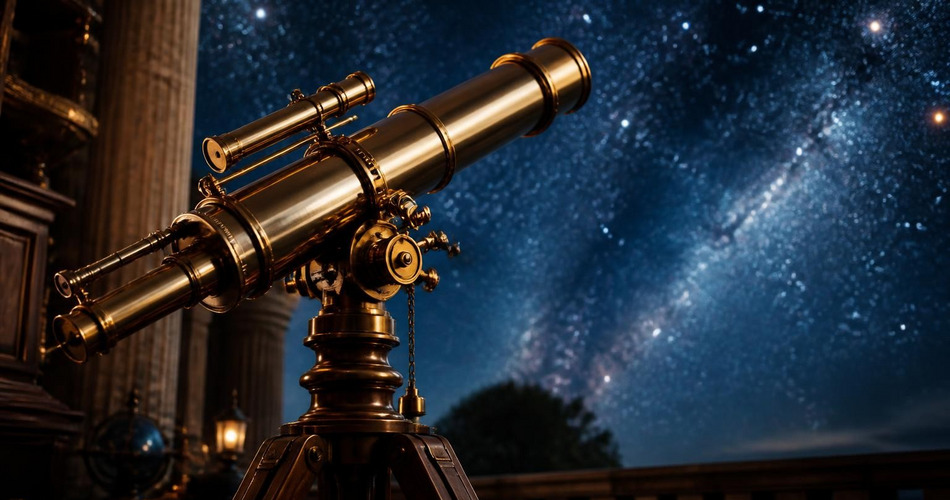
The telescope is a powerful symbol of exploration, discovery, and the relentless human pursuit of knowledge. It represents the desire to transcend the limits of human vision, to understand the vast cosmos, and to gain a broader perspective on our place within it. As an instrument of observation, it embodies clarity, foresight, and the principles of scientific inquiry.
What Does Telescope Symbolize?
The telescope primarily symbolizes exploration and the quest for knowledge. It is the tool that bridges the known world with the unknown universe, making the invisible visible. This makes it a potent emblem of curiosity and intellectual ambition.
It also represents perspective. By bringing distant objects into focus, the telescope allows us to see the bigger picture. It encourages a shift in viewpoint, reminding us that our immediate surroundings are just a small part of a much larger reality. This can be both humbling and empowering.
Furthermore, the telescope is a symbol of science and reason. Its invention marked a turning point in human history, challenging long-held beliefs and ushering in the Scientific Revolution. It stands for objective observation, empirical evidence, and the power of technology to reveal truth.
Positive and Negative Meanings of the Telescope
Positive associations: The telescope is overwhelmingly a positive symbol of discovery, foresight, and clarity. It represents the expansion of human potential, the joy of learning, and the ability to plan for the future by seeing what lies ahead. It is a tool of empowerment and enlightenment.
Negative meanings: The telescope can also carry negative connotations. Its use for surveillance links it to voyeurism and the invasion of privacy. The detached, observational nature of looking through a telescope can symbolize emotional distance or a cold, clinical analysis of life. Additionally, focusing too intently on the distant future can lead to neglecting the present moment.
History and Origins of the Telescope Symbolism
The symbolic power of the telescope is rooted in its historical impact. Invented around 1608 in the Netherlands, it was famously turned to the skies by Galileo Galilei in 1609. Galileo’s observations—the moons of Jupiter, the phases of Venus, the rugged surface of the Moon—directly contradicted the geocentric model of the universe. From this moment, the telescope became a symbol of revolutionary knowledge and the conflict between empirical evidence and established dogma.
In the 20th century, the Hubble Space Telescope redefined this symbolism. Its iconic images, such as the “Pillars of Creation” and the “Hubble Deep Field,” became cultural touchstones. The telescope evolved from a tool of earthly observation to a symbol of cosmic time travel, allowing humanity to look billions of years into the past and contemplate the origins of the universe itself.
Telescope Symbolism in Different Cultures
In Western culture, the telescope is deeply intertwined with the Enlightenment, science, and progress. It symbolizes human reason and technological mastery over nature. It is an emblem of the frontier spirit, often associated with the exploration of space as the “final frontier.”
In East Asian cultures, the telescope (遠眼鏡 in Japanese, 望远镜 in Chinese) was historically a fascinating scientific instrument. Its symbolism often aligns with farsightedness, strategic planning, and the ability to see into the future. It represents practical wisdom and the value of a long-term perspective.
While not a traditional tool in many indigenous cultures, the concept the telescope embodies—seeing far and seeing clearly—resonates with the roles of shamans and visionaries. In a modern context, it can be seen as a technological extension of the spiritual gaze, a tool for connecting with the cosmos.
Spiritual Meaning of the Telescope
Spiritually, the telescope serves as a powerful metaphor for the seeker’s journey. Just as a telescope gathers faint light from distant stars to make them visible, spiritual practice is seen as a way to bring subtle, distant truths into sharp focus. It represents the expansion of consciousness and the ability to perceive higher realms or deeper realities.
Looking through a telescope can be an act of meditation, a contemplation of the infinite. It symbolizes the bridge between the microcosm of the individual and the macrocosm of the universe, encouraging a sense of connection to something far greater than oneself.
Telescope in Myths and Folklore
The telescope is too recent an invention to have a place in ancient myths, but it has generated its own modern folklore. It is often cast as the tool that reveals a hidden truth or, conversely, as an instrument of hubris that allows mortals to spy on the gods or the secrets of the cosmos.
In popular culture, the “giant telescope” or “space eye” is a recurring motif, often representing humanity’s collective ambition or a warning about the dangers of knowing too much. The idea of a telescope powerful enough to see the beginning of time has become a staple of science fiction and philosophical contemplation.
Telescope in Dreams
In dreams, a telescope generally symbolizes the need for a broader perspective or a closer look at a specific situation. It can represent a desire to understand the future or to see the long-term consequences of current actions.
A clear, powerful telescope in a dream suggests clarity of thought and insight. A broken, blurry, or out-of-focus telescope might symbolize confusion, an inability to see the truth, or a lack of direction in one’s life.
Common Dream Scenarios Involving a Telescope
- Looking through a telescope and seeing clearly: Gaining insight into a problem, achieving a new perspective, or finding a solution.
- Looking through a telescope and seeing nothing but darkness: Feeling lost, overwhelmed by the unknown, or confronting an existential void.
- A telescope pointed at you: Feeling watched, judged, or having your privacy invaded. It can also symbolize being the subject of intense scrutiny.
- Owning or finding a telescope: A desire for knowledge, exploration, or a sign of intellectual curiosity and ambition.
Telescope in Art and Literature
The telescope has been a potent symbol in art and literature since its invention. In John Milton’s Paradise Lost, the poet’s cosmic scope and descriptions of the universe were directly influenced by his visit to Galileo, embedding the telescope’s perspective into the epic’s very fabric.
In Jules Verne’s From the Earth to the Moon, the telescope is a crucial plot device, representing the audacious ambition of humanity to reach the heavens. In H.G. Wells’ The War of the Worlds, the telescope is used to observe the Martians, symbolizing both scientific curiosity and the terrifying shock of a new cosmic perspective.
In visual art, the telescope frequently appears in surrealist works, such as those by René Magritte, where it is often placed in impossible contexts to challenge perception and reality. In modern times, Carl Sagan’s Cosmos series used the telescope as a central metaphor for the “ship of the imagination,” carrying humanity on a journey through space and time.
Frequently Asked Questions About Telescope Symbolism
Q: What does a telescope symbolize?
A: A telescope primarily symbolizes the quest for knowledge, exploration, clarity, and the desire to gain a broader perspective on life and the universe.
Q: What does a telescope mean in a dream?
A: In dreams, a telescope often represents a desire to see the future, gain insight into a situation, or a need to step back and see the bigger picture.
Q: What is the spiritual meaning of a telescope?
A: Spiritually, a telescope represents the expansion of consciousness and the ability to perceive deeper truths, connecting the individual soul to the vast cosmos.
Related Symbols
- Microscope: Represents looking inward, focusing on the infinitely small, the opposite of the telescope’s outward gaze.
- Binoculars: A more accessible tool for focused observation, sharing the symbolism of clarity and perspective.
- The Eye: The fundamental symbol of vision, perception, and awareness, of which the telescope is a technological extension.
- The Stars: The primary object of the telescope’s gaze, symbolizing destiny, guidance, and the infinite.
- Compass: A tool for direction and navigation, complementing the telescope’s role in exploration.