Briefly
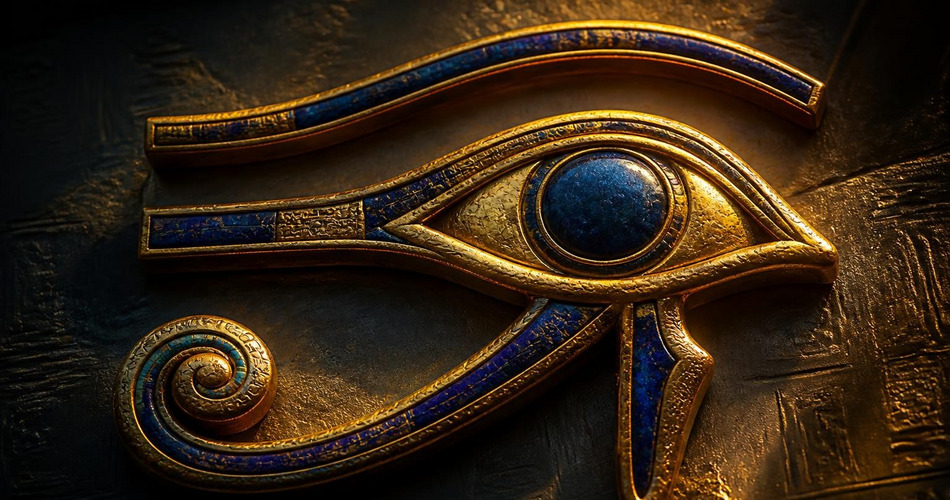
The Eye of Horus, also known as the Wadjet eye, is one of the most recognizable symbols from ancient Egypt. It represents protection, royal power, and good health. According to myth, the god Horus lost his left eye in a battle with Set, and it was restored by Thoth. The eye then became a powerful amulet against harm and a symbol of sacrifice and healing. Today, it continues to be used in jewelry, tattoos, and spiritual practices as an emblem of inner vision and safeguarding.
What Does the Eye of Horus Symbolize?
The Eye of Horus primarily symbolizes protection. In ancient Egyptian culture, it was worn as an amulet to ward off evil spirits and bring safety to the living and the dead. It also represents royal power: pharaohs used the eye to invoke the protection of the god Horus in life and afterlife. Additionally, the eye stands for healing and wholeness, as its mythical restoration by Thoth turned injury into renewal. In a broader sense, the symbol embodies the concept of sacrifice leading to regeneration—the eye that was lost and then made whole again.
The design of the Eye of Horus itself carries symbolic mathematics: each part of the eye corresponds to a fraction that adds up to 63/64, reflecting the idea that even after healing, something is always slightly incomplete—a reminder of the struggle that produced the symbol.
Positive and Negative Meanings
Positive associations: The Eye of Horus is overwhelmingly a positive symbol. It is a protective amulet that repels negativity, disease, and misfortune. It signifies healing, restoration, and the triumph of good over evil. In spiritual contexts, it encourages inner clarity and intuitive insight. Its association with the sky god Horus also links it to kingship and divine oversight.
Negative meanings: The symbol itself has no inherent negative meanings in its original context. However, in modern times, it is sometimes confused with the “evil eye” or mistakenly associated with conspiracy theories about a controlling “all-seeing eye.” These are misinterpretations: the Eye of Horus is a benevolent guardian, not a surveilling force. Some also conflate it with the Eye of Ra, which has a more aggressive, punitive character in Egyptian myth.
History and Origins of the Eye of Horus Symbolism
The Eye of Horus dates back to the Old Kingdom of Egypt (circa 2686–2181 BCE). It appears on amulets, jewelry, and sarcophagi from this period. The symbol is intimately tied to the myth of Horus and Set, recorded in texts like the Pyramid Texts and the Contendings of Horus and Set. According to the myth, Horus’s left eye was torn out by Set during a struggle for the throne of Egypt. The god Thoth—associated with wisdom and writing—magically restored the eye, after which it became known as the “Wadjet” (meaning “healthy” or “whole”) and was offered to the pharaoh as a protective emblem.
Archaeologically, the Eye of Horus has been found in countless burial sites: painted on coffins, carved into stone, and cast in gold and faience. It was also used as a measurement system in medicine and mathematics, with each part of the eye representing a fraction of a hekat (a unit of volume). This mathematical use reinforced the idea of completeness and precision in healing.
Symbolism in Different Cultures
While the Eye of Horus is originally Egyptian, its influence spread across the ancient Mediterranean. The Phoenicians and Greeks adopted it as a protective symbol, often placing it on ships and buildings. In Rome, it was used in amulets alongside other apotropaic signs. Today, the Eye of Horus is embraced globally within New Age spirituality as a symbol of the third eye, intuition, and higher consciousness. It is also popular in modern alternative fashion and tattoo art, where it retains its protective meaning while also representing a connection to ancient wisdom.
It is important to distinguish the Eye of Horus from the similar-looking All-Seeing Eye (Eye of Providence) on the US dollar bill. The All-Seeing Eye has roots in Christianity and Freemasonry, not Egyptian mythology, but they are frequently confused in popular culture.
Spiritual Meaning of the Eye of Horus
In spiritual circles, the Eye of Horus is often interpreted as a symbol of inner sight and enlightenment. It is said to activate the third eye chakra, promoting clarity, truth, and spiritual protection. Meditating on the Eye of Horus is thought to help one see beyond illusions and tap into a deeper understanding of the universe. Some practitioners use it as a talisman during rituals to cleanse negative energy or to seek guidance from higher powers.
Historically, the eye also represented the moon in Egyptian cosmology: its waxing and waning mirrored the myth of the eye being damaged and restored. Thus, the spiritual meaning includes cycles of loss and renewal, death and rebirth—a reminder that even in darkness, healing is possible.
The Eye of Horus in Myths and Folklore
The central myth involving the Eye of Horus comes from the Osiris cycle. Horus, the son of Osiris and Isis, battled his uncle Set to avenge his father’s murder. During one encounter, Set tore out Horus’s left eye and shattered it into pieces. The goddess Hathor (or in some versions, Thoth) restored the eye by reassembling the pieces. This restored eye became a powerful talisman, often called the Wadjet or “the healed eye.”
In Egyptian folklore, the Eye of Horus was believed to have the power to see everything, even the gods, and to protect the wearer from harm. It was placed in tombs to guard the dead and was painted on the bows of boats to ensure safe travel. The eye was also a symbol of sacrifice: Horus gave his restored eye to his father Osiris, helping him regain life in the afterlife. This act of offering reinforced the eye as a symbol of resurrection and filial devotion.
The Eye of Horus in Dreams
Dreaming of the Eye of Horus can carry several meanings depending on the dreamer’s context. Commonly, it symbolizes a need for protection or a desire for healing—either physical, emotional, or spiritual. It may also represent a call to awaken one’s intuition and see a situation more clearly. Because the eye is associated with the moon, dreams featuring it can relate to cycles and emotional tides. Some interpret the dream as a sign that a period of struggle is ending and restoration is at hand, mirroring the myth of the eye’s healing.
The Eye of Horus in Art and Literature
The Eye of Horus appears extensively in ancient Egyptian art: it decorates sarcophagi, stelae, temple walls, and papyrus scrolls. In tomb paintings, it is often shown alongside the deceased to provide protection and enable them to see in the afterlife.
In modern culture, the symbol is featured prominently in the 1999 film The Mummy, where the Eye of Horus book and amulet drive the plot. The graphic novel Watchmen by Alan Moore uses the Eye of Horus as the emblem of the character Ozymandias, emphasizing his perceived god-like oversight and his desire to protect humanity through sacrifice. The video game Assassin’s Creed Origins (2017), set in Ptolemaic Egypt, incorporates the Eye of Horus as part of its interface and narrative, reinforcing its link to ancient power and knowledge. In literature, Rick Riordan’s The Kane Chronicles series features the Eye of Horus as a magical object used by young magicians. These examples show the symbol’s enduring appeal as a shorthand for mystery, power, and protection.
Eye of Horus Tattoo Meaning
As a tattoo, the Eye of Horus is chosen for its strong protective qualities. People often get it on the wrist, back of the neck, or chest to act as a guardian against negativity. It also symbolizes a connection to ancient wisdom, spiritual awakening, and the ability to see beyond the surface. Some combine it with the Ankh or the Scarab to enhance its Egyptian themes. The tattoo is popular among those who have undergone a period of personal struggle and triumphed, mirroring the myth of loss and restoration.
Frequently Asked Questions
Q: What does the Eye of Horus symbolize?
A: It symbolizes protection, royal power, healing, and the triumph of good over evil. It is an ancient Egyptian amulet that guards against harm and promotes wholeness.
Q: Is the Eye of Horus the same as the Eye of Ra?
A: No. The Eye of Horus is a protective symbol associated with the god Horus. The Eye of Ra is a separate symbol representing the destructive, all-seeing power of the sun god Ra.
Q: Is the Eye of Horus evil?
A: No, the Eye of Horus is a benevolent symbol of protection and healing. Any negative connotations are modern misinterpretations or confusions with the “evil eye.”
Q: Can anyone wear the Eye of Horus?
A: Yes. It is a universal symbol of protection and is not tied to any specific religion or belief system in its modern usage. It can be worn by anyone who respects its cultural origins.
Q: What is the difference between the Eye of Horus and the All-Seeing Eye?
A: The Eye of Horus is Egyptian and has a specific mythos. The All-Seeing Eye (Eye of Providence) is a Christian/Freemason symbol representing divine providence. They look similar but have different origins and meanings.
Related Symbols
- Ankh – Symbol of eternal life, also Egyptian
- Eye of Ra – Destructive counterpart of the Eye of Horus
- Scarab – Symbol of transformation and protection
- Wadjet – The goddess who personifies the Eye of Horus
- All-Seeing Eye – Modern symbol often confused with the Eye of Horus