Briefly
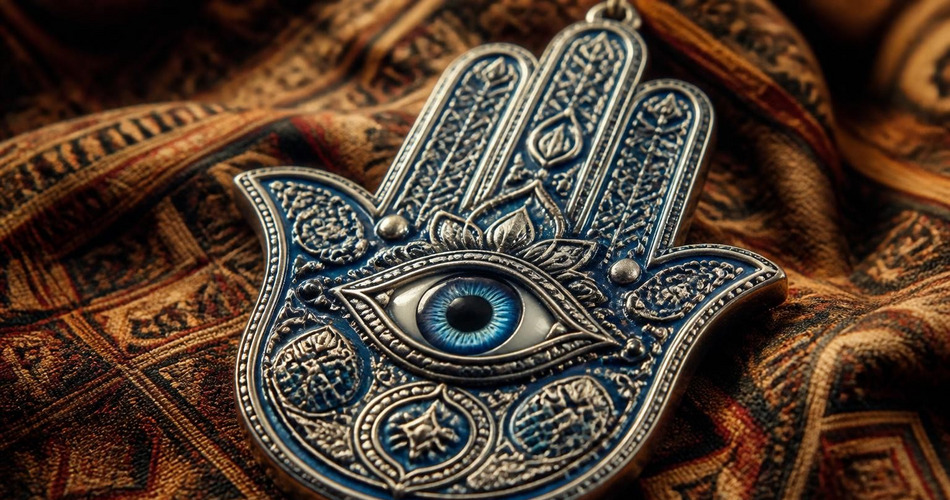
The Hamsa is a palm-shaped amulet widely used in Middle Eastern and North African cultures as a protective symbol against the evil eye and negative energies. Often depicted with an eye in the center of the palm, it represents divine blessing, strength, and power. The hand can be shown with fingers together (warding off evil) or spread apart (bringing good luck). Its name derives from the Arabic word for “five,” referencing the five fingers of the hand, and it is also known as the Hand of Fatima in Islam and the Hand of Miriam in Judaism.
What Does the Hamsa Symbolize?
The Hamsa primarily symbolizes protection. It is believed to shield its wearer from harm, particularly from the evil eye—a malevolent glare thought to cause misfortune. The open right hand is a universal gesture of defense, and the eye embedded in the palm is said to watch over and guard against envy and ill will. Beyond protection, the Hamsa also represents blessings, fertility, and good fortune. In many traditions, the five fingers correspond to the five pillars of Islam or the five books of the Torah, linking the symbol to faith and divine presence. The upward-facing hand invites positive energy, while a downward-facing hand is sometimes associated with grace and abundance.
Positive and Negative Meanings
Positive associations: The Hamsa is overwhelmingly positive, serving as a talisman for safety, happiness, and prosperity. It is thought to bring good luck, success, and health to those who carry or display it. In homes, it is hung on walls or placed near entrances to create a protective barrier. In jewelry, it is worn to attract positive energy and ward off negativity. The symbol is also linked to patience, loyalty, and inner strength, reflecting the virtues of Fatima, daughter of the Prophet Muhammad, after whom it is named in Islamic culture.
Negative meanings: The Hamsa itself carries no inherent negative meaning. However, some conservative religious interpretations discourage its use as an amulet, viewing it as a superstitious practice that conflicts with monotheistic faith. In these contexts, relying on the Hamsa for protection rather than on God may be considered a form of idolatry. Additionally, when the symbol is used in a commercialized or culturally appropriative manner, it can be seen as disrespectful to its traditional roots.
History and Origins of the Hamsa Symbol
The Hamsa’s origins trace back thousands of years to ancient Mesopotamia and Carthage, where hand-shaped amulets were used to invoke the goddess Tanit, a deity of fertility and protection. The symbol later spread across the Mediterranean and into North Africa, adopted by Jews, Christians, and Muslims. In Jewish tradition, the Hamsa is often called the Hand of Miriam, after the sister of Moses, and is associated with the protective hand of God. In Islamic culture, it is known as the Hand of Fatima, honoring Fatima al-Zahra, the daughter of the Prophet Muhammad. The symbol appears in artifacts from the Phoenician, Roman, and Byzantine periods, indicating its long-standing role as a cross-cultural emblem of defense.
Hamsa Symbolism in Different Cultures
In Islamic culture, the Hamsa (Hand of Fatima) is widely used as a protective charm. It is often inscribed with verses from the Quran or combined with the evil eye symbol. The five fingers are said to represent the Five Pillars of Islam: faith, prayer, charity, fasting, and pilgrimage. In Jewish culture, the Hamsa (Hand of Miriam) is similarly valued for protection. It is commonly found in Jewish homes and on jewelry, sometimes featuring a Star of David or Hebrew blessings. The five fingers are linked to the five books of the Torah. In Christianity, the Hamsa has been adopted in some traditions as a symbol of God’s protective hand, though it is less prominent. In Hindu and Buddhist cultures, a similar hand gesture (mudra) known as the Abhaya mudra represents fearlessness and protection, though it is not identical to the Hamsa. The symbol has also gained popularity in Western New Age spirituality as a general emblem of protection and positive energy.
Spiritual Meaning of the Hamsa
Spiritually, the Hamsa is seen as a conduit for divine energy. It is believed to connect the wearer to higher powers and to serve as a reminder of faith. The eye in the palm is thought to represent the all-seeing eye of God, watching over the individual. In meditation practices, visualizing the Hamsa can help focus intentions on protection and gratitude. The symbol also embodies the concept of balance—the five fingers can represent the five elements (earth, water, fire, air, spirit) or the five senses, encouraging harmony between the physical and spiritual realms.
Hamsa in Myths and Folklore
In Islamic folklore, the Hand of Fatima is associated with a story about Fatima, the daughter of the Prophet Muhammad. While cooking, her husband Ali brought home a new wife. Overcome with grief, Fatima dropped the spoon she was holding but continued stirring the pot with her hand, oblivious to the pain. Her patience and devotion became legendary, and the hand symbolizes these virtues. In Jewish folklore, the Hamsa is linked to the protective hand of God that guided the Israelites out of Egypt. Some traditions hold that the five fingers represent the five books of the Torah, and that the amulet wards off the evil eye (ayin hara). In both cultures, the Hamsa is often placed in homes, on doorways, and in cars to safeguard against jealousy and misfortune.
Hamsa in Dreams
Dreaming of a Hamsa can be interpreted as a sign of protection or a need for protection. It may indicate that the dreamer is feeling vulnerable or threatened in waking life and that a protective force is present. The Hamsa in a dream can also symbolize good fortune, blessings, or a reminder to stay faithful. If the Hamsa appears broken or damaged, it might suggest that the dreamer’s defenses are weakened or that they need to reinforce their spiritual boundaries.
Common Dream Scenarios Involving the Hamsa
- Seeing a Hamsa amulet: May indicate that you are being watched over or that you need to seek protection from negative influences.
- Receiving a Hamsa as a gift: Could symbolize an upcoming blessing or the support of loved ones.
- A broken Hamsa: Might represent a loss of protection or a warning to be cautious in a particular situation.
- Wearing a Hamsa: Suggests that you are actively seeking safety and positive energy in your life.
Hamsa in Superstitions and Omens
The Hamsa is deeply embedded in superstitions surrounding the evil eye. In many Middle Eastern and Mediterranean cultures, it is believed that envy can cause harm, and the Hamsa is used to deflect that negative energy. It is common to see Hamsa charms hanging in cars, above cribs, or on keychains. Some superstitions hold that the Hamsa should be made of specific materials—like silver or blue glass—to be most effective. The color blue is especially associated with protection against the evil eye. If a Hamsa breaks or cracks, it is sometimes thought to have absorbed negative energy and fulfilled its protective purpose, after which it should be replaced.
Hamsa in Art and Literature
The Hamsa appears in contemporary art and literature as a symbol of cultural identity and protection. In Ildefonso Falcones’ historical novel The Hand of Fatima (2009), the Hamsa serves as a central motif representing the protagonist’s struggle between Christian and Muslim worlds in 16th-century Spain. The symbol is also featured in the works of artists like Lalla Essaydi, who incorporates Hamsa imagery in her photography to explore themes of identity and female empowerment in Arab culture. In modern jewelry design, the Hamsa is a popular motif, appearing in collections by brands such as Tiffany & Co. and Alex and Ani, often combined with gemstones and other protective symbols.
Hamsa Tattoo Meaning
As a tattoo, the Hamsa is chosen for its protective qualities and aesthetic appeal. Many people ink the Hamsa on the wrist, forearm, or back of the hand to keep the symbol close and visible. Common design elements include an eye in the palm, floral patterns, or Hebrew/Arabic script. The tattoo can represent a personal shield against negativity, a connection to one’s heritage, or a reminder of faith. In some interpretations, the Hamsa tattoo also symbolizes the five senses or the five elements, encouraging mindfulness and balance. It is important for wearers to understand the cultural significance of the symbol to avoid appropriation.
Meanings of Different Hamsa Variations
- Hamsa with eye: The most common variation, emphasizing protection against the evil eye by adding a watchful eye in the palm.
- Hamsa with fingers together: Often used to ward off evil, as the closed hand is seen as a defensive gesture.
- Hamsa with fingers spread: Associated with bringing good luck and blessings, as the open hand invites positive energy.
- Hamsa with fish or other symbols: Fish are sometimes added as a symbol of fertility and abundance, common in Jewish Hamsa designs.
- Hamsa with Star of David or crescent: Incorporates religious iconography to reinforce the connection to Jewish or Islamic faith.
- Hamsa in blue: Blue is considered a protective color in many cultures, and a blue Hamsa is thought to be especially powerful against the evil eye.
Frequently Asked Questions About the Hamsa
Q: What is the Hamsa symbol?
A: The Hamsa is a palm-shaped amulet used for protection against the evil eye and negative energies. It is also known as the Hand of Fatima or Hand of Miriam.
Q: Is the Hamsa a religious symbol?
A: While it is not a formal religious symbol, it is deeply rooted in Islamic and Jewish traditions and is also used in Christianity and other spiritual practices.
Q: Which way should the Hamsa face?
A: The Hamsa is typically shown with fingers pointing upward, which is believed to ward off evil. Some designs point downward to invite blessings and abundance.
Q: Can anyone wear a Hamsa?
A: Yes, the Hamsa is widely worn by people of various backgrounds as a protective charm. However, it is respectful to understand its cultural origins.
Q: What does the eye in the Hamsa mean?
A: The eye represents the all-seeing eye of God or a watchful gaze that protects the wearer from envy and harm.
Related Symbols
- Evil Eye (Nazar): A blue-and-white eye-shaped amulet used for similar protective purposes in the same regions.
- Hand of Fatima: Another name for the Hamsa in Islamic culture, emphasizing its association with Fatima.
- Hand of Miriam: The Jewish equivalent, linking the symbol to the prophetess Miriam.
- Abhaya Mudra: A hand gesture in Buddhism and Hinduism representing fearlessness and protection.
- Khamsa: The Arabic word for “five,” from which the name Hamsa derives, also used to refer to the symbol.
- Fatima’s Hand: A common term in Western contexts for the Hamsa.