Briefly
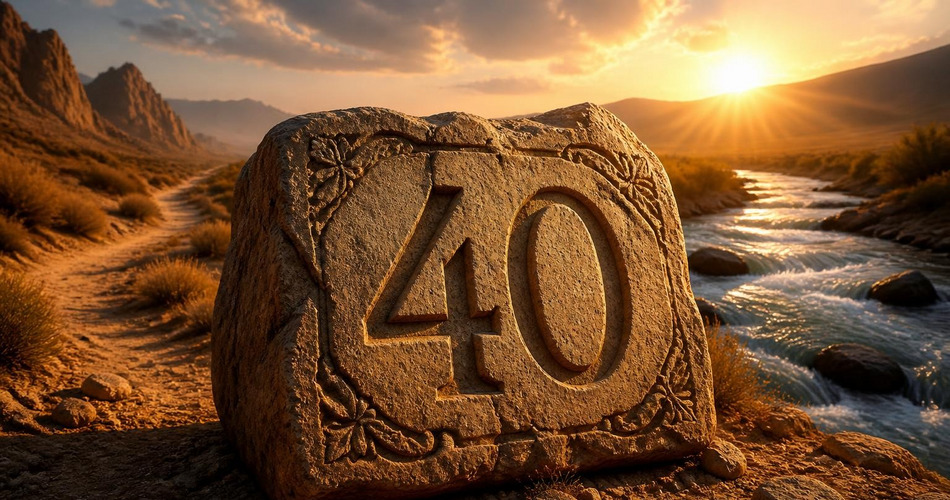
The number forty appears repeatedly across religious, mythological, and cultural traditions as a symbol of trial, transition, and transformation. It often marks a period of testing, purification, or preparation before a significant change or new beginning. From the forty days of rain in the biblical flood to the forty years of wandering in the desert, this number consistently represents a complete cycle of waiting, discipline, and eventual renewal.
What Does Number Forty Symbolize?
Number forty is primarily associated with periods of testing and preparation. In many traditions, it signifies the time needed for a person or community to undergo a profound change—whether spiritual, moral, or physical. The number implies a complete span of time that is long enough to test endurance but finite, leading to a new phase.
It also symbolizes purification. The forty-day flood cleansed the earth; the forty-year desert journey purified the Israelites. In this sense, forty is a threshold number, marking the boundary between an old state and a new one. It carries connotations of discipline, patience, and the eventual reward that follows a difficult passage.
Positive and Negative Meanings
Positive associations: Number forty is linked to spiritual growth, renewal, and the completion of a necessary trial. It suggests that after a period of hardship or waiting, a breakthrough or blessing will follow. It can represent hope, perseverance, and the promise of a fresh start.
Negative meanings: The number can also symbolize prolonged suffering, isolation, or punishment. The forty years in the desert were a consequence of disobedience; the forty days of Lent are a time of self-denial. In some contexts, forty evokes feelings of being tested beyond comfort, of enduring a seemingly endless ordeal.
History and Origins of Number Forty Symbolism
The symbolic weight of forty likely originates from its frequent appearance in ancient Near Eastern cultures. The number appears in the Hebrew Bible (Old Testament) dozens of times, often in contexts of judgment, preparation, or transition. The flood narrative in Genesis describes rain falling for forty days and forty nights. Moses spent forty days on Mount Sinai receiving the Law. The Israelites wandered for forty years before entering Canaan.
In the Christian New Testament, Jesus fasted for forty days in the wilderness before beginning his ministry. This period of fasting and temptation became the model for the season of Lent. The number also appears in Islam: the Qur’an mentions that a person reaches full maturity at age forty, and the Prophet Muhammad received his first revelation at that age. In Judaism, forty is associated with the mikveh (ritual bath), which must contain at least forty se’ah of water for purification.
Beyond the Abrahamic faiths, forty appears in ancient Greek mythology—for example, the forty-day period of mourning for the dead—and in Hindu traditions, where certain rituals last forty days. The widespread recurrence suggests that forty was recognized across cultures as a number representing a complete generation or a sufficient period for transformation.
Number Forty in Different Cultures
In Judaism, the number forty is deeply embedded in the Torah. The flood, the giving of the Torah, the spies’ exploration of Canaan (40 days), and the desert wandering all involve forty. It symbolizes a generation—enough time for a new generation to arise and old ways to pass away.
In Christianity, forty appears in the forty days of Lent, the forty days between Jesus’ resurrection and ascension, and the forty days of temptation. It is a number of preparation and spiritual discipline.
In Islam, age forty is considered the age of full understanding and responsibility. The Prophet Muhammad received his first revelation at forty. The Qur’an also mentions that a person is tested for forty days in the womb before the soul is breathed in.
In ancient Egyptian culture, the forty-two negative confessions in the Book of the Dead are a set of sins one must deny to enter the afterlife. While not exactly forty, the number forty-two is closely related and reflects the symbolic use of multiples of seven and forty.
In Chinese culture, the number forty is not particularly auspicious because the word for forty sounds similar to the word for “death” in some dialects. However, it appears in historical contexts such as the forty-day mourning period.
In Hinduism, certain vows and rituals last forty days (e.g., chaturmasya, a four-month period that includes forty days of special observance). The number also appears in the context of the forty-day period after birth when the mother is considered ritually impure in some traditions.
Spiritual Meaning of Number Forty
Spiritually, number forty represents a threshold between the old self and the new. It is a period of gestation, incubation, or initiation. Just as a baby takes about forty weeks to develop in the womb, so spiritual gestation often takes forty days or years. The number implies that transformation is not instantaneous but requires a sustained period of focus, surrender, and purification.
In many spiritual traditions, forty is the number of completion of a cycle. After forty days of prayer, fasting, or meditation, a person is believed to emerge changed—more aligned with divine will or higher consciousness. It is also associated with the idea of being “tested by God” and emerging stronger.
Number Forty in Myths and Folklore
In Greek mythology, the number forty appears in the story of the flood of Deucalion, which lasted nine days and nights, but also in the forty-day period of mourning for heroes. The number is less prominent than in Semitic traditions but still appears in contexts of purification and transition.
In Persian folklore, the number forty is magical. The phrase “forty days and forty nights” is common in tales of transformation, such as a prince turning into a beast for forty days. The number also appears in the story of the Forty Thieves from One Thousand and One Nights (though that is a literary work, it draws on folk motifs).
In Slavic folklore, the number forty is associated with the soul’s journey after death. It is believed that the soul remains on earth for forty days before departing to the afterlife. During this time, prayers and rituals are performed to aid the soul.
In African traditions, particularly in Yoruba culture, the number forty appears in rituals of initiation and mourning. For example, the Egungun festival involves a forty-day period of preparation.
Number Forty in Dreams
Dreaming of the number forty often reflects a period of transition or testing in the dreamer’s life. It may indicate that a current challenge is nearing completion or that the dreamer is in a phase of preparation for something new. Because forty is associated with purification, such dreams can also suggest a need for inner cleansing or letting go of old patterns.
In some dream interpretations, seeing the number forty in a dream is a sign of patience and endurance. It may encourage the dreamer to persist through a difficult time, as the end of the trial is approaching.
Common Dream Scenarios with Number Forty
- Seeing the number forty written or spoken: This may symbolize a need to pay attention to a specific period in your life—perhaps a 40-day or 40-year cycle is ending or beginning.
- Counting to forty: Could indicate that you are measuring progress or that you are aware of a deadline or threshold.
- Forty days or nights in a dream: Often represents a period of waiting, testing, or spiritual preparation. It may reflect real-life situations where you feel you are in a “desert” phase.
- Age forty in a dream: Might symbolize maturity, responsibility, or a midlife transition. It could also reflect concerns about aging or reaching a milestone.
Number Forty in Superstitions and Omens
In many cultures, the number forty is considered neither fully lucky nor unlucky but rather powerful. In some Middle Eastern traditions, the number forty is used in protective charms—for example, reciting “forty” to ward off the evil eye. In parts of Eastern Europe, it is believed that a baby should not be shown to strangers for forty days after birth to protect it from harm.
In Italian superstition, the number forty is sometimes associated with death, but also with the end of a difficult period. In some folk traditions, if you see a flock of forty birds, it is an omen of change. However, these beliefs vary widely and are not universal.
Number Forty in Art and Literature
In literature, the number forty appears in many classic works. In the Bible, the flood narrative and the desert wandering are foundational stories. In One Thousand and One Nights, the tale of “Ali Baba and the Forty Thieves” uses the number to denote a large group of bandits, emphasizing the scale of the threat. In Dante’s Divine Comedy, the number forty appears in the structure of the poem: the first canto begins with “Nel mezzo del cammin di nostra vita” (midway through life), which at the time was considered age thirty-five, but the poem is divided into three cantiche, each with 33 cantos, plus an introductory canto making 100 total—forty is not central here, but it appears in the context of the forty-day period of Lent in the allegorical interpretation.
In art, the number forty is often depicted in religious paintings of the flood, the temptation of Christ, or the forty days of Lent. For example, The Flood by Gustave Doré shows scenes from the forty-day deluge. In modern film, the 2007 movie 40 Days and 40 Nights uses the concept of a forty-day period of sexual abstinence as a comedic plot device, playing on the traditional symbolism of testing and purification.
Frequently Asked Questions
Q: Why is the number forty so important in the Bible?
A: The number forty appears repeatedly in the Bible to signify a period of testing, judgment, or preparation. Examples include the forty-day flood, Moses’ forty days on Sinai, the Israelites’ forty years in the desert, and Jesus’ forty-day fast. It symbolizes a complete cycle of trial leading to renewal.
Q: What does the number forty mean spiritually?
A: Spiritually, forty represents a threshold of transformation. It is a period of gestation, purification, and preparation for a new phase. Many traditions use forty-day periods for fasting, prayer, or ritual to achieve spiritual breakthrough.
Q: Is the number forty lucky or unlucky?
A: It depends on the culture. In Abrahamic traditions, it is often associated with hardship but also with eventual blessing. In some Asian cultures, it may be considered unlucky due to phonetic similarities with words for death. Overall, it is seen as a powerful number of transition rather than simple luck.
Q: What does it mean if I dream about the number forty?
A: Dreaming of forty often indicates that you are in a period of testing or preparation. It may suggest that a difficult phase is ending and a new beginning is near. It can also reflect a need for patience and endurance.
Related Symbols
- Number Seven – Often associated with completion and perfection, sometimes combined with forty (e.g., 7 x 40).
- Number Twelve – Represents divine order and governance, often appearing alongside forty in biblical contexts.
- Number Forty-Two – Appears in Egyptian mythology and the Bible (e.g., 42 months of tribulation).
- Lent – The forty-day period of fasting and reflection in Christianity.
- Flood Symbolism – The forty-day deluge as a symbol of cleansing and rebirth.