Briefly
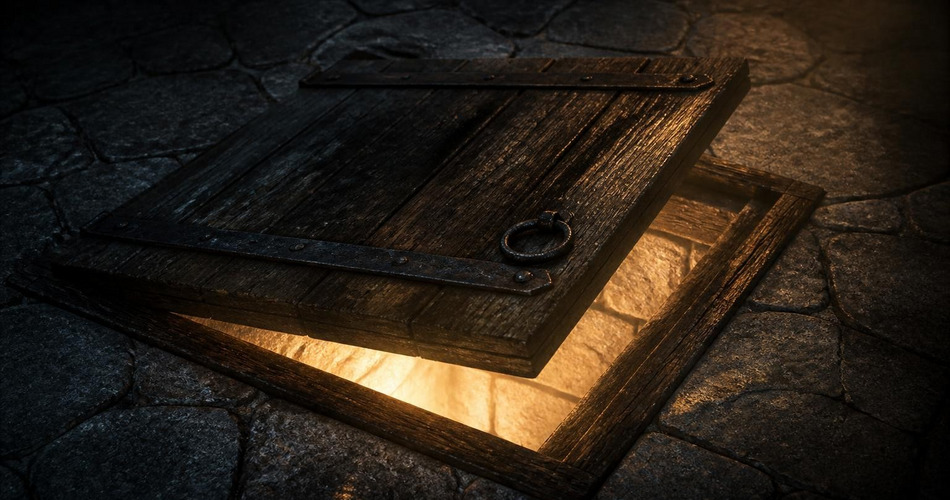
A trapdoor is a hidden or concealed entrance that opens unexpectedly, often revealing a passage, a secret space, or a sudden drop. Symbolically, it represents the unknown, hidden truths, and abrupt transitions—both positive and negative. Trapdoors can signify opportunities that appear without warning, but also dangers lurking beneath a seemingly stable surface. They are powerful metaphors for the subconscious, secrets, and the threshold between the visible and the hidden.
What Does a Trapdoor Symbolize?
At its core, a trapdoor symbolizes the hidden—something concealed from ordinary view. It often represents secrets, whether personal, familial, or institutional. The sudden opening of a trapdoor can signify a revelation, a surprise, or an unexpected change in circumstances. In many contexts, trapdoors also evoke the idea of a threshold or passage between two states: the known and the unknown, safety and danger, or the conscious and the subconscious mind.
Because trapdoors are typically operated by a mechanism that is not immediately obvious, they also symbolize deception or duality. A surface that appears solid may hide a void or a different reality. This duality makes the trapdoor a rich symbol for exploring themes of trust, betrayal, and hidden motives.
Positive and Negative Meanings of Trapdoor Symbolism
Positive associations: Trapdoors can symbolize unexpected opportunities, escape routes, or access to hidden knowledge. In stories, a trapdoor may lead to a treasure, a safe haven, or a way out of danger. They can represent the sudden unveiling of truth or a chance to start anew. In personal growth, encountering a trapdoor might signify an invitation to explore the deeper aspects of oneself.
Negative meanings: More commonly, trapdoors evoke fear, betrayal, and danger. They are associated with traps, ambushes, and sudden falls. A trapdoor can symbolize a hidden threat, a secret that destroys trust, or an unforeseen disaster. In dreams, they often represent repressed fears or unresolved issues that suddenly emerge. The element of surprise in a trapdoor can be disorienting and frightening, linking it to anxiety and loss of control.
History and Origins of Trapdoor Symbolism
The physical trapdoor has been used for centuries in architecture, theater, and military fortifications. In medieval castles, trapdoors provided secret passages for escape or surprise attacks. In theaters, trapdoors have been used since the Renaissance for dramatic entrances and exits, often associated with magic or supernatural appearances. The symbolism of the trapdoor as a hidden passage or a sudden change likely stems from these practical uses. The word “trapdoor” itself combines “trap” (a device for catching) and “door,” reinforcing the idea of a concealed mechanism that can ensnare or release.
In folklore and mythology, trapdoors appear in stories where heroes or villains use secret passages to move between worlds or to hide treasures. The concept of a hidden door that leads to another realm is a recurring motif in many cultures, from the rabbit hole in Alice’s Adventures in Wonderland to the trapdoors in Japanese ghost stories. Over time, the trapdoor evolved into a powerful symbol of the unknown and the threshold between realities.
Trapdoor Symbolism in Different Cultures
In Western culture, trapdoors are often associated with mystery and suspense. They appear in Gothic literature and horror films as devices that reveal dark secrets or lead to dungeons. In theater, the trapdoor is a classic tool for illusion, used to make actors appear or disappear, symbolizing transformation and the supernatural.
In Japanese folklore, trapdoors are sometimes featured in stories of haunted houses or hidden rooms, representing the concealment of shameful secrets or the presence of spirits. In some Native American traditions, hidden entrances to underground chambers were used for ceremonial purposes, symbolizing a connection to the earth and the spirit world.
In modern culture, trapdoors are common in video games and interactive media, where they often represent challenges, hidden rewards, or sudden danger. This digital symbolism has reinforced the idea of the trapdoor as a point of transition—a portal that can lead to either triumph or failure.
Spiritual Meaning of Trapdoors
Spiritually, a trapdoor can symbolize a gateway to the subconscious or to hidden spiritual truths. It may represent the sudden awakening of intuition or the unveiling of a deeper reality. In meditation or inner work, encountering a trapdoor might indicate that the seeker is about to access a new level of awareness or confront a buried aspect of the self.
Some interpret trapdoors as symbols of transformation—a sudden shift in perspective or life path. The act of falling through a trapdoor can be seen as a descent into the unknown, a necessary step for spiritual growth. However, the trapdoor also warns of the dangers of ignoring hidden truths; it reminds us that what lies beneath the surface can be both enlightening and unsettling.
Trapdoor in Myths and Folklore
Trapdoors appear in various myths and folktales, often as devices that facilitate escape or punishment. In European fairy tales, such as “The Twelve Dancing Princesses,” a trapdoor or hidden passage allows the princesses to sneak out at night. In the story of “Bluebeard,” a forbidden room is accessed through a secret door, which functions like a trapdoor in its revelation of hidden horror.
In Norse mythology, the concept of a hidden entrance to the underworld (like the gate to Hel) shares similarities with the trapdoor motif. In many cultures, trapdoors are associated with the idea of a “trap” set by tricksters or supernatural beings, testing the hero’s courage or cleverness. The trapdoor thus serves as a narrative device that introduces sudden change, often leading to a trial or a discovery.
Trapdoor in Dreams
Dreaming of a trapdoor often reflects feelings of insecurity, hidden fears, or unexpected changes in waking life. The trapdoor may represent a secret that is about to be revealed, or a situation that feels unstable. Falling through a trapdoor in a dream can symbolize a loss of control, a sudden setback, or a descent into the subconscious.
Alternatively, a trapdoor in a dream might indicate an opportunity that is not immediately obvious—a hidden path or a solution that requires looking beneath the surface. The context of the dream is crucial: if the trapdoor leads to a safe place, it may signify a positive transformation; if it leads to darkness or danger, it may warn of unresolved issues or hidden threats.
Common Trapdoor Dream Scenarios
- Falling through a trapdoor: Often symbolizes a sudden loss of stability, a fear of failure, or being caught off guard by a situation.
- Discovering a trapdoor: May represent uncovering a hidden truth, a secret, or a new opportunity that was previously concealed.
- Hiding or escaping through a trapdoor: Suggests a desire to avoid confrontation, to escape from a difficult situation, or to find a secret way out.
- Someone else opening a trapdoor: Could indicate that another person is about to reveal something unexpected or that you feel betrayed by someone’s hidden actions.
- A trapdoor that won’t open: May symbolize frustration, blocked access to knowledge, or an inability to confront a hidden issue.
Trapdoor in Superstitions and Omens
In some folk traditions, a trapdoor that opens by itself is considered an omen of bad luck or a warning of hidden danger. In theater lore, trapdoors are associated with superstitions about ghosts or accidents—actors often avoid standing directly over a trapdoor unless necessary, for fear of falling or attracting misfortune.
In home design, a trapdoor leading to a cellar or attic might be seen as a portal for spirits or negative energy in certain superstitions. Conversely, some cultures view a hidden door as a protective measure, allowing a family to escape danger or store valuables secretly. The superstition around trapdoors often reflects the dual nature of the symbol: it can be a source of safety or a source of peril, depending on how it is used.
Trapdoor in Art and Literature
Trapdoors appear prominently in literature and art as symbols of sudden revelation or hidden danger. In Lewis Carroll’s Alice’s Adventures in Wonderland, Alice falls down a rabbit hole—a kind of trapdoor—into a fantastical underworld, representing a journey into the subconscious and the absurd. In William Shakespeare’s The Tempest, trapdoors were used in early performances to create magical effects, such as the sudden appearance or disappearance of spirits.
In modern horror, the trapdoor is a staple of suspense. In the 1974 film The Texas Chain Saw Massacre, a trapdoor in the floor of the killers’ home leads to a basement of horrors, symbolizing the hidden brutality beneath a domestic facade. In the novel The Phantom Tollbooth by Norton Juster, the titular tollbooth functions like a trapdoor, transporting the protagonist to a world of imagination and learning.
In visual art, trapdoors are often depicted in surrealist works to challenge perceptions of reality. René Magritte’s paintings frequently feature hidden or impossible spaces, and while not always literal trapdoors, they evoke the same sense of concealed dimensions. The trapdoor remains a versatile symbol in art and literature, representing the boundary between the seen and the unseen.
Frequently Asked Questions About Trapdoor Symbolism
Q: What does it mean when you dream about a trapdoor?
A: Dreaming of a trapdoor often indicates hidden fears, secrets, or unexpected changes. It may suggest that you are about to uncover something concealed or that you feel your situation is unstable.
Q: Is a trapdoor a positive or negative symbol?
A: The trapdoor is a dual symbol. It can represent positive opportunities, escape, and hidden knowledge, but also danger, betrayal, and sudden loss. Its meaning depends on the context and the dreamer’s feelings.
Q: What does a trapdoor symbolize in literature?
A: In literature, trapdoors often symbolize secrets, sudden revelations, or transitions between worlds. They are used to create suspense, introduce plot twists, or represent the subconscious.
Q: Are trapdoors associated with any superstitions?
A: Yes, in theater superstition, trapdoors are considered unlucky if not treated with respect. In folk traditions, a self-opening trapdoor may be an omen of hidden danger or a sign of supernatural activity.
Related Symbols
- Secret door: Similar hidden passage, often leading to a concealed room or escape route.
- Rabbit hole: A metaphorical trapdoor that leads to a fantastical or unknown world.
- Abyss: Represents a sudden fall into the unknown, similar to the drop through a trapdoor.
- Threshold: The point of transition between two states, akin to the trapdoor’s function as a passage.
- Hidden room: A space revealed by a trapdoor, symbolizing secrets or the subconscious.